Jharkhand Rock Offers 3.5-Billion-Year-Old Evidence of Life, Among Oldest Directly Dated Signs on Earth
Scientists have discovered chemical signatures of ancient microbial life in a 3.5-billion-year-old rock from Jharkhand's Singhbhum region, offering some of the oldest directly dated evidence of life on Earth.

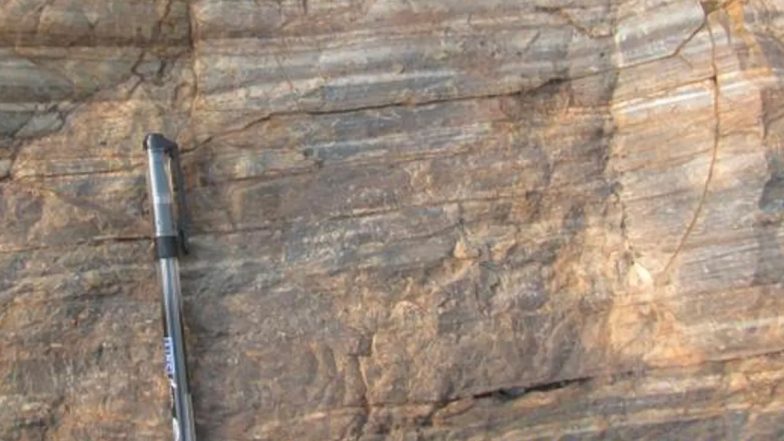
A 3.5-billion-year-old rock from Jharkhand's Singhbhum region has yielded what scientists say is the oldest directly dated evidence of biological activity documented on Earth so far. Researchers have identified chemical signatures consistent with ancient microbial mats preserved inside a silica-rich rock known as chert.
The discovery was made near Bhitardari village, about 20 km south of Jamshedpur, by Trisrota Chaudhuri, a scientist with the Geological Survey of India (GSI) in Calcutta, and her collaborators. Their findings were published in the journal Proceedings of the National Academy of Sciences.
3.5-Billion-Year-Old Rock Contains Signs Of Ancient Life
The rock contains tiny black bands running through the chert. Researchers interpreted these structures as remnants of microbial mats, thin carpet-like communities formed by microscopic organisms that lived billions of years ago.
Chemical analysis of the samples revealed distinct carbon signatures that the researchers say point to biological activity rather than purely geological processes. Did Life on Earth Begin 1.5 billion Earlier Than We Think?
The samples were dated to approximately 3.497 billion years old, making the finding particularly significant in the long-running scientific search for evidence of Earth's earliest life.
Scientist Spotted The Rock 12 Years Ago
Chaudhuri first encountered the unusual black-and-white patterns during fieldwork in Jharkhand in 2014.
While exploring ancient volcanic rock formations near Bhitardari, she noticed the patterns embedded in the chert and questioned whether the dark material could represent carbon left behind by ancient life forms.
She later worked with scientists from Europe and the US to analyse and date the samples. How Scientists Plan To Announce an Alien Signal: New International Protocols Released.
How Scientists Identified Biological Carbon
Researchers used differences in the carbon profile and molecular structure of the material to distinguish potentially biological carbon from carbon produced through non-biological geological processes.
One of the techniques used was Laser Raman Spectroscopy, which helped scientists examine the molecular structure preserved within the ancient rock.
The researchers said the ability to directly date the rock containing the suspected microbial material sets the discovery apart from some earlier claims of extremely ancient life.
Why The Discovery Matters
Earth formed around 4.6 billion years ago, but exactly when life first appeared remains one of science's biggest unanswered questions.
Previous studies have proposed possible evidence of life dating back as far as 3.9 billion years in Quebec and 3.7 billion years in Greenland. However, some of these findings remain debated because geological processes can sometimes produce structures or chemical signatures resembling those created by living organisms.
The Jharkhand discovery could provide an important new data point because the rock containing the suspected biological signatures was itself directly dated.
Singhbhum May Have Been Home To Early Life
Scientists have long proposed that some of Earth's earliest life may have emerged underwater around volcanic vents, where heat and mineral-rich fluids could have supplied chemicals and energy needed for early biological systems.
The Singhbhum region contains some of Earth's oldest rocks and preserves evidence of ancient underwater volcanic environments.
Researchers say these conditions could have provided a suitable setting for primitive microbial life to develop around 3.5 billion years ago.
(The above story first appeared on LatestLY on Aug 20, 2026 12:35 PM IST. For more news and updates on politics, world, sports, entertainment and lifestyle, log on to our website latestly.com).