El Niño 2026: Can the Strongest Event on Record Weaken India’s Monsoon?
Scientists are monitoring a developing El Niño in the Pacific Ocean that could become the strongest on record. The phenomenon is often linked to weaker monsoon rainfall in India. With the IMD forecasting below-normal rainfall and a 60% chance of a deficient monsoon, experts are assessing potential impacts on agriculture, water availability and food prices in the months ahead.

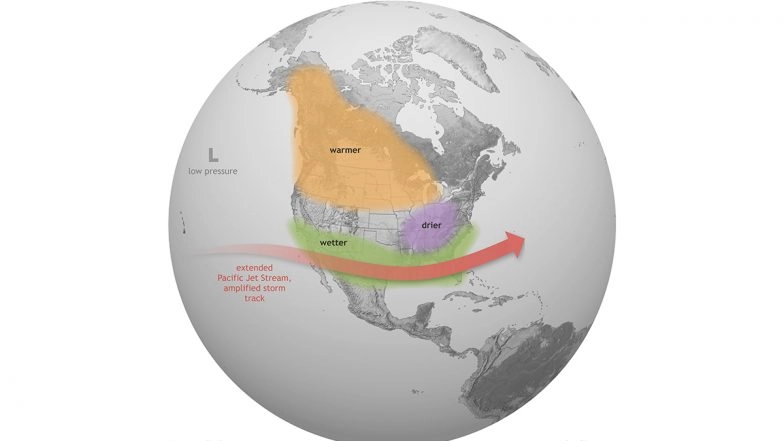
As the southwest monsoon begins its journey across India, climate scientists are closely monitoring another weather phenomenon unfolding thousands of kilometres away in the Pacific Ocean. Forecast models indicate that a developing El Niño could become one of the strongest ever recorded, raising concerns about its potential impact on rainfall, agriculture and food prices in India.
The monsoon reached Kerala on June 4, three days later than its usual onset date, and is gradually advancing northward. At the same time, ocean temperatures in a key region of the Pacific have crossed the threshold typically associated with El Niño conditions, although major international weather agencies have not yet officially declared a sustained event. What Is El Nino and How Does It Affect Weather?
What Is El Niño?
El Niño is the warm phase of the climate pattern known as the El Niño-Southern Oscillation (ENSO), a naturally occurring cycle that influences weather conditions around the world.
Under normal conditions, trade winds push warm surface waters across the tropical Pacific Ocean toward Asia. During an El Niño event, these winds weaken, allowing warm water to shift eastward across the Pacific. El Nino Alert: WMO Warns of 80% Chance by August, India Faces Risk of Weak Monsoon and Extreme Heat.
Scientists monitor these changes in a section of the ocean known as the Nino 3.4 region. Recent observations show temperatures in the region have risen to about 0.9 degrees Celsius above average, exceeding the 0.5-degree threshold commonly used to identify El Niño conditions.
El Niño 2026: Could This Become a Record-Breaking Event?
Climate forecasting agencies are closely tracking the development. The World Meteorological Organisation (WMO) estimates an 80 per cent probability that a sustained El Niño event will develop in the coming months, though it requires warming to persist before making an official declaration.
Forecasts from the European Centre for Medium-Range Weather Forecasts suggest temperatures in the Nino 3.4 region could rise to around 3 degrees Celsius above normal by December, with some projections approaching 4 degrees Celsius.
If those forecasts materialise, the event could surpass the intensity of the powerful El Niño episodes of 1997-98 and 2015-16, both of which had significant global climate impacts.
Why Is India Concerned?
For India, El Niño is often associated with weaker monsoon rainfall. When the Pacific Ocean warms, the atmospheric circulation patterns that help drive monsoon systems shift eastward. This can reduce the strength of moisture-bearing winds that bring rainfall to the Indian subcontinent.
The India Meteorological Department (IMD) has forecast below-normal rainfall for the current monsoon season, estimating precipitation at around 90 per cent of the Long Period Average (LPA), the benchmark based on rainfall data collected between 1971 and 2020. The IMD has also indicated a 60 per cent probability of a deficient monsoon season.
Another climate factor that can sometimes offset the effects of El Niño is the Indian Ocean Dipole (IOD), which measures temperature differences in parts of the Indian Ocean.
However, forecasts suggest the IOD is likely to remain neutral this year, reducing the possibility of it significantly strengthening monsoon rainfall. As a result, meteorologists are paying close attention to how the Pacific warming evolves in the coming months.
Impact on Agriculture and Food Prices
The monsoon plays a critical role in India's economy and food security. Around 70 per cent of the country's annual rainfall arrives during the monsoon season, while more than half of India's agricultural land remains dependent on rainfall rather than irrigation.
During the strong El Niño event of 2015-16, India received only 86 per cent of its average rainfall, leading to drought conditions in several regions. With nearly 60 per cent of farmers relying on monsoon rains for summer crops, below-normal rainfall can affect crop yields, reduce water availability and contribute to higher food prices.
Although El Niño conditions appear to be developing, scientists caution that forecasts remain subject to change. Weather agencies will continue monitoring Pacific Ocean temperatures over the coming months before determining the event's final intensity.
For India, the key question will be whether the monsoon can maintain adequate rainfall despite the warming Pacific. The answer could have significant implications for agriculture, water resources and inflation in the months ahead.
(The above story first appeared on LatestLY on Jun 07, 2026 06:02 PM IST. For more news and updates on politics, world, sports, entertainment and lifestyle, log on to our website latestly.com).