What Is El Nino and How Does It Affect Weather?
El Nino is one of the most powerful climate forces on Earth, and for India, it can mean the difference between a good monsoon and a devastating drought. Here is everything you need to know.

El Nino is one of the most powerful climate forces on Earth, and for India, it can mean the difference between a good monsoon and a devastating drought. Here is everything you need to know.
What Is El Nino?
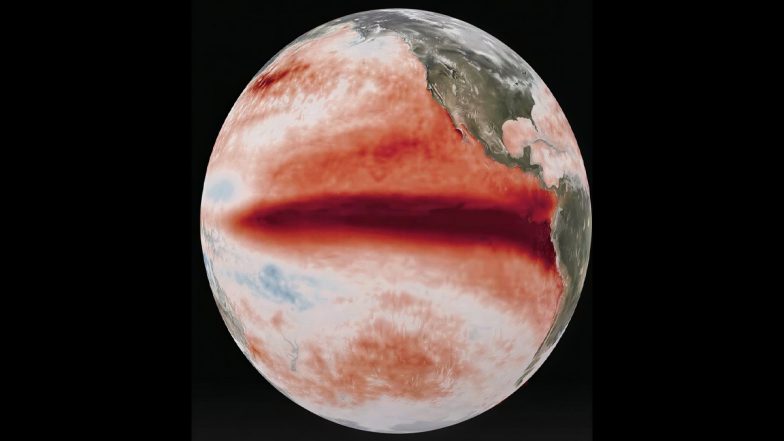
El Nino is a recurring climate event in which unusually warm ocean water spreads across the central and eastern tropical Pacific. The name comes from 19th-century Peruvian fishermen who noticed a warm current arriving around Christmas, calling it "El Nino," Spanish for "the child."
Scientists later discovered that this ocean warming is tightly linked to shifts in atmospheric pressure across the South Pacific, a connection known as the Southern Oscillation. Together, the two phenomena are officially called El Nino-Southern Oscillation, or ENSO. El Nino Alert: WMO Warns of 80% Chance by August, India Faces Risk of Weak Monsoon and Extreme Heat.
ENSO has three phases: El Nino (warm), La Nina (cold), and neutral. These phases cycle irregularly and trigger weather changes across the globe.
How Does El Nino Form?
Under normal conditions, trade winds blow warm surface water westward across the Pacific toward Australia and Indonesia. During El Nino, those trade winds weaken. Warm water sloshes back eastward toward South America, disrupting weather patterns far beyond the Pacific.
British physicist Gilbert Walker first identified this atmospheric seesaw in the 1920s. Norwegian-American meteorologist Jacob Bjerknes later confirmed the ocean-atmosphere link in the 1960s, establishing the full ENSO model that climate scientists use today. El Nino To Arrive During India Monsoon, Expected To Strengthen Till September: IMD Chief.
El Nino and India: A High-Stakes Relationship
For India, El Nino is not a distant Pacific phenomenon. It directly threatens the southwest monsoon, the lifeline of Indian agriculture.
When El Nino conditions develop, they suppress the monsoon by weakening the temperature contrast between land and sea that drives rainfall over the subcontinent. The result is often a deficient monsoon, with large parts of central and peninsular India receiving below-normal rain. Historical El Nino years such as 1982-83 and 1997-98 were associated with significant drought stress across India.
Northeast Brazil and Southeast Asia face similar drought risks during strong El Nino events, confirming a global pattern of disruption.
What a Super El Nino Could Mean for India in 2026-27
Short-term forecast models suggest the world may be moving into an El Nino phase by mid-2026, with the potential for an intense event toward year-end. Climate scientists have raised the possibility of a "super-El Nino."
If that happens, India could face:
- Below-normal monsoon rainfall, particularly over central, western, and southern states
- Higher-than-normal temperatures adding to heat stress across agricultural zones
- Drought risk in rain-dependent farming belts already under pressure from climate change
- A temporary global temperature spike of a few tenths of a degree above the baseline warming trend, pushing India's summers into more extreme territory
El Nino vs La Nina: What Changes for India?
La Nina, the cool opposite of El Nino, typically brings above-normal monsoon rainfall to India and is associated with stronger agricultural output. The contrast is stark. La Nina years tend to be good rainfall years; El Nino years carry drought risk.
The 2025-26 period began in a neutral phase following a mild La Nina. The transition to El Nino, if it intensifies as forecast, would reverse those favourable conditions.
A Global Phenomenon With Local Consequences
What began as an observation by Peruvian fishermen is now understood as one of the most consequential climate systems on the planet. For India, where hundreds of millions of farmers depend on monsoon timing and volume, El Nino is not just a weather event. It is an economic and food security variable that governments, farmers, and policymakers must plan around every year.
With a potential super-El Nino building, 2026-27 demands close attention from Indian meteorologists, agricultural planners, and water managers alike.
(The above story first appeared on LatestLY on Jun 05, 2026 07:32 AM IST. For more news and updates on politics, world, sports, entertainment and lifestyle, log on to our website latestly.com).