El Nino Forecast: Why India Faces Rising Heatwave and Weak Monsoon Risks in 2026
With heatwaves intensifying across northern, central, and eastern India and NOAA flagging a strong El Nino likely between May and July 2026, understanding the El Nino Southern Oscillation has never been more relevant for India. The phenomenon, which has been shaping global weather for thousands of years as evidenced by ancient coral skeleton records, is once again poised to disrupt monsoon patterns, agricultural output, and water availability across the country.

- Read in
- हिंदी
With heatwaves intensifying across northern, central, and eastern India and NOAA flagging a strong El Nino likely between May and July 2026, understanding the El Nino Southern Oscillation has never been more relevant for India. The phenomenon, which has been shaping global weather for thousands of years as evidenced by ancient coral skeleton records, is once again poised to disrupt monsoon patterns, agricultural output, and water availability across the country.
What Is ENSO and How Does It Work
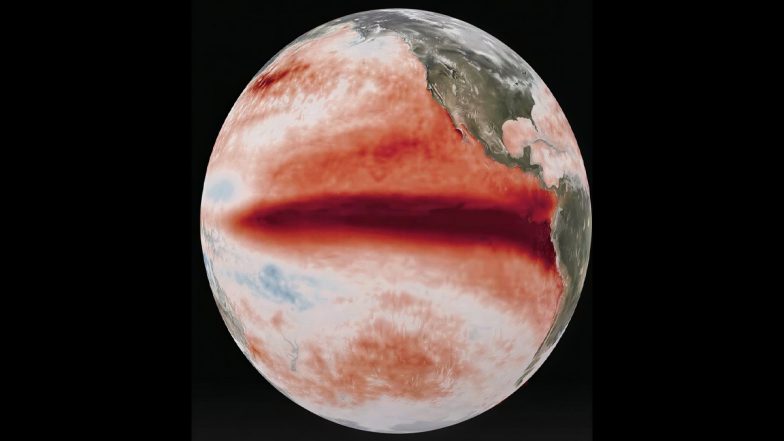
The El Nino Southern Oscillation is a periodic ocean-atmospheric fluctuation involving changes in sea surface temperatures and air pressure across the equatorial Pacific Ocean. It has three distinct phases: the warm El Nino phase, the cool La Nina phase, and a neutral phase. Under neutral conditions, trade winds blow from east to west along the equator in a pattern called Walker Circulation. The eastern Pacific near South America stays cooler than the western Pacific near Indonesia, and warm surface waters are pushed toward Australia and Asia. This allows cold, nutrient-rich water to rise from the depths near the South American coast through a process called upwelling, sustaining rich fisheries and supporting marine ecosystems in the region. The warm, low-pressure conditions in the western Pacific bring abundant December rainfall over northern Australia, Southeast Asia, and New Guinea.
What Triggers El Nino
El Nino arises when trade winds weaken or reverse direction, causing warm water to accumulate in the central and eastern Pacific rather than the western Pacific. This shift disrupts sea surface temperatures, atmospheric pressure gradients, and weather patterns globally. During an El Nino event, the low-pressure zone moves eastward into the central Pacific while the western Pacific experiences drought-like high-pressure conditions. This pressure shift is called the Southern Oscillation, which is where the combined term ENSO originates.
The term El Nino was first coined by South American fishermen in the 1600s, derived from Spanish meaning the Christ Child, as the phenomenon typically peaks around Christmas. Its full original name was El Nino de Navidad, meaning The Christmas Child. El Nino generally occurs every two to seven years, typically lasts 12 to 18 months, and is known to weaken monsoon winds over the Indian subcontinent.
How Scientists Track ENSO
NOAA monitors ENSO conditions through three key indices. The Oceanic Nino Index measures three-month average sea surface temperature anomalies in the Nino 3.4 region of the Pacific. Anomalies of +0.5 degrees Celsius or above sustained across at least five consecutive overlapping three-month periods are classified as El Nino, while anomalies of -0.5 degrees Celsius or below indicate La Nina. The Southern Oscillation Index tracks differences in sea-level pressure between Tahiti in French Polynesia and Darwin in Australia, with lower values pointing to El Nino conditions and higher values to La Nina. The Relative Oceanic Nino Index is the most advanced of the three, comparing Nino 3.4 temperatures against all tropical oceans simultaneously while adjusting for global oceanic warming, offering improved forecast accuracy as baseline temperatures rise worldwide.
Based on RONI strength probabilities, El Nino events are classified as weak at 0.5 to 1 degree Celsius, moderate at 1 to 1.5 degrees, strong at 1.5 to 2 degrees, and very strong at 2 degrees or above. The informal term Super El Nino is used to describe very strong events. However, NOAA has explicitly cautioned that stronger El Nino events do not automatically guarantee stronger impacts and can only make certain outcomes more likely.
Global Impact of El Nino
The impact of ENSO is felt worldwide but hits tropical countries of South and Southeast Asia, Latin America, and Africa hardest. El Nino typically brings drier conditions to southern Africa, South Asia, Southeast Asia, and northern Brazil, while triggering heavier-than-normal rainfall in Central America, Ecuador, northern Peru, and parts of equatorial East Africa. El Nino years also tend to produce above-average global temperatures. The year 2024 became the hottest year ever recorded, partly driven by the strong El Nino event of 2023-24. These conditions can trigger extreme heat, prolonged droughts, widespread wildfires, food insecurity, and shifts in the transmission patterns of vector-borne diseases. El Nino 2026: These States and Cities in India Face Highest Risk As Historic El Nino Prepares To Hit.
Why India Is Especially Vulnerable
India's vulnerability to El Nino is rooted in its deep dependence on the southwest monsoon for agriculture, drinking water, and broader economic stability. Historically, at least half of all El Nino years have been associated with below-normal monsoon rainfall in India. Since 1950, out of 16 El Nino years, seven recorded deficient rainfall across the country. The IMD's April 2026 forecast of a below-normal monsoon at 92 per cent of the long-period average raises serious concerns. During the last Super El Nino in 2015-16, India received only 86 per cent of its long-period average rainfall. El Nino Meaning, Causes and Effects: How the Phenomenon Will Affect Temperature Extremities in India and Globally.
A weak monsoon in 2026 could depress crop yields, fuel food price inflation, strain rural incomes, and push already stressed water resources to the brink. Increased heatwaves, forest fires, and public health pressures are likely to follow. Compounding the risk further, disruptions to energy and fertiliser supplies linked to ongoing tensions in West Asia could amplify the economic damage of a poor monsoon year.
Why Early Forecasting and Action Matter
While El Nino as a natural phenomenon cannot be stopped, its impact can be substantially reduced through timely preparation. Advances in ENSO monitoring have dramatically improved the ability to predict the onset, intensity, and duration of El Nino events, providing governments and farmers with critical lead time. Promoting drought-resistant kharif crop varieties, revising sowing windows in rainfall-deficient districts, strengthening disaster preparedness frameworks, and prioritising groundwater recharge and water conservation before the monsoon season are among the most effective responses available. States must finalise drought and heat action plans now, while the window to act remains open.
ENSO Quick Reference
| Parameter | Detail |
|---|---|
| ENSO Phases | El Nino (warm), La Nina (cool), Neutral |
| El Nino Frequency | Every 2 to 7 years |
| Typical Duration | 12 to 18 months |
| 2026 NOAA Forecast | Strong El Nino likely May-July 2026 |
| IMD Monsoon Forecast 2026 | 92% of long-period average (below normal) |
| Last Super El Nino | 2015-16 (86% of long-period average rainfall in India) |
| El Nino Years with Deficit Monsoon in India | 7 out of 16 since 1950 |
El Nino is not a new phenomenon, but its 2026 iteration arrives at a particularly fragile moment for India, with heatwaves already straining the country and a below-normal monsoon on the forecast. Understanding the science behind ENSO is the first step, but the real test lies in translating early warnings into decisive action across agriculture, water management, disaster preparedness, and public health. India has the forecasting tools it needs. What matters now is the political will and administrative speed to use them.
(The above story first appeared on LatestLY on May 22, 2026 08:28 AM IST. For more news and updates on politics, world, sports, entertainment and lifestyle, log on to our website latestly.com).