Loktak Lake Galaxy: Indian Astrophysicist Ronaldo Laishram Names Newly Discovered Galaxy Structure After Manipur’s Loktak Lake
An Indian astrophysicist from Manipur has named a newly discovered galaxy structure in the early universe after the state’s iconic Loktak Lake, linking a major scientific breakthrough with the cultural identity of Northeast India. The structure, officially named the ;Loktak Protocluster', was identified by an international team led by Dr. Ronaldo Laishram

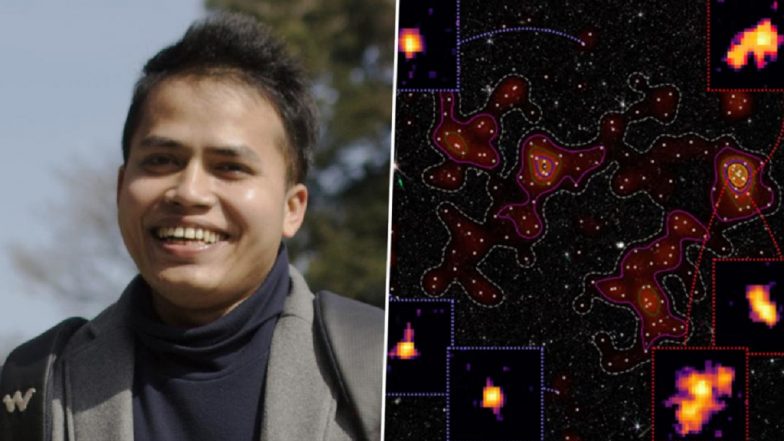
An Indian astrophysicist from Manipur has named a newly discovered galaxy structure in the early universe after the state’s iconic Loktak Lake, linking a major astronomical discovery with the cultural identity of Northeast India. The structure, called the “Loktak Protocluster,” was identified by an international team led by Dr. Ronaldo Laishram and is believed to date back around 12.6 billion years. The discovery provides new insights into how galaxies formed and evolved during the universe’s early stages, when it was only about 1.2 billion years old.
The Loktak Protocluster is a massive grouping of young galaxies discovered using observations from the Subaru Telescope in Hawaii and follow-up imaging from NASA’s James Webb Space Telescope (JWST). The findings were published in The Astrophysical Journal Letters. Shubhanshu Shukla Axiom 4 Mission: 140 Crore Dreams Soar With ISRO Astronaut Into Space, ‘Tiranga’ Touches the Stars.
Manipur Scientist Ronaldo Laishram Names Ancient Galaxy Structure After Loktak Lake
Heartiest congratulations to Dr. Ronaldo Laishram on the historic discovery of the “Loktak Protocluster,” a remarkable achievement that has brought global recognition to Manipur and our iconic Loktak Lake.
This proud moment reflects the brilliance, dedication, and potential of… pic.twitter.com/CwDATzLtgs
— N. Biren Singh (@NBirenSingh) May 26, 2026
Why It Was Named After Loktak Lake
Dr. Ronaldo Laishram, a postdoctoral researcher at the National Astronomical Observatory of Japan (NAOJ), said the structure reminded him of Loktak Lake in Manipur because of the way the galaxy concentrations appeared interconnected.
Loktak Lake is known for its floating masses of vegetation, locally called “phumdis,” which form linked patterns across the lake’s surface. Laishram said the arrangement of galaxies in the protocluster resembled these formations. Shubhanshu Shukla’s Space Mission Energises Nation’s Resolve To Build ‘Viksit Bharat’ by 2047, Says Cabinet Joining Celebration of Return of Indian Astronaut Back to Earth From ISS.
Speaking to ThePrint, Laishram described the naming as “the greatest tribute” he could offer to his home state. He said he wanted to “place Manipur, and Loktak, in the story of the universe itself.”
Astronomers describe a protocluster as an early-stage concentration of galaxies that eventually develops into a massive galaxy cluster. Researchers found that the newly identified structure contains four connected concentrations of galaxies spread across a vast region of space.
The study also suggested that galaxies located in dense environments were already evolving differently from those in less crowded regions, offering evidence that a galaxy’s surroundings influenced its development very early in cosmic history.
Research Led by Scientist Ronaldo Laishram From Manipur
Laishram, 29, is from Khangabok village in Manipur’s Thoubal district. He completed his engineering studies in Mysuru before pursuing higher studies in astronomy and astrophysics at Tohoku University in Japan. He said his interest in astronomy began during childhood after observing bright objects in the night sky while growing up in the village. That curiosity eventually led him into astrophysics research and international collaborations.
Laishram is also associated with astronomy outreach initiatives in Northeast India and co-founded the Manipur Astronomical Society in 2025 to encourage scientific learning and collaboration among students and researchers.
Global Recognition for Manipur
The discovery has drawn praise from scientific communities and public figures in India, particularly in Manipur. Former Chief Minister N. Biren Singh congratulated Laishram and described the achievement as a moment of pride for the state. Researchers believe future observations using advanced telescope systems could help determine whether similar environmental effects on galaxy growth were common across the early universe.
(The above story first appeared on LatestLY on May 26, 2026 08:25 PM IST. For more news and updates on politics, world, sports, entertainment and lifestyle, log on to our website latestly.com).