NASA's Webb Telescope Discovers Hidden Giant Planet in Beta Pictoris System; Know Its Name
Astronomers using the James Webb Space Telescope have discovered a new giant planet, Beta Pictoris d, in the famous Beta Pictoris star system. Identified via atmospheric chemical signatures rather than direct imaging, the planet provides new insights into the system's architecture and confirms long-standing theories about the structures within its debris disk.

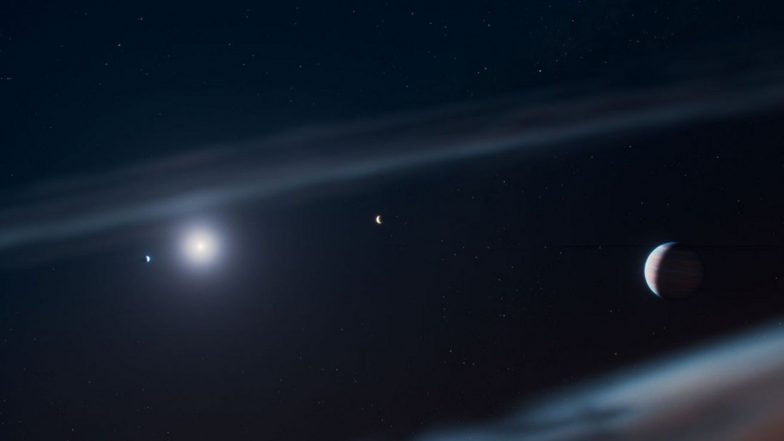
Astronomers using the James Webb Space Telescope have discovered a new giant exoplanet hiding within the Beta Pictoris system, one of the most intensely studied planetary systems in the Milky Way. The discovery of the planet, named Beta Pictoris d, marks a significant milestone in exoplanet research, as it was identified primarily through atmospheric fingerprinting rather than traditional imaging methods.
Beta Pictoris, a young star located approximately 63 light-years from Earth, was already known to host two giant planets, Beta Pictoris b and Beta Pictoris c. The addition of Beta Pictoris d makes this only the second planetary system known to contain at least three directly imaged planets. NASA Names 4 Astronauts for Artemis III Moon Mission Support Roles (Watch Video).
A Breakthrough in Detection Technology
Unlike its two neighbours, Beta Pictoris d remained elusive for over a decade, obscured by the glare of its host star and the surrounding disk of debris. Rather than relying on traditional coronagraphic imaging - which looks for a bright point of light - researchers identified the planet by detecting the unique chemical "barcode" of its atmosphere using Webb’s Near-Infrared Spectrograph (NIRSpec).
"This discovery adds another piece to an already fascinating planetary system," said Aidan Gibbs, a postdoctoral researcher at the University of California, San Diego, and lead author of the study published in the Astrophysical Journal Letters. "Beta Pictoris has long served as a laboratory for understanding how planetary systems form and evolve, and now we have another planet helping us tell that story," Gibbs added.
Characteristics of the New World
Beta Pictoris d is estimated to be at least two times the mass of Jupiter, making it the lightest of the three known giant planets in the system. Modelling suggests it orbits its star at a distance of approximately 30 astronomical units, placing it in a region comparable to Neptune’s orbit in our own solar system. The discovery also helps solve a long-standing mystery regarding the Beta Pictoris system. Astronomers had previously noted that the system's famous debris disk possessed a sharply defined inner edge and other unusual structures. The existence of a planet like Beta Pictoris d had been predicted to explain these anomalies, and its confirmed presence now provides a clearer picture of the system's architectural evolution. NASA Moon Base Mission: Space Agency Orders Landers, Rovers and Drones After Artemis II Lunar Flyaround Success.
Confirming the Discovery
The detection was solidified through multiple lines of evidence. Follow-up observations using Webb’s Mid-Infrared Instrument (MIRI) confirmed the presence of water vapour and methane in the planet's atmosphere. Furthermore, an independent imaging study led by researchers at the University of Edinburgh and the European Southern Observatory utilised data from the Very Large Telescope (VLT) and Webb’s NIRCam to confirm the planet's existence. Scientists note that this discovery demonstrates a powerful new method for finding worlds in complex environments. By isolating narrow molecular signatures - such as carbon monoxide - astronomers can now identify planets that were previously hidden within the light of their host stars or scattered debris.
(The above story first appeared on LatestLY on Jul 16, 2026 10:23 AM IST. For more news and updates on politics, world, sports, entertainment and lifestyle, log on to our website latestly.com).