What Are Black Hole UFOs? Scientists Detect Most Powerful Ultra-Fast Outflows Yet
Astronomers have detected the most powerful ultra-fast outflows, or 'UFOs,' ever observed blasting from a supermassive black hole more than 11 billion light-years away. The streams of superheated gas were recorded travelling at up to 670 million mph, or nearly 30% of the speed of light. Researchers say the discovery offers new insights into how black holes shaped galaxies in the early universe.

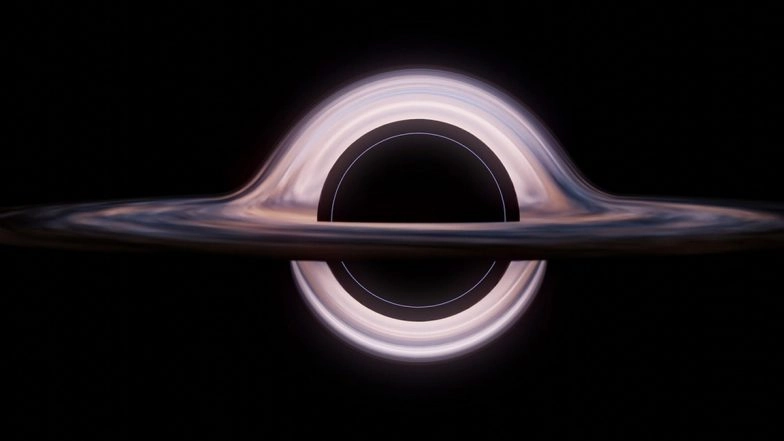
Astronomers have detected what they describe as the most powerful ultra-fast outflows (UFOs) ever observed emerging from a supermassive black hole more than 11 billion light-years from Earth. The streams of superheated gas were recorded travelling through space at speeds of up to 670 million mph, making them among the fastest and most energetic black hole winds ever discovered.
The outflows were detected around a distant quasar known as WISSH13, powered by a supermassive black hole consuming matter at an extraordinary rate. Researchers say the discovery provides a rare glimpse into conditions in the early universe, when galaxies were forming and evolving rapidly. Black Hole in Cosmic Horseshoe Galaxy Could Be the Largest Ever Detected.
What Are Ultra-Fast Outflows Or UFOs?
Despite the name, UFOs in this context do not refer to unidentified flying objects. Ultra-fast outflows are powerful streams of ionized gas launched from the regions surrounding supermassive black holes.
Scientists believe these winds play a major role in shaping galaxies by heating and expelling the gas required for star formation. Over time, the process can slow or even halt the growth of a galaxy. The newly detected outflows are among the most extreme examples ever observed. Astronomers Discover Milky Way’s Heaviest Stellar Black Hole, 33 Times the Mass of the Sun.
Black Hole Winds Reaching a Fraction of Light Speed
Using data from the XMM-Newton and NuSTAR space telescopes, astronomers identified two separate outflows emerging from WISSH13. One was found travelling at approximately 10 percent of the speed of light, while the second reached nearly 30 percent of light speed. Light travels at about 186,282 miles per second.
Researchers said the black hole existed when the universe was only around two billion years old, making the observation a valuable window into a key period of cosmic evolution. Together, the two outflows are ejecting the equivalent of more than 40 suns' worth of material every year.
How Scientists Detected the Outflows
The discovery was made by analysing unusual dips in X-ray emissions coming from the distant quasar. Scientists found that streams of superheated gas rich in ionized iron absorbed portions of the X-rays as they travelled toward Earth. Because the gas was moving away from the black hole at enormous speeds, the absorption signatures appeared shifted toward higher energies.
These shifts enabled researchers to calculate the velocity of the outflows and confirm their extraordinary speeds. To build the most detailed X-ray view yet of WISSH13, astronomers combined new observations collected in 2024 with data gathered seven years earlier.
The observations revealed that the slower outflow was present in both the 2017 and 2024 datasets, suggesting it is a long-term feature of the black hole system. The faster outflow, however, appeared only in the newer observations, indicating it may erupt in intermittent bursts before fading from view.
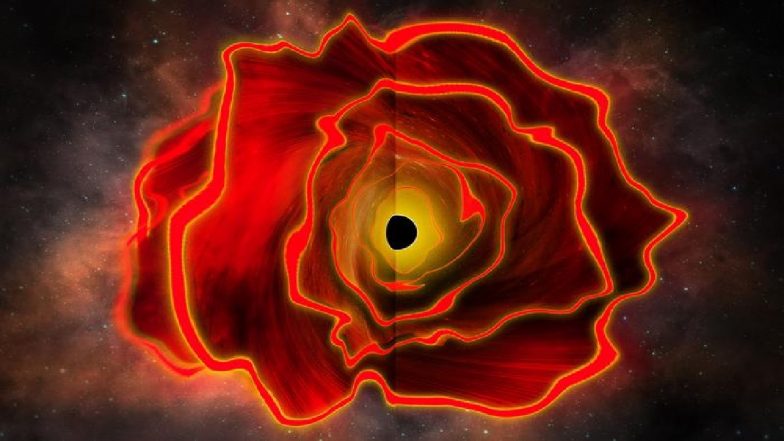
Based on the findings, researchers believe the black hole may generate a layered wind structure consisting of an extremely fast central stream, known as a "spine," surrounded by a slower outer "sheath." This configuration could help explain how supermassive black holes transfer enormous amounts of energy into their host galaxies.
Why the Discovery Matters
Most previous detections of distant ultra-fast outflows have relied on gravitational lensing, a phenomenon in which the light from a quasar is magnified by a galaxy positioned between it and Earth. While gravitational lensing makes distant objects easier to study, it can also introduce uncertainties into observations.
Researchers say the detection around WISSH13 is particularly important because it was made around a non-lensed quasar, providing a clearer view of the phenomenon.
Scientists described the finding as the most distant UFO ever identified around a non-lensed quasar. The discovery offers new insight into how supermassive black holes influenced galaxy growth during the universe's early history.
Future observatories are expected to identify many more of these powerful cosmic winds, helping astronomers better understand the relationship between black holes and the evolution of galaxies.
(The above story first appeared on LatestLY on Jun 17, 2026 04:31 PM IST. For more news and updates on politics, world, sports, entertainment and lifestyle, log on to our website latestly.com).