Wolf Moon 2026 Date and Time: When and How To See January’s Giant Full Moon Supermoon
The first full moon of the year, widely known as the Wolf Moon, is drawing attention from skywatchers around the world this weekend as it rises as a supermoon—a full Moon that appears slightly larger and brighter than usual due to its closer-than-average distance to Earth.

- Read in
- हिंदी
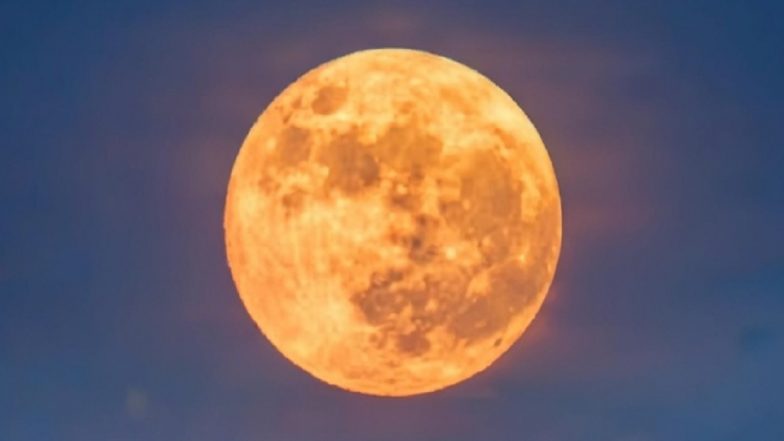
Mumbai, January 3: Stargazers across the globe are turning their eyes upward this weekend as the first Full Moon Supermoon of 2026 takes center stage. Known traditionally as the "Wolf Moon," this celestial event reached its peak illumination at 10:03 GMT on Saturday, January 3. Because the Moon is currently near its closest point to Earth in its elliptical orbit, it is appearing significantly larger and more luminous than a standard full moon, marking a bright start to a year that will feature an unusual 13 full moons.
A supermoon occurs when a full moon coincides with "perigee," the point in the lunar orbit where the Moon is closest to Earth. During this event, the Moon is approximately 362,000 kilometers away, compared to its average distance of about 384,400 kilometers. Don't Miss the Last Supermoon of 2025 on December 4.
Next Full Moon on January 3
The next full moon is tomorrow, Jan. 3.
Interested in what the Moon will look like any day of the year? Get the best views with our 2026 Moon Phases video!
Northern Hemisphere: https://t.co/CjtK1f855x
Southern Hemisphere: https://t.co/rRkTnhaluI pic.twitter.com/oRYXcJUcMh
— NASA (@NASA) January 2, 2026
According to NASA, a supermoon can appear up to 14% larger and 30% brighter than a "micromoon," which occurs when the Moon is at its farthest point (apogee). While the size difference can be subtle to the untrained eye, the increase in brightness is often striking, especially in areas with low light pollution. Cold Moon 2025: Last Supermoon of the Year To Grace Night Sky Today; Know if It Will Be Visible in India.
A Rare 'Triple Boost' in Brightness
Astronomers note that this particular Wolf Moon is receiving a "triple boost" to its brilliance. Beyond being at perigee, the event is occurring just as Earth reaches "perihelion"—its own closest annual approach to the Sun.
This proximity to the Sun increases the intensity of sunlight reflecting off the lunar surface by approximately 7%. When combined with the crisp, dry air of the Northern Hemisphere’s winter, which allows for better atmospheric transparency, the result is one of the most brilliant lunar displays expected for the next several years.
Origins of the Wolf Moon
The name "Wolf Moon" is rooted in centuries-old European and Native American traditions. Historically, January was a month of deep snow and scarce food in the Northern Hemisphere. It was believed that wolves howled more frequently during this time due to hunger.
While modern biology suggests that wolves howl to coordinate hunting and define territory rather than out of starvation, the name remains a cultural fixture used to distinguish the first full moon of the winter season.
Upcoming Celestial Events
If you missed the peak on Saturday morning, the Moon will continue to appear virtually full through Sunday night. This event is the first of three supermoons scheduled for 2026, with the others expected in November and December.
Tips for viewing:
- Timing: The best views often occur during moonrise or moonset, when the "Moon Illusion" makes it appear even larger against the horizon.
- Equipment: No special equipment is needed, though binoculars can help reveal details of the lunar craters and "seas."
- Planets: Look nearby for the planet Jupiter, which is currently shining brightly in the constellation Gemini.
(The above story first appeared on LatestLY on Jan 03, 2026 08:15 AM IST. For more news and updates on politics, world, sports, entertainment and lifestyle, log on to our website latestly.com).