Iran Imposes New Strait of Hormuz Transit Rules; Commercial Ships Must Obtain Permits and Approved Insurance
Iran's newly established Persian Gulf Strait Authority (PGSA) has implemented strict new permit registration and mandatory insurance regulations for all commercial vessels seeking to transit the Strait of Hormuz.

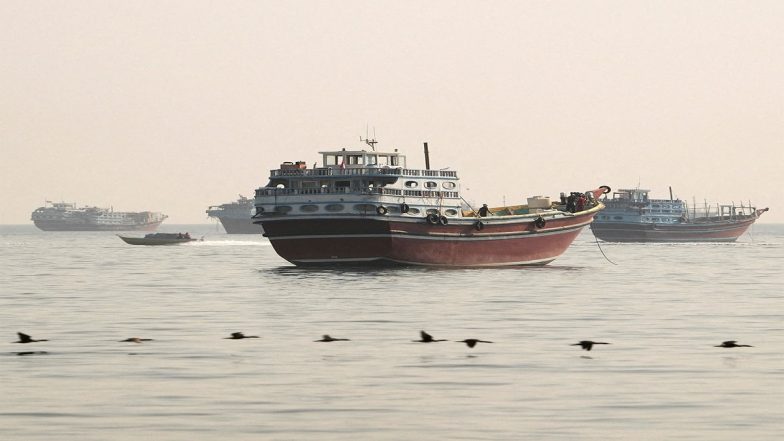
Iran's newly established Persian Gulf Strait Authority (PGSA) has implemented strict new permit registration and mandatory insurance regulations for all commercial vessels seeking to transit the Strait of Hormuz. The regulatory shift comes immediately after a United States–Iran interim ceasefire agreement aimed at ending recent military conflict and reopening the critical maritime chokepoint.
Under the new directives, shipowners must submit a transit application at least 48 hours in advance through the official PGSA portal. Approved permits will remain valid for a five-day window. Furthermore, the authority mandated that all transiting vessels carry insurance coverage approved by the PGSA, establishing a rigorous new framework for maritime traffic navigating the strategic waterway. Israel and Hezbollah Renew Ceasefire After Lebanon Fighting Forced Postponement of US-Iran Talks in Switzerland.
According to official PGSA documents circulated to the maritime industry, vessels are strictly required to utilize a designated northern transit route that runs close to Larak Island within Iranian territorial waters. The application procedures do not cover the alternative southern transit route currently patrolled by U.S. forces within Omani waters.
The policy explicitly states that "no vessel is permitted to pass through the Strait of Hormuz without a valid passage permit issued by the PGSA." While the required maritime insurance is currently being provided free of charge by the Iranian government, the authority explicitly reserved the right to levy insurance fees once the current geopolitical transition period concludes.
The implementation of these transit rules follows the signing of a bilateral Memorandum of Understanding (MoU) between Washington and Tehran. The broad interim agreement framework stipulates the "immediate and permanent" cessation of hostilities, the lifting of the U.S. naval blockade, and a 60-day waiver allowing Iran to export oil. Why Donald Trump Said Iran Is 'FINISHED' After Historic Peace Implementation Talks Collapse.
The MoU originally outlined a commitment to ensure the "safe passage of commercial vessels with no charge" for a 60-day duration. Analysts note that by offering the mandatory insurance free of charge during this initial period, Tehran is technically adhering to the letter of the agreement while simultaneously embedding an administrative infrastructure capable of collecting transit tolls in the future.
The shipping industry and international maritime bodies have expressed immediate reservations regarding the unilateral protocols. Representatives from global shipping trade groups have rejected the notion of a fee or toll system being imposed on what is widely recognized under international frameworks as an international waterway.
Legal experts point out that under the United Nations Convention on the Law of the Sea (UNCLOS), coastal states bordering international straits are prohibited from suspending transit passage or levying charges purely for the right of transit. However, because Iran is not a formal state party to UNCLOS, it has frequently asserted greater historical regulatory jurisdiction over the narrow passage.
Despite the new bureaucratic hurdles, commercial traffic through the strait has seen a sharp uptick. Maritime tracking firm AXSMarine reported that 25 verified commercial vessels transited the waterway on Thursday—the highest single-day count since mid-April and a fivefold increase over the daily average recorded earlier in the month.
The resumption of traffic remains complicated by significant security and operational risks. Maritime security agencies estimate that approximately 80 naval mines deployed during the conflict still need to be cleared from the central shipping lanes. Additionally, more than 500 merchant vessels remain backlogged within the Persian Gulf, meaning a full return to pre-war transit levels of roughly 110 to 120 ships per day could take weeks or months to achieve.
(The above story first appeared on LatestLY on Jun 19, 2026 09:16 PM IST. For more news and updates on politics, world, sports, entertainment and lifestyle, log on to our website latestly.com).