













 Quickly
 Socially
 Trending
 Crypto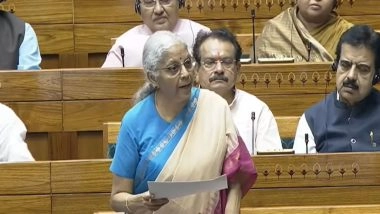
New Delhi [India], March 13 (ANI): Union Finance Minister Nirmala Sitharaman on Friday presented the Supplementary Demands for Grants - Second Batch for 2025-26 in the Lok Sabha, proposing a gross expenditure of approximately Rs 2.81 lakh crore.
The proposal, which includes cash, technical, and token supplements, aims to strengthen national defence, bolster social security through VB-G RAM-G, and establish a fiscal buffer to navigate global economic volatility.
Also Read | What Are the Penalties for Hoarding LPG Cylinders?.
Responding to the discussion on the grants, the Finance Minister clarified the components of the expenditure. "This involves gross expenditure of about Rs 2.81 lakh crore through cash or technical or token supplementaries. The present proposal also includes an amount of Rs 902 crore that is being provided for recouping advances of an equivalent amount from the Contingency Fund of India," Sitharaman said.
She further detailed that Rs 2.01 lakh crore constitutes the cash supplementary across 18 grants, while Rs 0.80 lakh crore is sought for 32 grants as technical supplementaries.
Also Read | Stock Market Today: Sensex, Nifty Drops Nearly 2% Amid Escalating Middle East Tensions.
A significant portion of the allocation is directed toward the Armed Forces and rural employment. The Minister announced an allocation of Rs 41,430.48 crore for Defence Services (Revenue), urging the House to support the move.
"Under Prime Minister Modi's government, efforts are being made to support and strengthen them (soldiers). In these Supplementary Demands for Grants, the Opposition should extend its support, as funds are being allocated for defence and for economic stability," she stated.
Addressing rural employment, Sitharaman noted that while Rs 95,000 crore was initially provided for the VB-G RAM-G, an additional Rs 30,000 crore is now allocated under these demands. "Our commitments for MGNREGA-VB-G-RAM G are being fulfilled," she added.
The Finance Minister also introduced an Economic Stabilisation Fund, involving Rs 57,381.84 crores, designed to protect the Indian economy from external shocks.
Sitharaman maintained that the introduction of supplementary demands does not indicate poor initial budgeting but reflects a flexible and responsive governance model. She noted that the government has restricted such demands to a "bare minimum" of two per year.
The Finance Minister also assured the House that these additional expenditures would not impact the government's fiscal discipline. "We will, in no way, fail to fulfil the commitment made in the Budget. I would like to reiterate that the assurances given in this House... will remain within the fiscal deficit target that was presented in Parliament on February 1, 2026," she said.
Defending the creation of this fiscal cushion, she asked, "Are the Opposition members suggesting that in times of unforeseen challenges, should the govt not create a fiscal buffer or equalisation fund of Rs 50,000 crores?"
She emphasised that this fund provides the "fiscal headroom" necessary to respond to supply chain disruptions and unanticipated global headwinds. (ANI)
(The above story is verified and authored by ANI staff, ANI is South Asia's leading multimedia news agency with over 100 bureaus in India, South Asia and across the globe. ANI brings the latest news on Politics and Current Affairs in India & around the World, Sports, Health, Fitness, Entertainment, & News. The views appearing in the above post do not reflect the opinions of LatestLY)
 Share Now
 Google Trends



 Live Bot