













 Quickly
 Socially
 Trending
 Crypto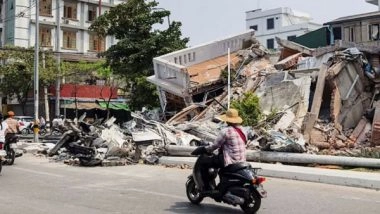
Naypyidaw [Myanmar], September 4 (ANI): An earthquake of magnitude 4.7 struck Myanmar on Thursday, a statement by the National Center for Seismology (NCS) said.
As per the NCS, the earthquake occurred at a depth of 120km.
In a post on X, the NCS said, "EQ of M: 4.7, On: 04/09/2025 11:03:35 IST, Lat: 23.97 N, Long: 94.50 E, Depth: 120 Km, Location: Myanmar."
https://x.com/NCS_Earthquake/status/1963477465566699913
Earlier in the day, another earthquake of magnitude 4.1 struck the region at a depth of 70km.
In a post on X, the NCS said, "EQ of M: 4.1, On: 04/09/2025 09:52:06 IST, Lat: 21.88 N, Long: 96.08 E, Depth: 70 Km, Location: Myanmar."
https://x.com/NCS_Earthquake/status/1963460592095863138
On Wednesday, another earthquake of magnitude 3.7 struck Myanmar at a shallow depth of 10km, making it susceptible to aftershocks.
The NCS said, "EQ of M: 3.7, On: 03/09/2025 16:23:40 IST, Lat: 23.85 N, Long: 93.73 E, Depth: 10 Km, Location: Myanmar."
https://x.com/NCS_Earthquake/status/1963196212409971118
Shallow earthquakes are generally more dangerous than deep earthquakes. This is because the seismic waves from shallow earthquakes have a shorter distance to travel to the surface, resulting in stronger ground shaking and potentially more damage to structures and greater casualties.
In the aftermath of the magnitude 7.7 and 6.4 earthquakes that struck central Myanmar on March 28, the World Health Organization (WHO) warned of a series of rapidly rising health threats for tens of thousands of displaced people in earthquake-affected areas: tuberculosis (TB), HIV, vector- and water-borne diseases.
Myanmar is vulnerable to hazards from moderate and large magnitude earthquakes, including tsunami hazards along its long coastline. Myanmar is wedged between four tectonic plates (the Indian, Eurasian, Sunda, and Burma plates) that interact in active geological processes.
A 1,400-kilometre transform fault runs through Myanmar and connects the Andaman spreading center to a collision zone in the north called the Sagaing Fault. The Sagaing Fault elevates the seismic hazard for Sagaing, Mandalay, Bago, and Yangon, which together represent 46 per cent of the population of Myanmar. Although Yangon is relatively far from the fault trace, it still suffers from significant risk due to its dense population. For instance, in 1903, an intense earthquake with a magnitude of 7.0 that occurred in Bago also struck Yangon. (ANI)
(The above story is verified and authored by ANI staff, ANI is South Asia's leading multimedia news agency with over 100 bureaus in India, South Asia and across the globe. ANI brings the latest news on Politics and Current Affairs in India & around the World, Sports, Health, Fitness, Entertainment, & News. The views appearing in the above post do not reflect the opinions of LatestLY)
 Share Now
 Google Trends



 Live Bot