Why Assam Wants To Cut Kaziranga Eco-Sensitive Zone From 10 Km to 1 Km
Why Assam wants to cut Kaziranga’s eco-sensitive zone from 10 km to 1 km is at the centre of a fresh conservation and development debate. CM Himanta Biswa Sarma said the state will approach the Centre within two months. The 10-km provision will remain in force until a revised ESZ is formally notified, while the proposal could affect infrastructure plans around Kaziranga.

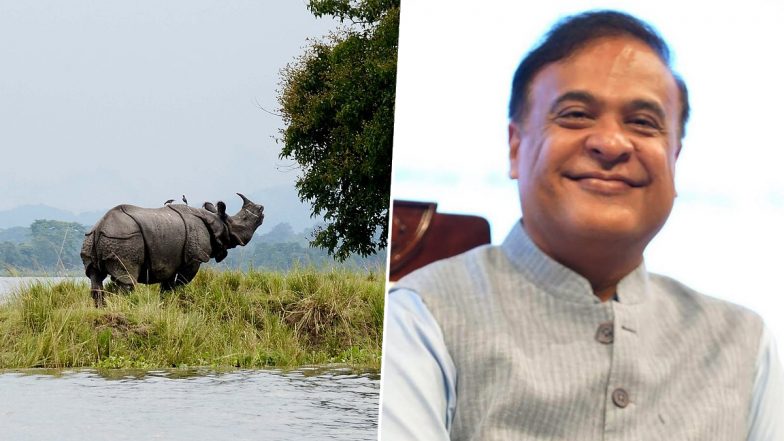
The Assam government is preparing to approach the Centre with a proposal to reduce the eco-sensitive zone (ESZ) around Kaziranga National Park and Tiger Reserve (KNPTR) from the current 10-km provision to 1 km. Chief Minister Himanta Biswa Sarma said the state plans to send the proposal to the Union government within the next two months for consideration and notification.
The move is being linked to the state government’s push for development and infrastructure in areas surrounding Kaziranga. Sarma has argued that the 10-km provision currently being followed is a default arrangement and was not based on a specific state notification. Until a site-specific ESZ is formally notified, however, the existing 10-km provision will continue to apply. Shantanu Naidu Criticises Assam Government's Proposed 1 Km Eco-Sensitive Zone for Kaziranga National Park (Video).
Assam Wants To Cut Kaziranga Eco-Sensitive Zone To 1 Km
Here's the real facts regarding the Eco sensitive zone around @kaziranga_ pic.twitter.com/Gu1yxcfwaG
— Himanta Biswa Sarma (@himantabiswa) August 12, 2026
Why Assam wants to reduce Kaziranga’s ESZ
The state government has cited restrictions on development as one of the reasons for seeking a smaller ESZ. Infrastructure projects in areas outside the protected area have been affected by the restrictions, with a proposed stadium among the projects cited in the debate.
Sarma has said that once Assam completes its notification process, the ESZ could be limited to 1 km, referring to the Supreme Court’s framework on eco-sensitive zones. Kaziranga National Park Among Top Five in Number of Migratory Waterbirds Across Country, Finds Water-Birds Census.
The proposed change would not itself remove all environmental restrictions around Kaziranga. Activities within an ESZ are regulated according to the applicable notification, with some activities prohibited and others requiring approval.
What the Supreme Court has said
In June 2022, the Supreme Court directed that protected areas should ordinarily have an eco-sensitive zone extending at least 1 km from their boundaries. The court also allowed variations based on existing notifications and the specific circumstances of individual protected areas.
The legal position has since been the subject of interpretation in relation to Kaziranga. A March 2026 Gauhati High Court proceeding recorded that the 10-km direction around Kaziranga remained operative because a final ESZ notification had not been issued by the state.
That distinction is important: the Assam government’s proposal to seek a 1-km zone does not mean the 10-km provision has already been withdrawn.
What happens to the 10-km zone now?
The existing 10-km provision will remain in place until the state government formally notifies a site-specific ESZ, Sarma clarified. The state is expected to prepare its proposal before sending it to the Centre for consideration and further action.
This means development restrictions associated with the existing provision continue for now. Any change would follow the required notification process rather than taking effect immediately.
Why the proposal matters for wildlife
Any reduction in the ESZ around Kaziranga is likely to receive close scrutiny from conservation groups because areas outside the park can also be important for wildlife movement and habitat connectivity.
Kaziranga is a UNESCO World Heritage Site and one of India’s most important wildlife reserves. It is particularly known for its population of the greater one-horned rhinoceros, while its wider landscape supports elephants, tigers and other species.
Conservation concerns around development near protected areas generally centre on habitat fragmentation, wildlife movement and increased human-wildlife interaction.
Development versus conservation
The Assam government’s position is that the current 10-km provision creates constraints for infrastructure and development in settlements surrounding Kaziranga. Its proposed 1-km ESZ is intended to provide greater room for such projects while maintaining a regulated area immediately outside the protected area.
The proposal, however, will have to go through the Centre’s consideration and notification process before any revised boundary takes effect.
For now, the 10-km provision remains applicable around Kaziranga. The next step will be Assam’s formal proposal and the Centre’s decision on the extent and conditions of any revised ESZ.
(The above story first appeared on LatestLY on Aug 13, 2026 06:35 PM IST. For more news and updates on politics, world, sports, entertainment and lifestyle, log on to our website latestly.com).