Cricket-Style Snicko Tech Confirms Goal in Sweden's 5-1 FIFA World Cup 2026 Win Over Tunisia
A cricket-inspired 'Snicko'-style technology, part of FIFA's Connected Ball system, dramatically confirmed Mattias Svanberg's goal in Sweden's 5-1 thrashing of Tunisia during their FIFA World Cup 2026 Group F match in Monterrey. This cutting-edge VAR intervention utilized an IMU sensor within the official match ball, Trionda.

Football fans witnessed a dramatic intervention of technology akin to cricket's 'Snicko' system as Sweden commenced their FIFA World Cup 2026 campaign with a resounding 5-1 win over Tunisia in a Group F clash at Estadio Monterrey (formerly Estadio BBVA). The spotlight, however, wasn't just on Sweden's five-star performance but on a groundbreaking VAR decision that utilized advanced ball-contact detection to award Mattias Svanberg a goal previously ruled offside. Mexican Spectator Apologises for Racist Gesture Towards Korean Influencer Yoon Su-jin at World Cup 2026 After Video Goes Viral.
The incident, which unfolded late in the match, saw substitute Mattias Svanberg score what appeared to be a swift goal just seconds after entering the field. However, the assistant referee's flag was raised, signaling offside. The Video Assistant Referee (VAR) system then initiated a review, turning to the FIFA-mandated 'Connected Ball Technology' to scrutinize the preceding play.
The 'Snicko' Moment
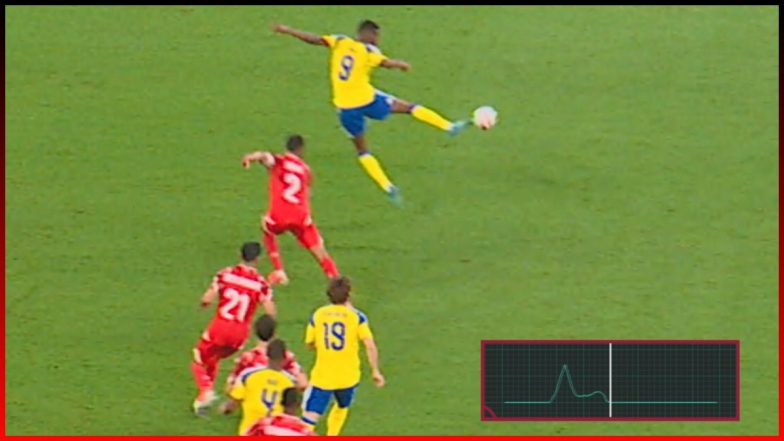
During the VAR check for Svanberg's goal, the crucial element was whether Sweden's Alexander Isak had made a faint touch on the ball in the build-up, which would have played Svanberg onside. This is where the cricket-style 'Snicko' visualization came into play. The official match ball, known as the 'Trionda', equipped with an inertial measurement unit (IMU) sensor tracking its movements 500 times per second, provided real-time data to the VAR officials.
The broadcast-style 'Snicko' graphic reportedly displayed a clear spike at the precise moment the ball passed Isak's boot, confirming even the slightest of touches. This definitive evidence, showing infinitesimal ball contact, was sufficient to overturn the on-field decision, validating Svanberg's goal and marking a significant moment for technological integration in football.
Snicko in Football During FIFA World Cup 2026 Game!
First time I've seen Snicko used in football https://t.co/J0QuGUtSGL
— Follow Journo Mode on YouTube (@MikeDingDong) June 15, 2026
Match Overview
Sweden's dominant performance saw Yasin Ayari open the scoring with a thunderbolt from distance in the seventh minute, and Alexander Isak doubled the lead on the half-hour mark. Tunisia pulled one back through Omar Rekik just before half-time, offering a glimmer of hope. However, the second half belonged to the Swedes, with Viktor Gyokeres extending their lead before Svanberg's controversial but ultimately confirmed goal. Ayari then sealed his brace and the emphatic 5-1 victory in stoppage time. Zee Issues Warning on Unauthorised FIFA World Cup 2026 Live Streaming and Branding in India.
Sweden will next face the Netherlands in Houston, while Tunisia will remain in Monterrey to play Japan. The utilization of such precise technology marks a new era for football officiating, promising greater accuracy and transparency in the game's most contentious moments.
(The above story first appeared on LatestLY on Jun 15, 2026 05:59 PM IST. For more news and updates on politics, world, sports, entertainment and lifestyle, log on to our website latestly.com).