The Rise of Online MCA in India: Why More Tech Professionals Are Choosing to Upskill in 2026
Online MCA enrolments in India are growing fast in 2026. Here is why more tech professionals are choosing to upskill with a postgraduate degree without leaving their jobs.

Something is quietly changing in how India's technology professionals think about their careers.
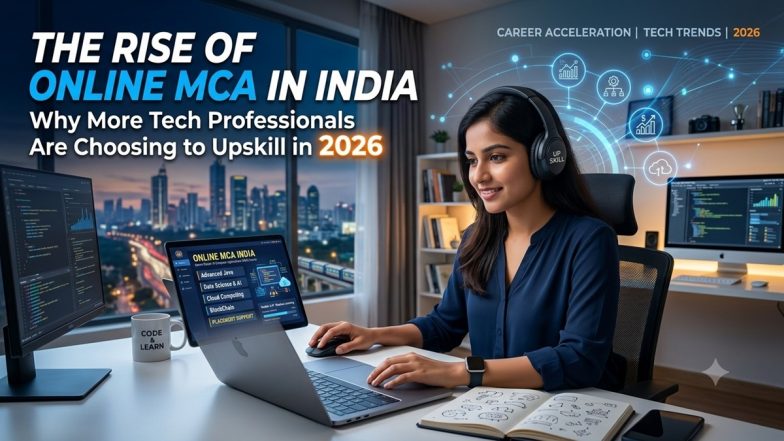
A growing number of working IT professionals, software developers, system analysts, network engineers, and data professionals, are going back to school. Not by quitting their jobs or enrolling in full-time campus programs. They are doing online MCA degrees while continuing to work, and the numbers reflect a clear shift in how postgraduate education is being approached in India's tech sector.
What is Driving the Shift
The trigger is a familiar one for anyone a few years into a tech career. Technical skills get you hired. But depth, formal credentials, and the ability to think beyond a single technology stack determine whether you grow into senior roles or stay stuck at the same level.
India's IT sector has matured significantly. The roles that are growing fastest and paying the most, cloud architecture, machine learning engineering, cybersecurity, systems design, demand a level of foundational computer science depth that on-the-job experience and short certifications do not always build. An MCA, with its rigorous two-year curriculum covering algorithms, software engineering, database systems, AI, and computer networks, addresses that gap directly.
At the same time, the practical barrier to doing a postgraduate degree has fallen substantially. Online MCA programs from UGC entitled universities now offer live classes, recorded lectures, flexible scheduling, and EMI fee options, making the degree accessible to working professionals without requiring a career break.
Why the Online Route is Gaining Credibility
Five years ago, an online degree in India was viewed with significant skepticism by employers. That perception has shifted following UGC's 2020 regulations formally recognizing online degrees as equivalent to regular campus degrees, provided the institution meets specific quality and accreditation standards.
The practical result is that a tech professional doing online MCA from a NAAC A++ accredited institution now holds a degree with the same academic standing as a campus MCA from the same university. Employers across the private sector, government departments, and public sector organizations increasingly recognize this, and the credential now appears without the asterisk it once carried.
Institutions like JAIN Online, the online education arm of JAIN (Deemed-to-be University), a NAAC A++ accredited institution, have built programs specifically around this shift. Their online MCA offers 8 specializations including AI and Machine Learning, Data Science, and Cloud Computing, with live faculty interaction and 38+ AI tools integrated into the curriculum. For tech professionals who want both the credential and current, relevant content, that combination matters.
The Profile of Who is Enrolling
The typical online MCA student in 2026 is not a fresh graduate uncertain about their next step. They are professionals with 2 to 5 years of experience who have hit a visible ceiling and want to break through it.
Many are BCA graduates who entered the workforce directly and now want the postgraduate credential to qualify for senior technical roles or government positions that require a postgraduate degree. Others are BSc Computer Science graduates who want to specialize in AI, cloud, or cybersecurity without leaving their current job. A third group are career changers from adjacent fields, commerce graduates, science professionals, or even non-technical roles, who have been building coding skills on the side and want formal recognition.
What they share is a clear goal and limited patience for programs that are not built around their constraints. Live classes scheduled around work hours, recorded lectures for revision, and a degree they can list on a resume without explanation are non-negotiable requirements.
The Career Case is Clear
The salary difference between a BCA graduate and an MCA graduate in India is consistent and documented. Entry-level MCA graduates from recognized institutions start at Rs. 5 to 9 LPA. BCA graduates entering the same market start at Rs. 3 to 5 LPA. The gap widens with experience.
More significantly, an MCA opens access to roles that simply require a postgraduate qualification, senior engineer designations at large companies, government IT roles, faculty positions, and tech leadership tracks that are formally closed to candidates without a postgraduate degree.
For a working professional already earning and paying EMIs, the monthly cost of an online MCA from a top institution is often less than one month's salary. The return over a 5 to 10 year horizon is not a difficult calculation.
What to Check Before Enrolling
With the growth in online MCA enrollment has come growth in institutions offering the degree without the credentials to back it up. Before enrolling, verify two things.
First, confirm the university is on the UGC's approved list for online programs. This list is publicly available on the UGC website and is the only authoritative source of which institutions can legally offer online degrees.
Second, check the NAAC grade. Only institutions with a minimum grade of B++ are permitted by UGC to offer online degree programs. A and A++ rated institutions carry significantly stronger employer credibility.
If you are considering doing online MCA, platforms like JAIN Online provide a starting point to understand what a quality program looks like, accreditation, specializations, live class infrastructure, and fee structure, before comparing options.
The Bigger Picture
India is producing more technology graduates than ever before. The competition for senior roles is intensifying. And the fastest growing areas of tech, AI, cloud, cybersecurity, data, require the kind of foundational depth that short courses cannot build.
The rise of the online MCA is not a trend driven by convenience alone. It is a response to a real gap in how India's tech workforce is credentialed versus how it needs to be positioned for the roles the industry is creating.
For working professionals who want to close that gap without pausing their careers, 2026 is a good time to start.
(All articles published here are Syndicated/Partnered/Sponsored feed, LatestLY Staff may not have modified or edited the content body. The views and facts appearing in the articles do not reflect the opinions of LatestLY, also LatestLY does not assume any responsibility or liability for the same.)