El Niño Officially Begins As US Scientists Warn of Potentially Record-Breaking Global Heat
The El Niño climate pattern has officially developed in the tropical Pacific Ocean, according to the U.S. National Oceanic and Atmospheric Administration (NOAA), raising concerns about higher global temperatures and increased risks of extreme weather events over the next two years.

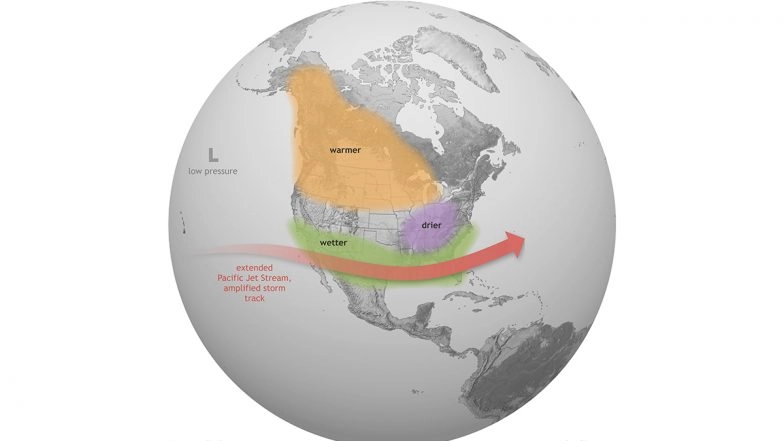
The warming climate pattern known as El Niño has officially developed in the tropical Pacific Ocean, according to the United States' National Oceanic and Atmospheric Administration (NOAA). Scientists say the event could become one of the strongest on record, increasing the likelihood of higher global temperatures, extreme weather events, and disruptions to food production and economies over the coming years.
NOAA confirmed that sea surface temperatures in the central and eastern equatorial Pacific have exceeded the threshold used to classify an El Niño event, marking the start of a phenomenon that typically influences weather patterns worldwide. El Niño 2026: Can the Strongest Event on Record Weaken India’s Monsoon?.
NOAA Confirms El Niño Conditions
In its latest assessment, NOAA reported that above-average sea surface temperatures have expanded across the tropical Pacific, while atmospheric conditions are also beginning to respond to the ocean warming.
"El Niño conditions developed over the past month," the agency said, noting that warmer-than-average ocean temperatures are now firmly established across key regions of the Pacific. Scientists had anticipated the arrival of El Niño after the cooler La Niña phase ended earlier in the year. However, the speed at which the event has intensified has attracted significant attention from climate researchers. What Is El Nino and How Does It Affect Weather?.
Forecasts Suggest Potentially Very Strong Event
Climate models indicate a high probability that the current El Niño could strengthen substantially during the second half of the year. According to NOAA's outlook, there is a 63% chance that the event will become "very strong" between November and January. Such an outcome would place it among the most powerful El Niño episodes recorded since modern observations began in 1950.
Historically, major El Niño events occurred in 1982-83, 1997-98 and 2015-16, all of which were associated with significant global weather disruptions. Some forecasts from U.S. and European climate centres suggest sea surface temperatures in parts of the tropical Pacific could rise more than 3°C above average by the end of the year. However, NOAA cautioned that the strength of an El Niño does not guarantee identical impacts across all regions.
Impact on Global Temperatures
Scientists say the current El Niño is occurring against the backdrop of long-term human-driven climate change, increasing concerns about its potential effects. El Niño typically transfers heat stored in the Pacific Ocean into the atmosphere, leading to a temporary rise in global average temperatures. A very strong event can raise global air temperatures by around 0.2°C.
Researchers warn that this additional warming is now being added to an already warmer planet. Professor Adam Scaife, head of monthly to decadal prediction at the UK Met Office, said the combination of El Niño and climate change could produce unprecedented temperatures in some parts of the world. "The warming from El Niño is being added to an already elevated baseline caused by climate change," he said.
Weather, Agriculture and Economic Risks
El Niño often alters rainfall patterns and weather systems across multiple continents. Depending on the region, it can contribute to droughts, floods, heatwaves, and changes in storm activity. These shifts can affect agricultural production, water supplies, energy demand and economic activity. The impacts frequently continue well beyond the peak of the event itself.
Experts say governments and industries are closely monitoring forecasts as stronger El Niño conditions could increase the risk of weather-related disruptions in 2026 and beyond.
Climate Change Amplifies Concerns
The return of El Niño comes after a series of exceptionally warm years globally. Scientists note that recent temperature records have been influenced by both natural climate variability and the long-term warming trend caused by greenhouse gas emissions. Even relatively moderate El Niño conditions have contributed to record-breaking global temperatures in recent years. Researchers say a stronger event could further increase the likelihood of new temperature records and intensify climate-related impacts worldwide.
While the precise strength and consequences of the current El Niño will become clearer in the coming months, climate experts agree that its development is likely to be a major factor shaping global weather patterns in the year ahead.
(The above story first appeared on LatestLY on Jun 11, 2026 07:15 PM IST. For more news and updates on politics, world, sports, entertainment and lifestyle, log on to our website latestly.com).