
India News | IIT Bombay Develops Indigenous Technology to Combat LPG Shortage
Get latest articles and stories on India at LatestLY. The Indian Institute of Technology (IIT) Bombay developed an indigenous technology to combat the rising prices and potential shortages of LPG (cooking gas).

Mumbai (Maharashtra) [India], March 31 (ANI): The Indian Institute of Technology (IIT) Bombay developed an indigenous technology to combat the rising prices and potential shortages of Liquefied Petroleum Gas (LPG).
Through its patented biomass gasification technology, the institute has successfully converted dry leaves into cooking fuel.
This technology is the culmination of nearly a decade of research, which began in 2014 under Professor Sanjay Mahajani.
Sanjay Mahajani, speaking to reporters, said, "I am a faculty member here in the Department of Chemical Engineering at IIT Bombay. My research focuses on gasification and energy conversion. These dried leaves and twigs, if we simply burn them, do, in fact, yield energy. However, the situation here is that IIT Bombay possesses a vast green cover; consequently, a large volume of leaves and twigs fall onto the pathways and grounds. So, we reasoned that since this waste material inherently contains energy, why not harness it for our own internal applications? Given the extensive cooking activities and various thermal applications within the IIT campus, we decided to explore using this waste as a fuel source for those needs."
He stated that the process was not simple; it required research, adding that we have engineered the gasifier's design in such a way as to drastically minimise these emissions.
"However, it was not quite that simple; it required a significant amount of research. Gasification involves first converting these leaves into pellets, essentially compressing them, and then feeding these pellets into the gasification unit that we have designed... Consequently, when combusted, it tends to generate significant emissions, particularly particulate matter. Therefore, we have engineered the gasifier's design in such a way as to drastically minimise these emissions," said Professor.
He explained that the process is considered 'Producer gas', and it contains carbon monoxide and hydrogen, which makes the gas easily combustible.
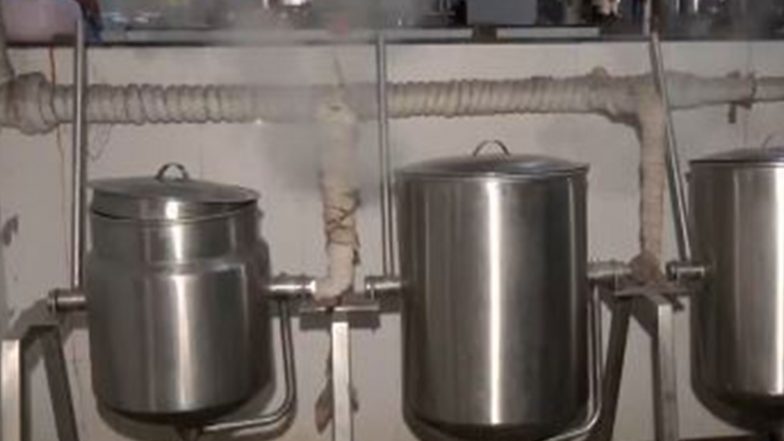
"The gas produced through this process is known as 'producer gas." It consists primarily of carbon monoxide and hydrogen; we combust this gas immediately, and when this combustion takes place, the resulting emissions are extremely low. And when this gas is combusted, the energy released is used to generate steam from water; essentially, we convert water into vapour. This steam is then channelled into the canteen, where it powers the steam-based cooking equipment and other utilities used for food preparation," Sanjay added. (ANI)
(The above story is verified and authored by ANI staff, ANI is South Asia's leading multimedia news agency with over 100 bureaus in India, South Asia and across the globe. ANI brings the latest news on Politics and Current Affairs in India & around the World, Sports, Health, Fitness, Entertainment, & News. The views appearing in the above post do not reflect the opinions of LatestLY)