
India News | IIT Guwahati Develops Framework to Identify High-Risk Areas for Glacial Lake Formation in the Eastern Himalayas
Get latest articles and stories on India at LatestLY. Research from the Indian Institute of Technology Guwahati have developed a predictive framework to identify the locations where glacial lakes are likely to form in the Eastern Himalayan mountains.

Guwahati (Assam) [India], January 27 (ANI): Research from the Indian Institute of Technology (IIT) Guwahati have developed a predictive framework to identify the locations where glacial lakes are likely to form in the Eastern Himalayan mountains.
The research provides crucial insights for hazard management and water-resource planning in high-mountain regions.
When glaciers melt, their water accumulates in the natural depressions.
In the Himalayas, glaciers are rapidly melting due to climate change, leading to the formation of new glacial lakes.
Although the rise in temperature is increasing meltwater production, the formation and location of glacial lakes are influenced by surrounding topography, including bowl-shaped depressions, valleys, flow channels, and lakes created by glaciers.
The expansion of glacial lakes increases the chance of their outburst, resulting in floods, which can destroy infrastructure and disrupt natural habitats. Past disasters, such as the 2013 Kedarnath floods and the recent Uttarkashi floods in August 2025, underscore the high stakes involved.
Most of the existing models developed to address this challenge focus on climate, neglecting landscape features, resulting in a lack of completely reliable forecasts.
To bridge this gap, the IIT Guwahati team created a probabilistic framework, a smarter way to forecast future glacial lake formation location.
The team achieved this by using high-resolution Google Earth images and digital elevation models that help capture complex landscape features and estimate uncertainty in the predictions. This makes the forecasts more realistic and reliable, reflecting the natural variability and unpredictability of mountain environments.
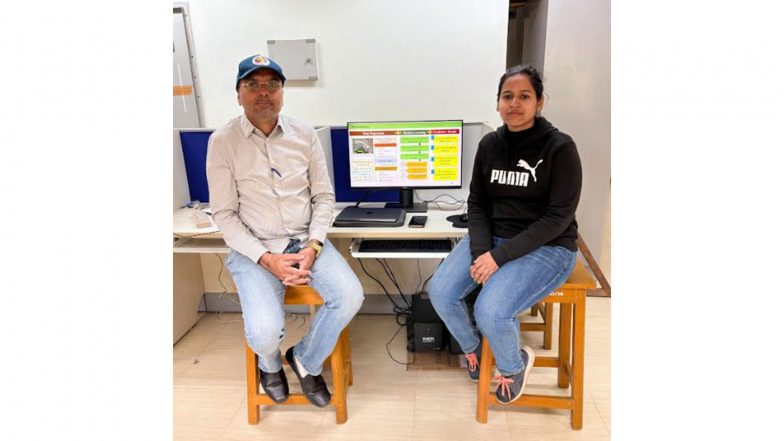
The findings of this research have been published in the prestigious Nature's Scientific Reports journal, in a paper co-authored by Prof. Ajay Dashora, along with his research scholar Anushka Vashistha, Department of Civil Engineering, IIT Guwahati, and Dr. Afroz Ahmad Shah, Universiti of Brunei Darussalam (UBD), Brunei.
In the development process, the research team tested three predictive methods, including Logistic Regression (LR), Artificial Neural Network (ANN), and Bayesian Neural Network (BNN).
Among these, the research team found the Bayesian Neural Network (BNN) to be the most accurate and showed that certain earth features, such as neighbouring lakes, cirques, gentle slopes, and retreating glaciers, are the strongest predictors of glacial lake formation.
Speaking about the research, Prof Ajay Dashora, Assistant Professor, Department of Civil Engineering, IIT Guwahati, said, "By pinpointing high-risk areas, the framework can guide early-warning systems for GLOFs, help plan safer locations for roads, hydropower projects, and settlements, and support long-term water-resource management. It offers a practical tool for reducing risks to communities and infrastructure in the Himalayas."
"Beyond hazard management, the method can help understand how water systems may change as glaciers continue to retreat. Importantly, the framework is adaptable to other glaciated mountain regions around the world, making it a valuable tool for climate-resilient planning and disaster-risk reduction globally," he added.
With the developed framework, the research team identified 492 locations in the Eastern Himalaya where new glacial lakes are likely to form, thereby indicating areas that require careful monitoring and preventive measures.
These findings confirm that the shape and structure of the land, often overlooked in previous studies, can play a central role in where and how a glacial lake may appear.
As the next step, the research team plans to integrate moraine development histories, automate data preparation, and add field-based validation to the developed framework. These improvements will enhance the model's accuracy and broaden its use for large-scale monitoring of glacial hazards. (ANI)
(The above story is verified and authored by ANI staff, ANI is South Asia's leading multimedia news agency with over 100 bureaus in India, South Asia and across the globe. ANI brings the latest news on Politics and Current Affairs in India & around the World, Sports, Health, Fitness, Entertainment, & News. The views appearing in the above post do not reflect the opinions of LatestLY)