
India News | Nalanda Mahavihara: Buddhist Scholars, Academics Discuss Rise and Fall of Nalanda in Delhi Conference
Get latest articles and stories on India at LatestLY. A one-day international conference titled `Contribution of Nalanda Mahavihara in the dissemination of Buddha Dhamma' was organised jointly by the International Buddhist Confederation (IBC), the Ministry of Culture, and Dr Ambedkar International Centre, Ministry of Social Justice and Empowerment, Government of India, in the national capital.

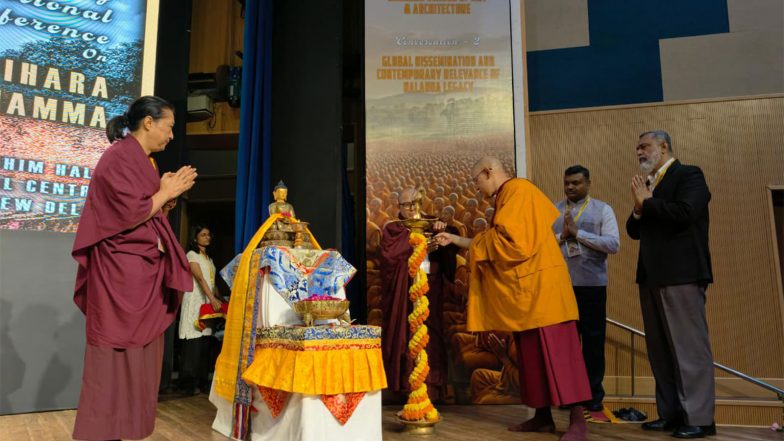
New Delhi [India], March 26 (ANI): A one-day international conference titled `Contribution of Nalanda Mahavihara in the dissemination of Buddha Dhamma' was organised jointly by the International Buddhist Confederation (IBC), the Ministry of Culture, and Dr Ambedkar International Centre, Ministry of Social Justice and Empowerment, Government of India, in the national capital.
The gathering on Tuesday witnessed sangha members, scholars, practitioners, diplomats and members of academia from India and abroad, including Nepal, Bhutan and the United States.
Also Read | Gold Rate Today, March 26, 2026: Check 22K and 24K Gold Prices in Delhi, Mumbai, Chennai and Other Cities.
According to a press release, the day-long conference was divided into four sets of conversations covering facets of the `Historical evolution, philosophical contribution and institutional framework of Nalanda Mahavihara'; `the life and work of distinguished Acharya (masters)'; `the rise and fall of Nalanda'; and `the global dissemination and contemporary relevance of Nalanda'.
The evolution of the Nalanda Mahavihara in Magadh (modern-day Bihar, India) as a school of learning is a lesson in patronage of higher learning by the state. Established during the Gupta dynasty and subsequently sustained by other rulers for almost 800 years, it was the pinnacle of human achievement.
Nalanda Mahavihara flourished as the world's first residential monastic university and a major centre of intellectual discourse and intercultural dialogue. Its contribution to higher learning and the spread of Buddha Dhamma marks a remarkable chapter in history. The university attracted students and scholars from across the world, demonstrating the universal appeal of Dhamma.
Opening the conference, Shartse Khensur Jangchup Choeden Rinpoche, Secretary General, IBC, mentioned that the core message of the Buddha was an invitation to inquire, to reflect, and to understand, not merely to believe.
He said that Nalanda embodied this vision, transforming a spirit of questioning into a flourishing centre of learning; it nurtured a tradition where intellectual rigour met inner exploration, advancing disciplines such as logic, language, medicine, arts, and contemplative sciences in an integrated pursuit of wisdom.
In his Keynote Address on the occasion, HE Gyeltrul Jigme Rinpoche, President and Chief, Rigon Thupten Mindrolling Monastery (Padmasambhava Maha Vihara), Odisha, said that Nalanda's today is in ruins, we are not talking in the physical sense, but Nalanda as a thought continues, its philosophy, awareness and the path. In a way, Nalanda has crossed all barriers and boundaries and still remains relevant- a bright light, a burning light as an embodiment of Buddha Dhamma that Nalanda signifies in its philosophy.'
On a panel on `Historical evolution, philosophical contribution and Institutional Framework', while talking of prominent Acharyas of Nalanda, the 14th Dhardo Tulku Rinpoche, Drepung Monastery, Darjeeling, mentioned Aryabhatta and his role in formalising mathematical ideas that would shape the course of global science, most notably advancing the use of Zero within a place-value system.
He mentioned that in many ways, Aryabhatta's work reflects the spirit of Nalanda: a place where abstract thought met practical application, and where insights like zero quietly transformed the destiny of human knowledge.
Speaking on the same theme, HE The 18th Choekyong Palga Rinpoche, Naljorling Monastery, Ladakh mentioned that while we tend to praise and appreciate the role that Nalanda played as a centre for knowledge and academic enlightenment, at the same time we tend to ignore the role played by the patrons or the rulers of the time who took immense interest and pride in creating, facilitating and sustaining such a universal concept.
Participating in the conference, Indra Prasad Kafle Associate Professor, Faculty of Buddhist Studies, Lumbini Buddhist University, Lumbini, Nepal highlighted the seven kinds of intelligence embodied within the Nalanda tradition and its Mahasiddhas, presenting them as a holistic map of human potential, which includes, linguistic intelligence, mathematics, music, spatial intelligence, visible in the creation of mandalas, deity iconography, and sacred art as visual pedagogies; kinetic intelligence, represented by ritual precision, yogic discipline; interpersonal intelligence, exemplified by Nalanda's community of ten thousand students living in universal brotherhood; and intrapersonal intelligence.
Starting the Panel on `Life and Work of Distinguished Acharyas of Nalanda', Moderator Lopen Lungtaen Gyatso, President, College of Language and Cultural Studies, Royal University of Bhutan mentioned that at a time when AI was becoming a central player, it is the human mind that should remain relevant and dominating so that smart use of AI could be made rather than enabling AI to take over human activities in an uncontrolled manner.
Sharda Poudel, Associate Professor, Faculty of Buddhist Studies, Lumbini Buddhist University, Lumbini, Nepal, addressed the conference on the famous masters of Nalanda, such as Kamalasila, remembered as one of the most distinguished philosophers of the later Nalanda tradition, renowned for his clarity, analytical depth, and meditative insight. As the foremost and direct disciple of Santaraksita, he carried Nalanda's scholastic brilliance into Tibet during the reign of King Trisong Detsen, where his presence shaped the very foundations of Tibetan Buddhism.
Lama Ngodup Dorji, Hereditary Dungzin Rinpoche of Shingkhar Chair, Longchenpa Centre (Bhutan), Former National Nyingma Representative, Commission for Religious Organisations of Bhutan, explained, 'the teachings of truth at Nalanda were characterised by a rigorous and boundary-transcending methodology. The scholars relied on unshakable logic, systematic debate, and fearless critical inquiry to distinguish genuine insight from misconception, ensuring that the Buddha's message could travel from the nearest to the farthest without distortion.
He mentioned that the Nalanda lineage reached the Bhutanese highlands through the scholastic and contemplative disciplines of Nalanda's exponents, like Guru Rinpoche (Padmasambhava), ensuring that the spirit of inquiry and the precision of reasoning continued to flourish across the Himalayan world.
Among the distinguished international Buddhist scholars and academics participating in the conference were two renowned nuns, Ven Kaveri Gill, Senior Fellow, Centre for Excellence in Himalayan Studies, Shiv Nadar University, Delhi NCR, and Lama Aria Drolma, Buddhist Meditation Teacher, New York, USA.
Ven Kaveri Gill said that Buddhist teaching is not only monastic but also includes science and philosophy. So if any tradition is open to being beyond religion and secular, it is Buddhist philosophy, while Lama Drolma shared her reflections on the very name 'Nalanda', describing its etymology, the giver of the lotus (knowledge) or more broadly, "the giver of knowledge", and linking this meaning to the refuge in bodhicitta prayer. She reminded participants that at the heart of the Nalanda legacy lies a single guiding intention: "May we attain Buddhahood for the benefit of all sentient beings."
Guiding the session on the rise and fall of Nalanda, Basanta Kumar Bidari, Archaeological Advisor, Lumbini Development Trust, Lumbini, Nepal, reminded participants that Nalanda's ascent was not merely an academic phenomenon but a 'civilisational flowering, where philosophy, monastic discipline, and artistic expression evolved in tandem'. In tracing Nalanda's rise, he highlighted how the university became a magnet for scholars across Asia, fostering an environment where rigorous debate, refined logic, and contemplative practice shaped the intellectual landscape of the Buddhist world.
Among the others who spoke at the conference were Bimlendra Kumar, Professor, Department of Pali and Buddhist Studies, Banaras Hindu University; Hira Paul Gangnegi, Former Head, Department of Buddhist Studies, University of Delhi; Ven Wangchuk Dorjee Negi, Vice Chancellor, Central Institute of Higher Tibetan Studies, Sarnath. (ANI)
(The above story is verified and authored by ANI staff, ANI is South Asia's leading multimedia news agency with over 100 bureaus in India, South Asia and across the globe. ANI brings the latest news on Politics and Current Affairs in India & around the World, Sports, Health, Fitness, Entertainment, & News. The views appearing in the above post do not reflect the opinions of LatestLY)