













 Quickly
 Socially
 Trending
 Crypto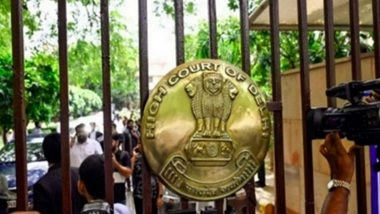
New Delhi [India], April 3 (ANI): The Delhi High Court has observed that while the Right to Education Act ensures access to education, it does not give a student the right to insist on admission in a specific school.
A Division Bench headed by Chief Justice Devendra Kumar Upadhyay and comprising Justice Tejas Karia made these observations while dismissing an appeal filed by a mother seeking her child's admission to a particular private school under the EWS category. The Bench upheld the earlier ruling and found no grounds to interfere with the Single Judge's decision.
Also Read | Don't Talk About 'Samosas', Stop Soft PR: AAP Leader Saurabh Bhardwaj Slams Raghav Chadha (Watch Video).
The Court emphasised that the objective of the Right of Children to Free and Compulsory Education Act is to promote social inclusion and equal opportunity in education. However, this right cannot be interpreted to mean that a parent can demand admission in a school of their personal choice.
In this case, the child had been selected through a computerised draw of lots conducted by the Directorate of Education for admission in a private school. However, when the school did not grant admission, the authorities offered the child a seat in another school, which was among the parents' preferred choices and located at a similar distance.
Despite being offered an alternative, the parent refused to accept the admission and instead approached the Court seeking a direction to the original school to admit the child. The Court noted that such a refusal was not justified, particularly when an arrangement had already been made to secure the child's education.
The bench further observed that there was no interim order granting provisional admission or reserving a seat during the pendency of the case. As a result, once the academic year ended, the right to seek admission in that school also came to an end.
It clarified that courts cannot create additional seats or grant admission in a subsequent academic year after the relevant session has concluded. Allowing such relief would be unfair to other eligible candidates competing for limited seats.
The Court also rejected reliance on a Supreme Court judgment related to medical admissions, stating that such exceptional reliefs apply only in rare cases and within strict timelines, which were not met in the present matter.
Accordingly, the High Court dismissed the appeal and reiterated that while the right to education must be protected, it does not extend to choosing a particular institution or bypassing established procedures. (ANI)
(The above story is verified and authored by ANI staff, ANI is South Asia's leading multimedia news agency with over 100 bureaus in India, South Asia and across the globe. ANI brings the latest news on Politics and Current Affairs in India & around the World, Sports, Health, Fitness, Entertainment, & News. The views appearing in the above post do not reflect the opinions of LatestLY)
 Share Now
 Google Trends



 Live Bot