Artemis 2 Mission: NASA Sets April Launch Window for Historic Crewed Moon Flyby
US space agency NASA has said that it has set a potential date to launch its Artemis 2 rocket mission to the moon in April, which will see astronauts fly around the Moon for the first time in over 50 years.

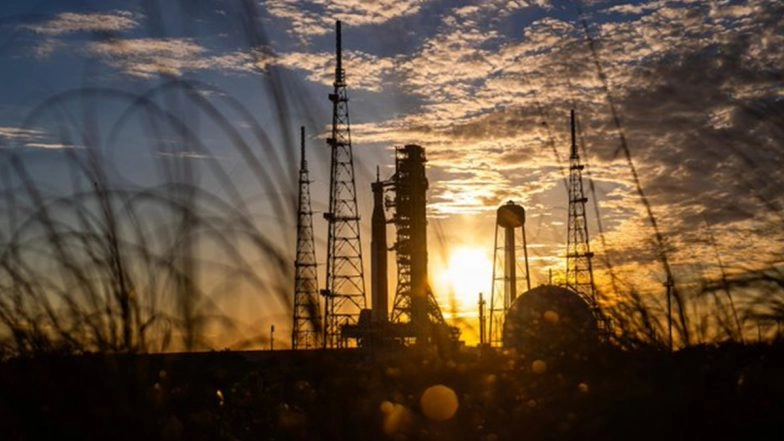
Washington DC, March 13: US space agency NASA has said that it has set a potential date to launch its Artemis 2 rocket mission to the moon in April, which will see astronauts fly around the Moon for the first time in over 50 years. NASA teams have polled 'go' to proceed toward Artemis 2's lift off attempt on April 1 and are targeting a March 19 date to roll the SLS (Space Launch System) rocket and Orion spacecraft to the launch pad 39 B at the Kennedy Space Centre in Florida, the space agency said in a statement on March 12.
"We have also added Thursday, April 2 as a potential launch date for Artemis 2," it added on the backup opportunity. It will launch NASA astronauts Reid Wiseman, Victor Glover and Christina Koch, as well as Canadian astronaut Jeremy Hansen, on a 10-day journey around the moon and back to Earth. The mission will test spacecraft systems with a crew aboard before future lunar surface landings. NASA said that the mission is a critical step in the Artemis program, aiming to establish a long-term human presence on the Moon and prepare for future missions to Mars. NASA Advances Artemis II Efforts With Key Vehicle Confidence Test Ahead of Moon Mission.
It aims to "explore the Moon for scientific discovery, economic benefits, and to build the foundation for the first crewed missions to Mars," the space agency said. The space agency announced the potential date of launch after conducting a two-day flight readiness review (FRR). "At the conclusion of the FRR, all the teams polled go to launch and fly Artemis II around the moon pending completion of some of the work before we roll out to the launch pad," said Lori Glaze, acting associate administrator, Exploration Systems Development Mission Directorate, at a press conference on Thursday at Kennedy Space Centre.
"It's a test flight, and it's not without risk, but our team and our hardware are ready," Glaze said. NASA had postponed the Artemis 2 mission, which was initially scheduled for February and March, after an issue was encountered with the flow of helium to the rocket's upper stage, which prompted a February 25 rollback to the Kennedy Space Centre's Vehicle Assembly Building for repair. Neil Armstrong and Buzz Aldrin were the first humans to walk on the moon on July 20, 1969, during NASA's Apollo 11 mission. NASA landed six crewed Apollo missions on the moon. On December 14, 1972, Eugene Cernan became the last person to walk on the moon during the Apollo 17 mission. NASA Satellite Crash Alert: 1,323-Pound Van Allen Probe A Set to Re-enter Earth After 14 Years in Space.
Incidentally, the Arteris mission is the flagship for the Artemis Accords, a US-led framework of over 40 countries, including India, designed to establish international norms for peaceful space exploration and resource utilisation. China is targeting a crewed lunar landing by 2030 and it, alongside Russia, is developing the International Lunar Research Station (ILRS). NASA's Artemis 2 mission to the moon coincides with India's own Gaganyaan program, which aims to achieve an indigenous human spaceflight capability in low Earth orbit, aiming for a 2027-2028 crewed launch. As part of this program, two unmanned missions and one manned mission have been approved by the Government of India.
(The above story is verified and authored by ANI staff, ANI is South Asia's leading multimedia news agency with over 100 bureaus in India, South Asia and across the globe. ANI brings the latest news on Politics and Current Affairs in India & around the World, Sports, Health, Fitness, Entertainment, & News. The views appearing in the above post do not reflect the opinions of LatestLY)