Japan: Volcano in Sakurajima Erupts, Creating 4,400m High Plume (Watch Video)
A volcano on Sakurajima in Kagoshima Prefecture, southwestern Japan, erupted early Sunday morning, sending a plume of ash and smoke up to 4,400 meters into the atmosphere, Kyodo News reported the weather agency as saying.

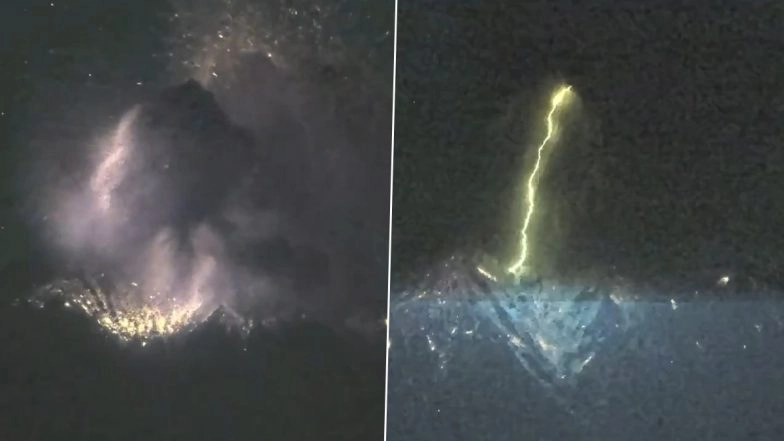
Tokyo, November 17: A volcano on Sakurajima in Kagoshima Prefecture, southwestern Japan, erupted early Sunday morning, sending a plume of ash and smoke up to 4,400 meters into the atmosphere, Kyodo News reported the weather agency as saying. The eruption continued after the initial event, prompting the agency to issue an ashfall forecast for parts of Kagoshima, Kumamoto and Miyazaki prefectures. No injuries or damage to buildings have been reported.
An explosive eruption around 12:57 am (local time) on Sunday at the Minamidake crater sent a plume rising above 4,000 meters for the first time since October 18 last year, according to the local meteorological observatory.
In the latest series of eruptions, large volcanic rocks flew as far as the fifth station, but no pyroclastic flows were detected. The alert level remains at three on a scale of five, which restricts access to the mountain. Kilauea Erupts Again: Volcano Eruption Shoots Large Columns of Lava Into the Air, Video Surfaces.
Volcano Erupts in Sakurajima
The Sakurajima volcano in Kagoshima Prefecture, southwestern Japan erupted early Sunday morning, with plumes rising up to 4,400 meters above the summit crater.
This is the recording of the initial moments of the eruption. pic.twitter.com/Wm5lvw1ITX
— Massimo (@Rainmaker1973) November 16, 2025
Sakurajima, one of Japan's most active volcanoes, is linked to the Osumi Peninsula on Kyushu, the country's southwestern main island. It was once an island, but a 1914 lava flow created a land bridge to the peninsula, as per Kyodo News. Earlier on August 30, the Japanese government has released simulated video footage of a large Mt. Fuji eruption, predicting its impact, including ashfall, in an effort to better prepare people for such a disaster scenario. The 10-minute video uses computer graphics to depict scenes after an eruption on a scale equivalent to the last confirmed blast in 1707. It warns that power supplies, sewage systems, and roads and railways would be among the infrastructure affected.
The video featuring a potential disaster at the 3,776-meter peak -- Japan's tallest -- can be viewed on the Cabinet Office website and comes as the country observes "Volcanic Disaster Preparedness Awareness Day" on August 26. "It is a bit unusual that Mt. Fuji has not erupted for over 300 years," Toshitsugu Fujii, professor emeritus at the University of Tokyo, said in the footage. On average, Mt. Fuji erupts once every 30 years, he said.
(The above story is verified and authored by ANI staff, ANI is South Asia's leading multimedia news agency with over 100 bureaus in India, South Asia and across the globe. ANI brings the latest news on Politics and Current Affairs in India & around the World, Sports, Health, Fitness, Entertainment, & News. The views appearing in the above post do not reflect the opinions of LatestLY)