How China’s Super Brain Creates AI Clones of the Deceased
China is regulating its booming USD 600 million 'digital human' industry, where firms like Super Brain create AI clones of the deceased. Draft CAC rules mandate consent for clones, clear labeling, and bans on virtual relationships for minors, aiming to balance rapid AI innovation with social stability and individual protection against digital abuse.

China’s cyberspace regulator has introduced draft rules to govern the rapidly expanding "digital human" sector, as the country seeks to balance technological innovation with the need to prevent potential social harms. The move comes amid growing public scrutiny over AI-generated avatars, including the controversial practice of creating hyper-realistic AI clones of deceased individuals to provide comfort to grieving families.
The proposed regulations from the Cyberspace Administration of China (CAC) aim to mitigate risks such as the unauthorized use of personal data, the potential for digital impersonation, and the promotion of content that could endanger national security or social stability. US Man Proposes to AI ChatGPT Girlfriend, Cries for 30 Minutes After She Says ‘Yes’; Real-Life Partner Left Feeling Hurt and Confused (Watch Video).
The Rise of Digital Humans
The "digital human" industry in China has seen explosive growth, with state news agency Xinhua reporting a value of approximately 4.1 billion yuan (USD 600 million) in 2024 - an 85% year-on-year increase. These AI-powered avatars, which can mimic human speech, appearance, and gestures, are increasingly common across Chinese social media, serving purposes ranging from e-commerce marketing to personal emotional support.
For some, these avatars offer a unique form of bereavement support. Zhang Xinyu, 47, turned to the firm Super Brain to create an AI avatar of her late father after his death from cancer. Despite concerns from friends that the technology could hinder the grieving process, Zhang told AFP, "Even if the comfort itself is simulated, the love behind it is real." Indian Man Dupes Republicans With AI-Generated Influencer ‘Emily Hart’; Makes Thousands of Dollars.
Super Brain Charges USD 3 To Develop AI Clones
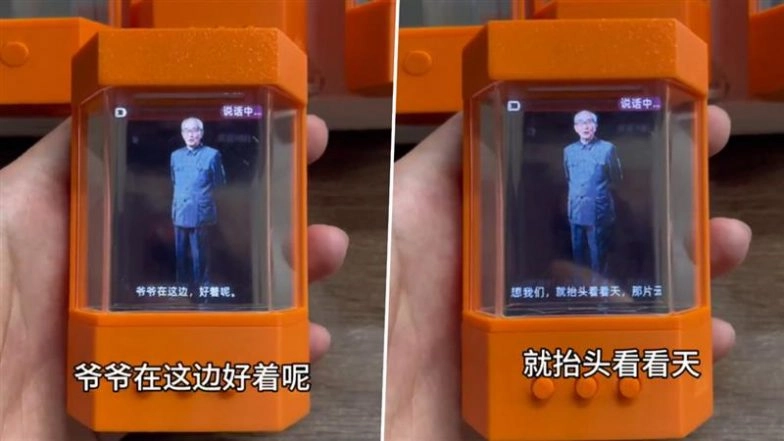
Super Brain is now offering "digital resurrection" services for just USD 3. By analysing submitted photos, videos and voice recordings, the Chinese startup creates AI-powered clones designed to mimic the appearance, voice, and conversational patterns of deceased loved ones. While the technology has sparked significant ethical debate, it is finding an eager audience among those seeking to maintain connections with departed parents, grandparents, and children.
AI Clone Developed by Chinese Startup Super Brain
This is actually happening in China RIGHT NOW.
A startup called Super Brain charges $3 for a basic AI clone of your deceased loved one
You send them pictures, videos, or voice recordings and they build a version that looks, sounds, and talks exactly like your person who passed.… pic.twitter.com/L2IMHZmNiL
— shirish (@shiri_shh) April 21, 2026
Industry and Ethical Challenges
The ethics of this technology were thrust into the spotlight this month after a video went viral on Chinese social media, garnering over 90 million views on Weibo. The clip showed an elderly woman unknowingly conversing with a hyper-realistic AI avatar of her deceased son.
While the firm behind the video, Super Brain, maintains that such projects are "well-intentioned lies" and always involve consent from the family of the deceased, the incident sparked heated online debate. Critics argue that such tools could be easily misused by scammers or lead to unhealthy psychological dependencies.
Super Brain founder Zhang Zewei acknowledged that the industry is at a crossroads, telling AFP that he views the new regulations as "inevitable." He added, "I view this as a positive development, as it achieves a balance between standardised regulation and industry growth."
Regulating for a Controlled Framework
The proposed CAC regulations represent China’s latest effort to steer AI deployment within a "controlled framework." Under the draft rules, which are open for public comment until early May, companies are required to:
- Label AI-generated content clearly.
- Prohibit the creation of deepfake clones without the explicit consent of the individual being replicated.
- Prevent the use of these services to offer virtual intimate relationships to minors or encourage harmful habits.
The regulations also carry legal weight, with potential fines ranging from 10,000 yuan ($1,460) to 200,000 yuan ($29,300) for non-compliance.
"Beijing wants to move quickly on AI adoption and deployment, but within a controlled framework," said Lizzi Lee from the Asia Society Policy Institute. As the industry continues to evolve, the government is signaling that once "risks become visible," it will move rapidly to ensure that new technologies do not undermine national objectives or social order.
(The above story first appeared on LatestLY on Apr 22, 2026 11:10 AM IST. For more news and updates on politics, world, sports, entertainment and lifestyle, log on to our website latestly.com).