‘Cosmic Kiss’ Alert: Venus and Jupiter To ‘Kiss’ After Sunset Tonight in Rare Sky Event; When and Where To Watch
Skywatchers around the world are turning their eyes to the western evening sky as Venus and Jupiter, the two brightest planets visible from Earth, appear unusually close together in a rare celestial event popularly known as a 'cosmic kiss'. The planetary conjunction reached its peak on June 8–9, 2026, offering one of the most striking astronomical sights of the year.

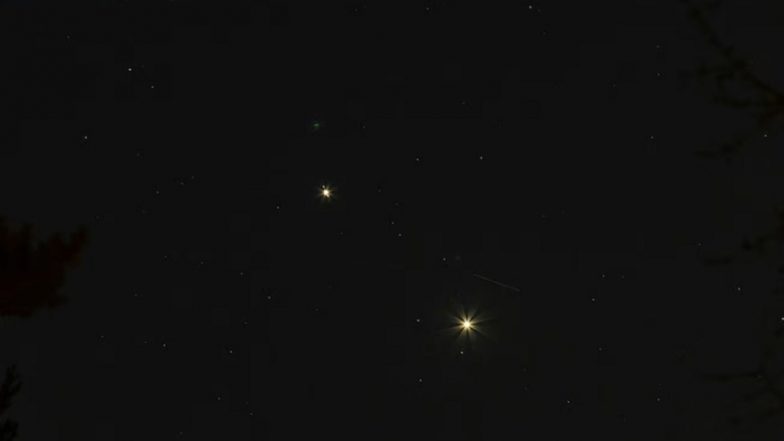
A rare celestial event will unfold in the evening sky tonight as Venus and Jupiter, the two brightest planets visible from Earth, appear exceptionally close together in a phenomenon popularly known as a “cosmic kiss.” The planetary conjunction will be visible shortly after sunset on June 9, offering skywatchers across India and other parts of the world one of the year's most notable astronomical displays.
Astronomers say the planets will appear separated by only about 1.6 degrees in the western sky, creating the illusion that they are nearly touching. Despite their apparent proximity, Venus and Jupiter remain hundreds of millions of kilometres apart in space. Venus-Jupiter Conjunction 2026: When and How To Watch the 2 Brightest Planets Appear Side by Side in India.
What Is the ‘Cosmic Kiss’?
The event is an astronomical phenomenon known as a conjunction, which occurs when two celestial bodies appear close together in the sky from Earth's perspective. During this year's conjunction, Venus and Jupiter were separated by roughly 1.6 degrees, making them appear nearly touching to the naked eye.
Closest Venus-Jupiter Approach Until 2028
According to astronomy experts, this is the closest visible Venus-Jupiter conjunction for observers in the Northern Hemisphere until late 2028. The event reaches its peak tonight, although the planets have been moving closer together over recent weeks and will remain near each other in the sky for several days afterward.
The conjunction occurs because the planets orbit the Sun at different speeds. From Earth's perspective, their paths temporarily align, making them appear unusually close together against the backdrop of the night sky. Moon, Venus and Jupiter Set to Light Up Night Sky This Week: Date, Time and India Visibility Guide for Rare Triangle in the Sky.
When and Where to Watch
Observers are advised to look toward the western or west-northwestern horizon about 45 minutes after sunset. Venus will appear as the brighter object, with Jupiter positioned nearby. The pair should remain visible for up to two hours after sunset, depending on local weather conditions and the clarity of the horizon.
No telescope is required to enjoy the event. Both planets will be bright enough to be seen with the naked eye, though binoculars can provide a more detailed view. Amateur astronomers using telescopes may also be able to spot some of Jupiter's largest moons.
Mercury Joins the Evening Display
The conjunction is part of a broader planetary showcase this month. Mercury is also visible low in the western sky and may be seen beneath Venus and Jupiter under favourable conditions. The stars Castor and Pollux in the constellation Gemini can serve as additional landmarks for locating the planets.
Astronomy enthusiasts note that the combination of three planets visible after sunset makes June one of the most rewarding months of the year for casual stargazing.
Why the Event Matters
Planetary conjunctions are relatively common, but close pairings involving Venus and Jupiter attract particular attention because both planets are exceptionally bright. Venus is the brightest planet in Earth's sky, while Jupiter is usually the second brightest, making their conjunction easy to spot even from urban areas with moderate light pollution.
The event offers an opportunity for both experienced observers and first-time skywatchers to witness a striking example of how planetary motions create changing patterns in the night sky.
While tonight marks the peak of the conjunction, astronomers emphasize that observers who miss the event will still have opportunities to see Venus and Jupiter close together over the coming days. The planets will gradually drift apart as June progresses, but they are expected to remain a prominent feature of the evening sky throughout the month.
(The above story first appeared on LatestLY on Jun 09, 2026 10:11 PM IST. For more news and updates on politics, world, sports, entertainment and lifestyle, log on to our website latestly.com).