'Vulnerable' Satellites Guide the World — and Its Wars
From smartphone maps to precision weapons, satellite navigation underpins modern life and war.

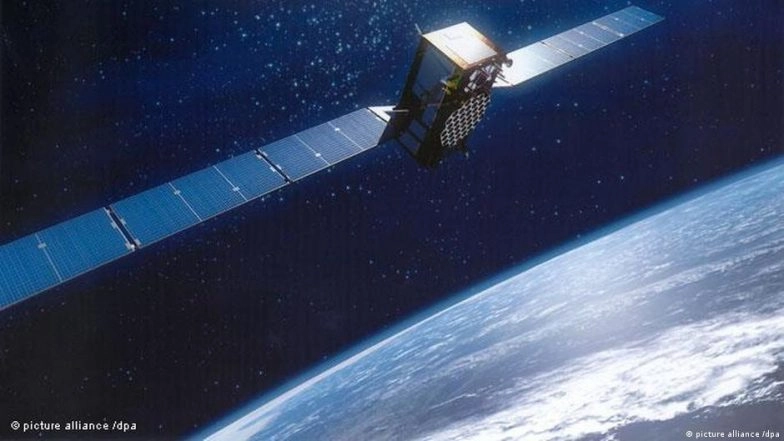
From smartphone maps to precision weapons, satellite navigation underpins modern life and war. Global Navigation Satellite Systems have become indispensable, and that's made them vulnerable to disruption and attack.If you have ever used a smartphone map or watched a delivery vehicle move across a tracking app, you have used GPS.
Also Read | Meteor in US Videos: 7-Ton Asteroid Causes Sonic Boom Across Ohio, Pennsylvania.
What many people do not realize is that GPS — the US's Global Positioning System — is only one part of a broader family known as Global Navigation Satellite Systems (GNSS).
Also Read | UFO Files: Donald Trump's UFO Disclosure May Include Satellite Photos of 'Non-Human' Craft.
Four global satellite systems circle Earth. They guide aircraft, ships, cars and trucks, or tourists looking for a place to eat. But they also play a central role in war.
How do satellites tell you where you are?
At its core, satellite navigation is a matter of time. GNSS satellites carry extremely precise atomic clocks and constantly broadcast two key pieces of information: their exact position in orbit and the exact moment the signal was sent.
Meanwhile, on Earth, receivers — like your smartphone, car or scooter, or an airplane or ship — pick up these signals to determine their exact position.
They do that with signals from four satellites, providing data on latitude, longitude and altitude — plus one to smooth out any timing errors.
GNSS technology is highly accurate and fast. It is deeply embedded in everyday life. But it also comes with a hidden fragility.
"Signals from Global Navigation Satellite Systems are quite vulnerable," Dana Goward, President of the Resilient Navigation and Timing Foundation in the US, told DW.
"They are exceptionally weak — meaning that any radio noise near their frequency, accidental or malicious, can interfere with reception," said Goward. "I am confident that there are people in every government who understand the problem. The challenge is getting leadership to both understand and act to reduce the risk."
Four global navigation powers: US, Russia, Europe, China
The first two global navigation systems were developed in the 1970s, during the Cold War between the US and the then-Soviet Union (Russia).
The US developed GPS, which became the first satellite navigation network to reach full global coverage. It is the most widely used navigation system in the world.
Around the same time, Soviet Russia developed GLONASS.
Then, when in the early 2000s the European Union decided that relying solely on GPS left Europe too dependent on US strategic infrastructure it began building Galileo.
China's BeiDou system is the newest of the four networks. As in Europe, Chinese military planners wanted to reduce their reliance on the US's GPS.
The four systems are very similar, and "dual-use" — designed for civilian and military purposes.
"GPS, GLONASS, and Galileo all use very similar orbits, with a similar number of satellites at around 19,000 to 23,000 kilometers altitude," said Malcolm Macdonald, a professor of satellite engineering at the University of Strathclyde in Glasgow, Scotland. "BeiDou augments [its system with] higher altitude orbits to support local coverage over Asia."
Each system can ping to any point on Earth at any one time, even if it’s as small as your wristwatch.
"Most devices will use multiple constellations [of satellites]. It depends on the device, for example, my own smartwatch can use GPS and GLONASS, and I can tell it to use either, or both."
Japan and India own and operate similar systems, but theirs do not cover the entire planet. They only provide regional navigation data.
How global navigation systems are used in war
Increasingly, armed forces depend on satellite navigation for logistics, mapping, and operational planning.
They are used to guide weapons, including cruise missiles and so-called smart bombs. Militaries also use navigation satellites to control drones.
But this has made satellites a target themselves.
In conflicts, such as the Russia-Ukraine war, both sides have used electronic warfare tactics, like "jamming" and "spoofing". They are used to interfere with satellite navigation signals to disrupt their transmission or deceive GPS-based systems on the ground.
Spoofing is more difficult than jamming, but it offers the opportunity to baffle the other side.
"Your navigation system may be saying that you are moving at 400 knots and leaving Helsinki airport, where in reality, you are in a car travelling at 120 kilometers-an-hour outside Berlin," said Thomas Withington, an electronic warfare analyst at the UK's Royal United Services Institute.
The technique could be used to hide the location of, for example, a Russian shadow fleet that is trying to transit a certain region and remain undetected.
"It has also been used to inject small errors into a ship's location as it transits the Strait of Hormuz, which then causes that ship to enter a country's territorial waters by mistake, allowing that country to board and force it to shore for illegal entry," said Macdonald.
Goward said this was potentially a bigger threat for Europe and the US than Russia and China, because while Russia and China have "domestic, terrestrial systems to complement and backup GNSS, the West does not."
And the "frustrating thing" is that there is no one technology that will effectively neutralize the problem that GNSS disruption causes, said Withington.
There are attempts to develop technological alternatives to GNSS. But for now, said Withington, one of the "most expedient" options in war is "simply hunting down the jammer and destroying it."
Edited by: Zulfikar Abbany
(The above story first appeared on LatestLY on Mar 18, 2026 07:10 PM IST. For more news and updates on politics, world, sports, entertainment and lifestyle, log on to our website latestly.com).