Wolf Moon Dazzles Night Skies Across Southern England, Stuns Skywatchers
The first major celestial event of 2026 took place this weekend as the "Wolf Moon" reached its peak, illuminating the night sky over England. Appearing larger and brighter than a typical full moon, the lunar display arrived as a "supermoon," the fourth in a consecutive string of such events that began in late 2025.

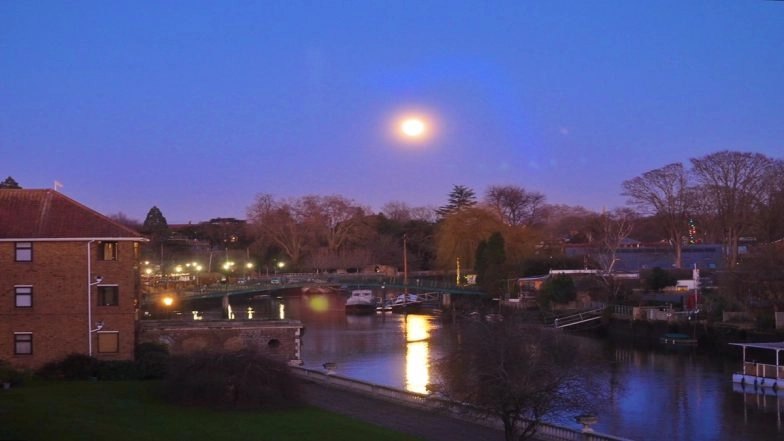
London, January 4: The first major celestial event of 2026 took place this weekend as the "Wolf Moon" reached its peak, illuminating the night sky over England. Appearing larger and brighter than a typical full moon, the lunar display arrived as a "supermoon," the fourth in a consecutive string of such events that began in late 2025.
A Rare "Triple Boost" for Skywatchers
The Wolf Moon officially reached its full phase at 10:03 GMT on Saturday, January 3. While the exact moment of fullness occurred during daylight hours for the UK, the most striking views were reserved for the evening moonrise. Astronomers noted that this year's January moon was particularly brilliant due to a "triple boost" of celestial mechanics. Not only was the moon at perigee—its closest point to Earth in its elliptical orbit—but the event also coincided with Earth reaching perihelion, the point in its own orbit where it is closest to the Sun. This proximity increased the intensity of sunlight reflecting off the lunar surface, making it one of the brightest full moons of the year. Wolf Moon 2026: On Paush Purnima, First ‘Full Moon Supermoon’ To Light Up Sky Today.
The "Moon Illusion" and Viewing Conditions
Across England, residents from Newcastle to Cornwall reported clear conditions for much of Saturday evening. The moon appeared most dramatic as it hovered near the eastern horizon shortly after sunset, around 3:54 PM in London and slightly earlier in northern regions. This "Moon illusion" is a well-known optical phenomenon where the brain perceives the moon as significantly larger when viewed next to terrestrial objects like buildings or trees. Experts from the Royal Observatory Greenwich explained that although the moon is physically about 7% larger during a supermoon, the visual contrast against the skyline provides the most memorable experience for observers.
Cultural Roots and Celestial Neighbors
The name "Wolf Moon" is rooted in traditional folklore, popularized by the Old Farmer’s Almanac. It refers to the midwinter period when hungry wolves were often heard howling outside settlements in North America and Europe. Adding to the spectacle, the bright planet Jupiter was visible just below the moon throughout the night. The gas giant is currently approaching "opposition" on January 10, making it appear exceptionally large and luminous to the naked eye. Wolf Moon 2026: Paush Purnima’s First Full Moon Supermoon Lights Up the Sky Over Puri (Watch Video).
Looking Ahead
For those who missed the weekend display, 2026 promises to be a busy year for amateur astronomers. According to the Royal Museums Greenwich, this year will feature 13 full moons instead of the usual 12, including a rare "Blue Moon" in May. The next supermoons are not expected until November and December of this year. In the immediate future, skywatchers can look forward to the Snow Moon, which will reach its peak on February 1, 2026.
(The above story first appeared on LatestLY on Jan 04, 2026 10:23 PM IST. For more news and updates on politics, world, sports, entertainment and lifestyle, log on to our website latestly.com).