Ancient Graffiti Reveals Scenes of Everyday Life in Pompeii
A growing number of researchers are turning to the Pompeii's graffiti to better understand the lives, humor and concerns of ordinary people nearly 2,000 years ago.

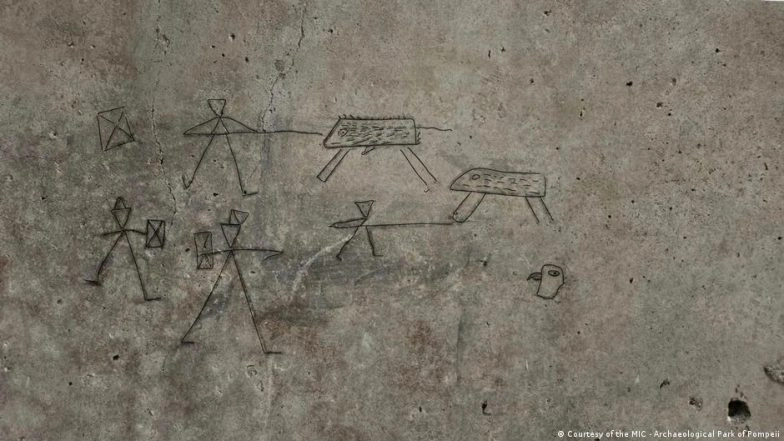
A growing number of researchers are turning to the Pompeii's graffiti to better understand the lives, humor and concerns of ordinary people nearly 2,000 years ago. Spoiler alert: They liked gladiators.If you thought that the "I was here" style graffiti is a modern-day phenomenon confined to the backs of bathroom stalls, think again! New technologies are unearthing graffiti scratched on ancient sites like never before, giving voice to everyday people of the ancient world — from enslaved individuals to bored soldiers who etched their names onto walls.
Also Read | India News | Kerala Polls: Congress Announces List of 55 Candidates, LoP Satheesan to Contest from Paravur.
The ancient graffiti research epicenter, so to speak, is the once-bustling city of Pompeii, which was buried in the eruption of Mount Vesuvius in AD 79. The eruption left buildings exquisitely preserved under meters of ash.
Also Read | Business News | SEBI Proposes Modified Nomination Norms for Demat and Mutual Fund Accounts.
Since excavations started in the 18th century, archeologists have mainly kept busy uncovering colorful paintings, frescos and mosaics in the homes of the city's elites.
But in recent years, a growing number of researchers are focusing on the messages of everyday people — from slaves to merchants. "There has been a surge of studies in ancient graffiti over the last 15, maybe 20 years, and that's very exciting," says historian Rebecca Benefiel, initiator of The Ancient Graffiti Project, a user-friendly platform that digitizes ancient graffiti from the early Roman empire found in Pompeii and the nearby Herculaneum.
"Social media has of course amplified the reach of new discoveries," Benefiel tells DW.
The writing is on the wall
The word "graffiti" can be traced back to the ancient Greek verb "graphein," meaning "to write" or "to draw."
Unlike a pre-planned piece of literature or dedicated inscription, graffiti are spontaneous compositions written by everyday people — much like the graffiti found in urban areas today. And since they're found in situ, they give direct insight into what life was like centuries ago in a given place.
There's a reason for the newfound interest, Benefiel explains: "When graffiti were first being discovered in the 1830s and 1840s, there was an initial excitement about what these little handwritten scratches might tell us."
But then, "an influential Roman archaeologist, August Mau, said 'well, they're really not giving us anything of substance, they're like tourists today who scratch their names on a wall," she explains. "He put a damper on studying the writing of the everyday population for more than a century."
A prayer and an irreverent poem
"I think we really missed out because it is exciting to see what people of all social ranks were writing," adds the historian. And also, where they were writing it: "It was really a paradigm shift to see that graffiti are across the entire city, in every kind of space," Benefiel points out. "It's not something that was just done by a couple of teenagers, as some people might say when they try to understand antiquity through our modern lens."
Some of Benefiel's favorite finds include messages by people who rarely make it into history books.
An enslaved woman named Methe, for example, wrote a prayer to Venus, the deity of Pompeii: "Methe loves Chrestus, may Pompeian Venus be propitious in her heart to each of them and may they both live of one heart," it read. "This was an enslaved person who we normally wouldn't know anything about. But now we have this beautiful prayer," Benefiel points out.
Other writings quote Latin literature, like the beginning of Virgil's "Aeneid." "To my mind those quotations of Latin poetry are kind of equivalent to our music. It's something that's going along in the back of your head, like a soundtrack. You can write it down and someone else knows the next line," explains Benefiel.
One writer seems to have had enough of Virgil, and instead of the work's opening lines: "I sing of arms and a man," they wrote: "I sing of dry cleaners and a hoot owl, not arms of a man."
New technology moves research forward
Meanwhile, new technology is opening up further possibilities for ancient graffiti research, namely the use of Reflectance Transformation Imaging (RTI) which uses special lighting to expose scratches in plaster that the naked eye can no longer see.
Focusing on one particular corridor in Pompeii that once led to a theater, history professor Marie-Adeline Le Guennec at the University of Quebec and Eloise Letellier-Taillefer and Louis Autin of the Sorbonne University in Paris recorded hundreds graffiti samples scratched into plaster. They also documented 80 new inscriptions, which came as a surprise, since the surface was considered to be thoroughly documented — a nod to the power of this new technology.
Some of the graffiti have been left up for over 100 years, researchers noted. "That's a difference with today's modern-day graffiti — the fact that it didn't bother the authorities or it wasn't a concern and they would just leave it up," Marie-Adeline Le Guennec tells DW.
Some themes are more present than others, say the researchers — from boats inscribed into the wall in meticulous detail to "many images of gladiators."
"It's kind of funny because people would just draw gladiators, making it seem that they didn't care about the tragedies or comedies on at the theater nearby," says Le Guennec.
In addition to portraits of people, inscriptions of animals and numbers, the team also found names with writing sourced from thousands of miles away in the eastern Mediterranean. "We think they were soldiers coming from the far East staying for a while in Pompeii and leaving their names on the walls," says Le Guennec — proof that the "I was here" style inscription has been around for centuries.
As technology advances, the world is sure to learn more about the lives of everyday people of the past thanks to these ancient etchings. "Each message is its own unique, distinctive voice and there's something really immediate and really powerful about that. I think we now can really appreciate all the individuals who lived in Pompeii, not just the ruling class," says Benefiel.
Edited by: Elizabeth Grenier
(The above story first appeared on LatestLY on Mar 17, 2026 07:30 PM IST. For more news and updates on politics, world, sports, entertainment and lifestyle, log on to our website latestly.com).