Democrats Embrace DEI as 'American Values' at NYC Gathering
Democratic presidential prospects touted the importance of diversity, equity and inclusion policies as a way to advance American values during the National Action Network conference in New York

NEW YORK (AP) — Ever since President Donald Trump started purging diversity initiatives last year, the letters “DEI” have faded from corporate boardrooms and Democratic stump speeches.
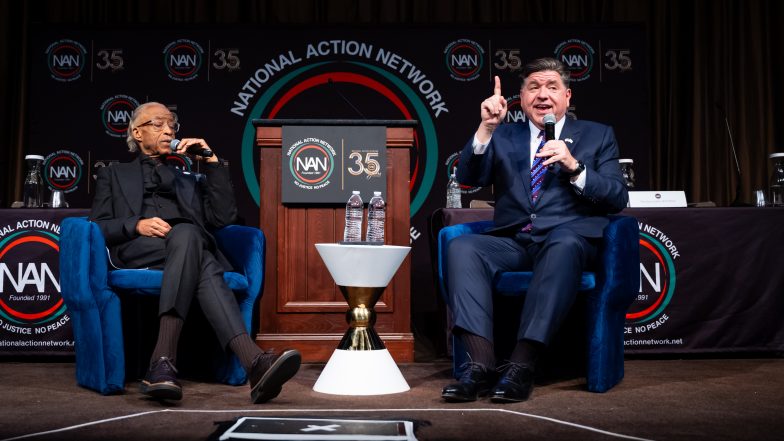
But that wasn't the case for the past few days at the annual National Action Network conference in New York, where Democratic politicians and potential presidential candidates repeatedly made the case for diversity, equity and inclusion policies that seemed to have fallen out of favor.
“We have the high ground on this issue,” House Minority Leader Hakeem Jeffries declared to a packed audience of Black activists. He criticized Republicans as “extremists” who “are trying to do an all-out assault on civil rights, on voting rights, certainly on diversity, equity and inclusion.”
Also Read | What the Iran War Means Around the World.
“They’re not trying to celebrate merit, they’re trying to elevate mediocrity,” Jeffries contended. “They want to suggest that diversity, equity and inclusion are foreign values. They’re not foreign values, they’re American values.”
DEI initiatives became widespread in workplaces, colleges and government agencies after Black Lives Matter protests over the murder of George Floyd in 2020.
But Republican leaders, including Trump, have argued that DEI programs are divisive and discriminate against white people.
Also Read | Brittney Griner to Sign with Connecticut Sun, AP Source Says.
On his first day in office, Trump signed executive orders banning “illegal DEI” throughout the federal government. A March order went further by mandating that any companies that work with the federal government must also comply with the administration’s anti-DEI platform.
“We ended DEI in America,” Trump said in his State of the Union address in February.
Democrats had mixed and at times muted responses to the administration’s anti-DEI crusade over the last year, with some in the party blaming a focus on diversity and identity as a reason why the party alienated many voters across racial and socioeconomic lines.
But some Democrats discussed as potential White House contenders are promoting DEI policies.
The rhetorical shift also reflects the party’s efforts to court and energize Black voters, who often view attacks on DEI as linked to broader opposition to civil rights and economic justice.
Pennsylvania Gov. Josh Shapiro leaned in during his appearance on the first day of the National Action Network.
“We believe diversity is our strength in the Commonwealth,” Shapiro said. “We continue to have an Office of Diversity and Equity and Inclusion when other states have shuttered them.”
Maryland Gov. Wes Moore, the nation's only sitting Black governor, touted that his state had “unapologetically” responded to the rollback of DEI policies in Washington by creating state offices focused on supporting minority businesses and social mobility while combating racial inequality. He offered his state as a model for equitable policymaking.
“We are seeing what the policies and the position are when it comes to belief in diversity from this federal administration,” Moore later told The Associated Press. “I actually think the future of how we should think about it should be seen in the present, of how places like Maryland are actually moving in this moment.”
During his remarks, Illinois Gov. JB Pritzker highlighted that he’d directed his state to “set aside a whole bunch of that money to address inequities that have plagued the Black community over so many years” and defended Illinois’ policies meant to reduce socioeconomic and racial inequality.
Kentucky Gov. Andy Beshear, who will address the conference Saturday, is expected to highlight his commitment to diversity despite political backlash, according to political adviser Eric Hyers.
Beshear, who leads a state Trump last carried by more than 30 points, vetoed what he described as a hateful bill from his Republican-controlled legislature last year that would have banned diversity, equity and inclusion programs from public universities. The legislature overrode the veto days later.
“He never wavered even when there was a post-2024 backlash,” Hyers said of Beshear. “He believes in his core that diversity is a strength, not a weakness.”
Rev. Al Sharpton, who founded and hosts the conference, told The Associated Press he was looking for 2028 contenders to show “that what they’re campaigning on is something that addresses the race gap in the country, specifically, not just generalizations.”
Rep. James Clyburn, a South Carolina Democrat and influential former chair of the Congressional Black Caucus, warned that leaders in either party who do not support DEI may oppose core American values.
“DEI stands for ‘diversity, equity and inclusion.’ Who, in search for a more perfect union, would shy away from diversity equity and inclusion? If you’re against those things, you are against democracy,” he told the AP.
(The above story first appeared on LatestLY on Apr 11, 2026 09:35 AM IST. For more news and updates on politics, world, sports, entertainment and lifestyle, log on to our website latestly.com).