Iconic German Musician Udo Lindenberg Turns 80
From a historic East German concert to a hit with rapper Apache 207, Udo Lindenberg has shaped German rock music like few others.

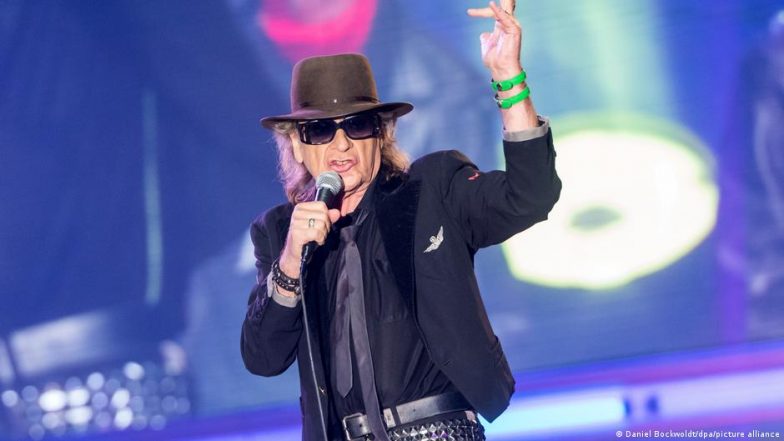
From a historic East German concert to a hit with rapper Apache 207, Udo Lindenberg has shaped German rock music like few others. Even at 80, the "Panikrocker" is still reinventing himself.Udo Lindenberg comes from Gronau, a small town near the Dutch border. His hometown is so proud of its most famous son that it dedicated both a public square and a larger-than-life statue to him. At its unveiling in 2015, Lindenberg himself described the monument as the "Statue of Liberty of Gronau." Years later, the statue collapsed and had to be restored, but this did little to diminish its symbolic value.
Leaving the countryside behind
Also Read | Business News | Nifty, Sensex End Week Under Pressure as Rupee Hits Record Low of 96/USD.
Lindenberg always had a strong urge to leave his rural surroundings behind. He grew up with three siblings in modest conditions; his father drank heavily, and the family home was often described as emotionally distant. As a child, Udo would drum on metal boxes in the backyard, spend time with friends, and imagine a life beyond Gronau.
He later summed up that feeling in the line: "The best road in our town is the one leading out of it." That sense of restlessness — of pushing beyond boundaries, both geographic and political — has shaped much of his career.
He started with music as a jazz drummer, quickly building a reputation and becoming a sought-after studio musician. His drumming also left a mark on German pop culture: the iconic intro to the long-running crime series "Tatort" still carries his signature, a tight, no-frills 30-second piece featuring Lindenberg on drums that has remained largely unchanged since 1970.
In 1971, Lindenberg launched his solo career as a rock musician with his self-titled debut album "Lindenberg." But it was his third album, "Alles klar auf der Andrea Doria" (1973), that turned him into a figure who would permanently change German rock music.
With the Panic Orchestra through the 'Colorful Republic'
With his "Panikorchester" (Panic Orchestra), Lindenberg created a world of his own, hovering somewhere between rock and roll, theater, irony and political messages.
Most significantly, he made German-language rock music internationally visible. While many German artists tried to succeed in English, Lindenberg consistently stuck to German — his slurred voice and rough colloquial style becoming unmistakable. He turned into a key cultural figure of West Germany and its complicated relationship with East Germany.
German-German history
His connection to East Germany made him especially interesting to international audiences. With his satirical protest song aimed at the East German leadership in the early 1980s, "Sonderzug nach Pankow" (Special train to Pankow — a borough in East Berlin), he provoked the communist head of state, Erich Honecker.
Nonetheless, he was allowed to perform in October 1983 at the Palace of the Republic in East Berlin for 4,000 carefully selected audience members loyal to the regime. With this concert, he became a symbol of how pop music could break political barriers — even while being closely monitored by the Stasi, East Germany's secret police.
That concert became part of Europe's Cold War cultural history, and Lindenberg still represents a key chapter of German-German history. For the artist, making music was about freedom, protest and cultural exchange, despite political barriers.
A hit later in life
What is especially remarkable is how successful Lindenberg has remained, well into his golden years.
The musician struggled with alcohol addiction, leading to major setbacks in his career, yet he overcame them, and the last two decades have become some of the strongest phases of his career.
In 2008, he released his comeback album "Stark wie zwei" (As strong as two), which became his first number-one album in the German charts.
His MTV Unplugged project in 2011 helped him reach a younger audience by collaborating with artists from different generations and proving that his music works far beyond his own era.
His big hit came in 2023 with the song "Komet," — a collaboration with German rapper Apache 207. The tune dominated the charts for weeks and became the most successful song of his career — more than five decades after his first successes.
Most recently, several live compilations and the best-of album "Udopium" were released. The 2020 biopic "Mach dein Ding" (Do your thing") was also a major success in cinemas.
Speaking out against war and nationalism
Outside of music, Lindenberg has continued to expand his cultural significance. His "Likörelle" — watercolor paintings created with liqueur — have been exhibited around the world. In Hamburg, the major exhibition "Udoversum" opened in April 2026 and is dedicated to the "Udo Lindenberg phenomenon" — and the fact that he is not only a rock star, but also a painter, a historical figure and larger-than-life persona.
Although the Lindenberg has no plans for a major tour, he remains an active voice against war and nationalism — and someone who helped find an audience for German-language rock around the world.
This article was translated from German.
(The above story first appeared on LatestLY on May 15, 2026 04:30 PM IST. For more news and updates on politics, world, sports, entertainment and lifestyle, log on to our website latestly.com).