












 Quickly
 Socially
 Trending
 Crypto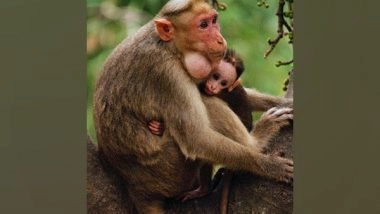
Washington [US], November 30 (ANI): According to new research, female rhesus macaques "actively reduce" their social networks and prioritise friends and family as they age.
Having fewer friends in later life has been seen as harmful, including among humans.
But the new study shows female macaques become increasingly selective, focussing more on relatives and long-standing friendships.
The results show females aren't shunned in later life - the changes are driven by the females themselves.
Also Read | DoorDash Layoffs: Online Food Delivery Platform Sacks 1,250 Employees, Offers 17 Weeks Severance Pay.
The research - by the University of Exeter, Arizona State University, New York University and the University of Pennsylvania - was carried out on Cayo Santiago, also known as Monkey Island, off Puerto Rico.
"This pattern of narrowing social networks with age is common in humans," said Professor Lauren Brent, from Exeter's Centre for Research in Animal Behaviour.
"Our study offers the most conclusive evidence to date that social selectivity is not unique to humans, and therefore might have deeper evolutionary underpinnings."
The study used eight years of data on more than 200 macaques, seeing how the social lives of each individual changed.
By ruling out other explanations such as the death of partners, the researchers found clear evidence of social selectivity by females.
"There are many possible reasons why macaques become more socially selective with age," said Dr Erin Siracusa, also from the University of Exeter.
"For example, the benefits of social interactions might change with time. Young macaques might benefit from a wide social group that can help them explore and find potential mates.
"For older macaques, it might be easier and safer - in terms of everything from conflict to disease transmission - to stick with family and existing friends.
"New relationships also require more mental effort, so while we see no decline in time spent socialising, older macaques might save mental energy by shrinking their network."
Long-term monitoring of the macaques on Cayo Santiago is made possible by the Caribbean Primate Research Center, and this study was funded by the National Institute of Health.
The paper, published in the journal Proceedings of the National Academy of Sciences, is entitled: "Within-individual changes reveal increasing social selectivity with age in rhesus macaques." (ANI)
(The above story is verified and authored by ANI staff, ANI is South Asia's leading multimedia news agency with over 100 bureaus in India, South Asia and across the globe. ANI brings the latest news on Politics and Current Affairs in India & around the World, Sports, Health, Fitness, Entertainment, & News. The views appearing in the above post do not reflect the opinions of LatestLY)
 Share Now
 Google Trends



 Live Bot