
World News | China Offers to Help India Tackle Its Severe Air Pollution Crisis
Get latest articles and stories on World at LatestLY. China faced similar air pollution issues in the past but implemented aggressive measures to reduce pollution, including shifting industries, restricting vehicular emissions, and expanding clean energy use.

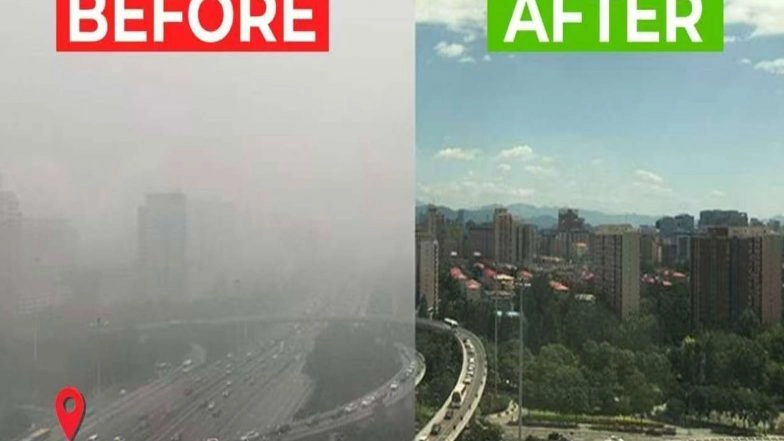
New Delhi [India], November 5 (ANI): China has offered to help India tackle its severe air pollution crisis, particularly in Delhi and surrounding areas.
The Chinese Embassy in India shared on X that China is willing to share its experience in controlling pollution, having successfully reduced smog levels in cities like Beijing and Shanghai.
China faced similar air pollution issues in the past but implemented aggressive measures to reduce pollution, including shifting industries, restricting vehicular emissions, and expanding clean energy use.
Chinese Embassy spokesperson Yu Jing on X stated, "China once struggled with severe smog, too. We stand ready to share our journey toward blue ones -- and believe India will get there soon."
https://x.com/ChinaSpox_India/status/1985633127721750929
Meanwhile, Delhi's air quality saw a marginal improvement on Wednesday morning, with the overall Air Quality Index (AQI) recorded at 228 at 9 am, according to data from the Central Pollution Control Board (CPCB).
For comparison, the national capital had recorded an AQI of 291 at 4 pm on November 4. Despite the slight improvement, the city's air quality remained in the 'poor' category, affecting several parts of the capital.
According to CPCB data, Anand Vihar recorded an AQI of 279, while Lodhi Road, as per the India Meteorological Department (IMD), reported 213. The Air Quality Index at ITO stood at 274, remaining in the poor category. Other prominent areas, including RK Puram (223), Jahangirpuri (235), Chandni Chowk (228), and Sirifort (263), also continued to experience poor air quality.
After the Chinese government declared a war against pollution in 2013, Beijing pressed ahead with a multiyear, USD 100 billion effort to clean its air. The authorities clamped down on factories, forced old vehicles off the road and shifted from coal to natural gas. While more still needs to be done, Beijing officials say the city now has over 100 more days of clear skies each year than when the campaign began, according to The New York Times.
The government also introduced aggressive afforestation and reforestation programs, such as the Great Green Wall, and planted more than 35 billion trees across 12 provinces. With investments in such programmes, China's forestry expenditure per hectare exceeded that of the US and Europe and became three times higher than the global average, as per Earth.org. (ANI)
(The above story is verified and authored by ANI staff, ANI is South Asia's leading multimedia news agency with over 100 bureaus in India, South Asia and across the globe. ANI brings the latest news on Politics and Current Affairs in India & around the World, Sports, Health, Fitness, Entertainment, & News. The views appearing in the above post do not reflect the opinions of LatestLY)