An Answer to America's Drought May Be Hiding in the Toilet
Americans in the US are willing to fork out extra money each month to drink recycled wastewater.

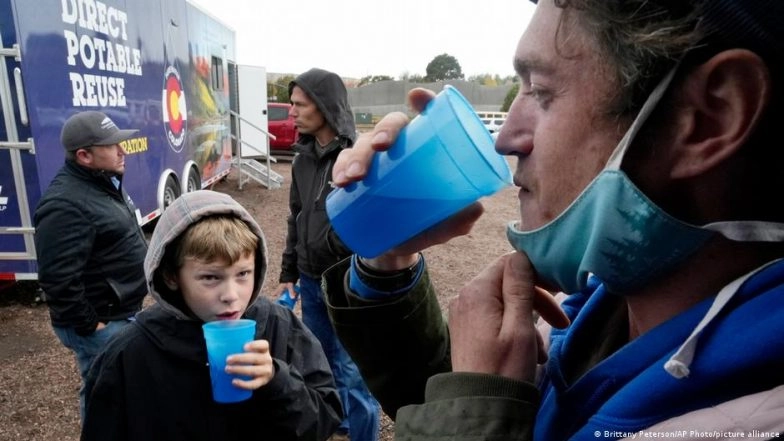
Americans in the US are willing to fork out extra money each month to drink recycled wastewater. With climate change intensifying drought in the country, cities are exploring ways to turn sewage into drinking water.The United States is facing a growing water problem. Around half of the country is experiencing drought conditions right now — and it's only March.
Climate change is making the problem worse, with rising temperatures intensifying drought. When rain does fall, it increasingly comes in intense bursts that can run off hardened, dry ground rather than slowly replenishing soils and aquifers.
Also Read | India News | UP CM Yogi Adityanath Stresses Importance of Forests on International Forest Day in Lucknow.
Scientists warn that the situation could dramatically worsen in the future. The American Southwest and Central Plains regions may face "megadroughts" after 2050 — dry spells potentially longer and more severe than any seen in the past 1,000 years, according to NASA.
When water runs short, authorities typically respond by restricting use, raising prices or searching for new sources. But in some regions, options are in short supply.
"There's a water demand in arid places that has to be met. We cannot just say, 'Well, there's no water for Southern California or for Arizona or for West Texas,'" Bridger Ruyle, an environmental engineer at New York University, told DW.
And as Americans face water restrictions, renewed interest in a source that once fell afoul of the "yuck factor" is growing: the toilet.
A recent survey showed those living in small communities would be willing to pay higher utility bills for a wastewater recycling program if it meant avoiding limits on their water use.
"This can be a sustainable great idea for some communities, because essentially you're really taking the most out of the supply that you're naturally given," Todd Guilfoos, a water economist from the University of Rhode Island who ran the survey, told DW.
How does wastewater recycling work?
America's modern sewage treatment goes back to the turn of the 20th century. That's when countries around the world set up systems to send the water that passes through toilets, showers and sinks to treatment plants.
Technology has advanced since then, though the premise is pretty much the same. Facilities first perform a primary treatment, removing solids from the water. Next comes secondary treatment, usually involving microorganisms that break down organic pollutants.
These stages typically get wastewater only clean enough to discharge safely into the environment. To make it drinkable or usable for farming, it has to go through tertiary treatment. That typically involves some kind of ultrafiltration and disinfection to eliminate pathogens, using ultraviolet light or chemicals like chlorine.
But most of America's wastewater plants aren't equipped for that critical tertiary treatment. Overall, they treat 33 billion gallons of water per day, but only recover about 7% of it for reuse, according to the Environmental Protection Agency. Closing that gap would require massive investment in upgrading existing plants.
"Rather than building another dam or drilling another well or putting another catchment, we are already treating water. This is one of the most economical solutions to save water," said Samuel Sandoval Solis, a water resources expert at the University of California, Davis.
Overcoming the 'yuck factor'
Public opposition has at times kept wastewater reuse programs from taking off. In the 1990s, San Diego attempted to institute a reuse program, but the city had to scuttle it due to fierce political opposition. Residents recoiled at the thought of water that went from "toilet-to-tap," as it was described in newspapers at the time.
But attitudes have changed, as water scarcity issues have become more acute. Today, the city is building a new water reuse facility to provide 30 million gallons a day, or one-third of its water supply, by 2035. Similar programs have emerged across drought-stricken states like California, Arizona, Texas and Florida.
"I don't think 20 years ago anybody thought of recycling wastewater," Metin Duran, a microbiologist at Villanova University in Pennsylvania, told DW. "Water scarcity has been a major shift in paradigm."
For holdouts who still can't stomach the thought of consuming recycled water, scientists have some tough news. Many Americans are already drinking water that once carried waste.
Half of the country's drinking water treatment plants draw from rivers or streams that have upstream wastewater discharges, a phenomenon called de facto reuse.
"Anyone thinking, 'I'm not using recycled water' — most of the people are already doing it one way or another," Solis said. "It's most likely indirect."
The costs of water reuse
If Americans were to get on board, wastewater reuse programs would still be expensive to implement. Communities would likely need to bear some of the cost themselves.
Guilfoos surveyed residents across the country from communities of less than 10,000 people. On average, respondents said they would pay $49 (€42) a month on top of their existing water costs to fund a water reuse program in their community. That amount rose among those with firsthand experience of water shortages or knowledge about water reuse.
Such a monthly utility charge would typically be enough to operate and manage tertiary treatment, Guilfoos said. What it wouldn't cover is investments upgrading the aging US water infrastructure with new pipes, large treatment facilities and lift stations that pump sewage uphill.
The first phase of construction on San Diego's new plant alone will cost $1.5 billion (€1.3 billion), which is where federal and state government funds come in.
Beyond finances, there are environmental tradeoffs. Wastewater recycling can be extremely energy intensive — the more thorough the treatment, the more power it requires. And there are concerns refilling aquifers with recycled wastewater could disturb heavy metals in soils, which can be detrimental to human health and ecosystems, said Ruyle.
We need to be very careful about "addressing one problem and having that not cause a different downstream problem," said Ruyle, "so that it's not just kicking the can down the road for a new problem that we'll find out about in 10 years."
Scientists agree that water reuse is not a silver bullet for water scarcity. But climate change is leaving communities with fewer alternatives.
"I don't think there's any future in which you can just say, 'Oh, no, we don't need this at all,'" said Ruyle.
Edited by: Jennifer Collins
(The above story first appeared on LatestLY on Mar 21, 2026 02:50 PM IST. For more news and updates on politics, world, sports, entertainment and lifestyle, log on to our website latestly.com).