
India News | India Eyes Multi-layered Conventional Missile Force, Boosts AMCA Push: Defence Secretary Rajesh Kumar Singh
Get latest articles and stories on India at LatestLY. Defence Secretary Rajesh Kumar Singh said on Thursday that India is working towards developing a multi-layered conventional missile force spanning short, medium and long ranges, even as the government pushes for diversified fighter aircraft production lines under the Advanced Medium Combat Aircraft (AMCA) programme.

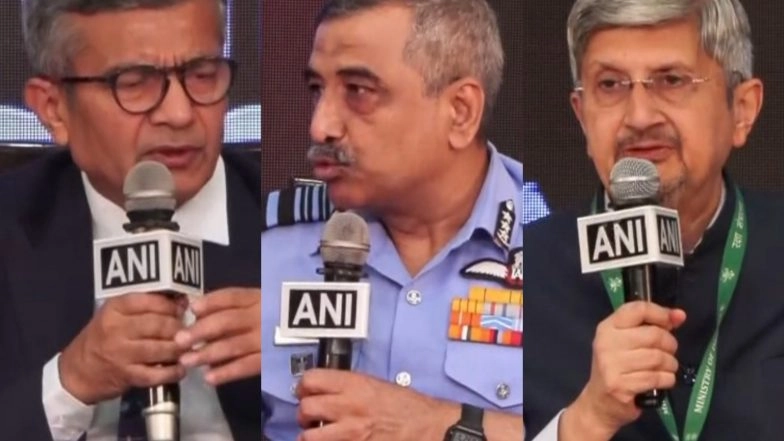
New Delhi [India], April 30 (ANI): Defence Secretary Rajesh Kumar Singh said on Thursday that India is working towards developing a multi-layered conventional missile force spanning short, medium and long ranges, even as the government pushes for diversified fighter aircraft production lines under the Advanced Medium Combat Aircraft (AMCA) programme.
Speaking at the ANI National Security Summit 2.0 in the national capital, Singh stressed that India's defence manufacturing strategy must avoid overdependence on a single production line, highlighting global practices where multiple companies operate parallel fighter aircraft production systems.
"I think most of our major defence producers in the world, the US, the Russians, the Chinese, all have two fighter production lines in two separate companies, sometimes both are public in China, but they do have two. In the current case, I would imagine that putting all your eggs in one basket is not a good idea and you should have at least some levels of limited competition," Singh said.
He asserted that strategic diversification is critical to long-term resilience.
Addressing concerns over Hindustan Aeronautics Limited (HAL) not being part of the AMCA prototype stage, despite its involvement in several major defence programmes, Singh clarified that the opportunity for participation remains open in later stages.
"We would have been perfectly happy if HAL were there in AMCA, but even if they are not, I would imagine this is the prototype stage, so at the production stage, they could still get their chance," he said.
On the broader Rafale and AMCA ecosystem from separate production lines, he added that decisions will evolve over time but emphasised the importance of risk distribution. "Having... separate production lines, hedging your bets across different industry partners rather than being confining yourself to one particular case... supply chain vulnerability also tends to get concentrated," Singh noted.
Last year in May, in a significant push towards enhancing India's indigenous defence capabilities and fostering a robust domestic aerospace industrial ecosystem, Defence Minister Rajnath Singh approved the Advanced Medium Combat Aircraft (AMCA) Programme Execution Model. The Aeronautical Development Agency (ADA) is set to execute the programme through an industry partnership.
Meanwhile, elaborating on India's evolving conventional missile doctrine, Chairman of the Defence Research and Development Organisation (DRDO) Samir V Kamat also said the structure of the proposed missile force is still under consideration but would likely be multi-dimensional.
"So with respect to the conventional missile force, as the defence secretary mentioned, the structure has not yet been formed, but what I consider would be required in a conventional missile force would be ballistic missiles for short ranges, medium ranges, and ranges maybe up to 2000 kilometers," Kamat said.
He explained that such a force would require layered capabilities for different tactical scenarios. "So you would need ballistic missiles of these three types and you would also need cruise missiles, you would need hypersonic missiles... it would consist of a variety of missiles which give you the capability of striking at different ranges for tactical application," he added.
On current preparedness, Kamat highlighted progress in short-range systems. "For short-range ballistic missiles, the Pralaye which is now in the final stages of testing, that should be ready," he said.
He also noted that existing strategic missile platforms could be adapted for tactical roles. "Then we have some of our strategic missiles which can be converted to tactical usage for the medium range and the higher ranges," he added.
Providing insights into cutting-edge missile development, Kamat said India is pursuing both hypersonic glide and hypersonic cruise missile programmes, with the glide system currently ahead. "With respect to the hypersonic, we are working on two programs, the Hypersonic Glide Missile and the Hypersonic Cruise Missile," he said.
"The hypersonic cruise missile... has a scramjet engine and it is powered during its flight. The hypersonic glide missile...uses a booster to give it initial velocity and then it just glides without any powering," Kamat explained. He indicated that the glide missile programme is nearing initial testing. "The glide missile will come out first... we should be doing the first trials fairly soon and that is at a more advanced stage than the cruise missile," he said.
On the cruise missile programme, he said formal approval is awaited, but technological groundwork is progressing. "The cruise missile... program has not yet been sanctioned, although we are working on the various technologies which will get into the cruise missile," he noted.
Highlighting a major technological milestone, Kamat said, "Recently, we have done a scramjet propulsion for more than 1000 seconds. So that's been a major achievement and once the program is sanctioned, we'll convert the scramjet propulsion into a working missile system."
He added that operationalisation would take time. "I think that should take about five years after the sanction," he said.
Meanwhile, Chief of Integrated Defence Staff Air Marshal Ashutosh Dixit pointed to increasing coordination among adversaries, particularly in terms of equipment supply and intelligence sharing.
"Without being too open about this answer... yes, we are aware what is happening amongst various adversaries and how they are shaking hands with each other," Dixit said.
"If you just look at their equipment profile, you will come to know the answer. 80 per cent of the equipment owned by the Western adversary is supplied by the Northern adversary," he noted.
He further flagged the emergence of additional actors in this alignment. "Similarly, now one more Turkey is also now joined. So there is a separate axis. So, along with equipment, a lot of support information also comes," Dixit said.
He emphasised the need for preparedness, adding that India must take necessary measures to ensure such developments do not adversely impact its security.
The 'ANI National Security Summit 2.0' was inaugurated by Defence Minister Rajnath Singh.
The Defence Minister affirmed that India voluntarily put a halt to Operation Sindoor on its own terms and was ready for a long war against Pakistan.
Singh called Pakistan the epicentre of International Terrorism and called for uprooting the ideological and political roots of terrorism. Hailing Prime Minister Narendra Modi's leadership, the Defence Minister lauded the "zero tolerance policy." He also noted that India did not fall for the "bluff" of a nuclear attack. (ANI)
(The above story is verified and authored by ANI staff, ANI is South Asia's leading multimedia news agency with over 100 bureaus in India, South Asia and across the globe. ANI brings the latest news on Politics and Current Affairs in India & around the World, Sports, Health, Fitness, Entertainment, & News. The views appearing in the above post do not reflect the opinions of LatestLY)