Dilapidated Wall, Platform Cannot Be Conferred as Religious Place for Offering Prayers or Namaaz, Says Supreme Court
Jindal Saw Limited said that said dilapidated structure is a stumbling block in the mining process which has been awarded to the company in terms of the Lease dated in December 2010 by the Government of Rajasthan for an area measuring 1,556.78 hectares at Bhilwara.

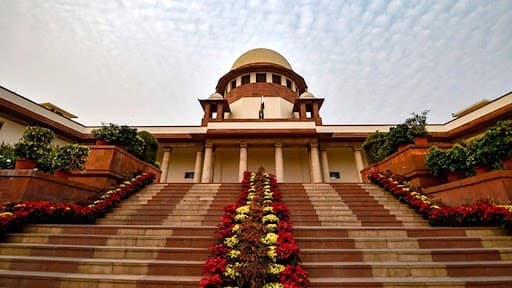
New Delhi, April 30: The Supreme Court has remarked that "in the absence of any proof of dedication or user, a dilapidated wall or a platform cannot be conferred a status of a religious place for the purpose of offering prayers or Namaaz.
"The report of the experts is relevant only to the extent that the structure has no archaeological or historical importance. In the absence of any proof of dedication or user, a dilapidated wall or a platform cannot be conferred a status of a religious place for the purpose of offering prayers/Namaaz," a bench of justices Hemant Gupta and V Ramasubramanian observed.
The apex court remark came while dismissing appeals filed by the Rajasthan Waqf Board challenging an order of the High Court of Rajasthan at Jodhpur. "We do not find any merit in the present appeals. Consequently, the appeals are dismissed," the court said.
Rajasthan High Court had allowed Jindal Saw Limited's plea to direct the appellant Waqf Board and others not to interfere with the action of the writ petitioner in the removal of the structure at village Pur, Bhilwara, Rajasthan.
Jindal Saw Limited had urged Rajasthan High Court to issue direction to the Waqf Board not to interfere with the act of removal of the structure, i.e., dilapidated platform/chabutarh at Tiranga Hills in village Pur, Bhilwara, Rajasthan for mining purpose. Uttar Pradesh: Nearly 46,000 Unauthorised Loudspeakers Removed from Religious Places in State, Says ADG.
Jindal Saw Limited said that said dilapidated structure is a stumbling block in the mining process which has been awarded to the company in terms of the Lease dated in December 2010 by the Government of Rajasthan for an area measuring 1,556.78 hectares at Bhilwara.
The company had submitted that the said dilapidated structure is not a religious structure.The top court observed that the stand of the State Government that they have identified it to be a religious structure comprising in Khasra has not been produced on record.
"There is nothing on record that such decision if any, was arrived at after associating the writ petitioner. It is always open to the State as lessor to exercise the powers conferred in it by the lease deed after complying with the principles of natural justice and on good and sufficient grounds," the top court said.
(The above story is verified and authored by ANI staff, ANI is South Asia's leading multimedia news agency with over 100 bureaus in India, South Asia and across the globe. ANI brings the latest news on Politics and Current Affairs in India & around the World, Sports, Health, Fitness, Entertainment, & News. The views appearing in the above post do not reflect the opinions of LatestLY)