Cyclone Narelle Viral Video: Skies Turn Blood Red in Western Australia As Storm Approaches Coast
Residents in Western Australia witnessed dramatic red skies as Tropical Cyclone Narelle approached the coast near Denham. The phenomenon was caused by dust, moisture, and dense cloud cover altering sunlight. The cyclone, which travelled over 5,500 km across Australia, has since weakened to a subtropical system after an unusual multi-state path.

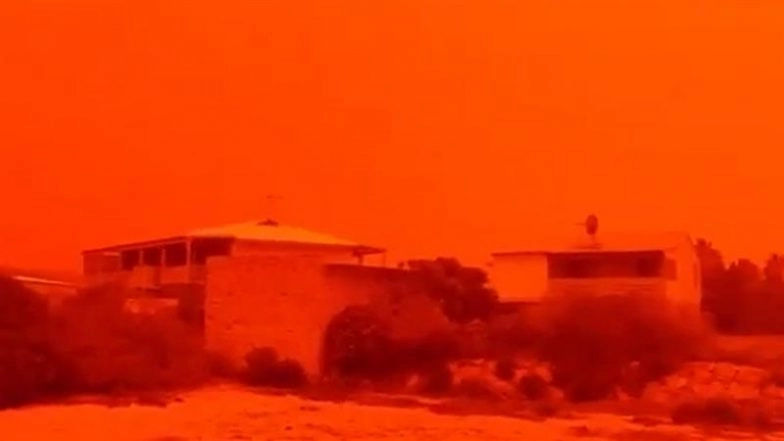
Sydney, March 28: Residents in parts of Western Australia witnessed striking blood-red skies as Tropical Cyclone Narelle approached the coast, creating what locals described as an “incredibly eerie” atmosphere. The unusual visual phenomenon was reported at an RV park in Denham as the storm system moved closer before later weakening into a subtropical system on Saturday.
The dramatic sky colouration occurred as the cyclone carried dust, moisture, and dense cloud cover across the region, altering the way sunlight filtered through the atmosphere. While visually unusual, such phenomena are occasionally associated with severe weather systems. Cyclone Narelle Update: Massive Power Outages Reported As Category 4 Storm Makes Landfall in Far North Queensland.
Cyclone Narelle Turns Skies Blood Red in Western Australia
Skies turned blood red across Western Australia as Tropical Cyclone Narelle approached, creating this "incredibly eerie" sight for residents at an RV park in Denham. Narelle was later downgraded to a subtropical storm on Saturday. pic.twitter.com/VjTCoghUqR
— CBS News (@CBSNews) March 28, 2026
Apocalyptic red skies over Shark Bay, Western Australia, as Tropical Cyclone Narelle approaches.
A massive dust storm has turned daylight into a deep red haze, with outback dust whipped up by the cyclone’s powerful winds.
Raw footage from a local resident - no edits.
Video… pic.twitter.com/8012WF8Eyq
— Eric Unfiltered™ (@erictrumpfan1) March 27, 2026
Cyclone Narelle Live Map on Windy
A Rare and Far-Reaching Cyclone
Cyclone Narelle has drawn attention not only for its visual impact but also for its unusual path across Australia. The system first formed in far north Queensland as a high-end Category 4 cyclone, before weakening to Category 3 as it moved through the Northern Territory and eventually tracking west toward the Indian Ocean.
By the time it approached Western Australia, the cyclone had travelled more than 5,500 kilometres, making it one of the few systems in recent decades to cross multiple states and territories. Comparable events include Cyclone Ingrid in 2005 and Cyclone Steve in 2000. Cyclone Narelle Update: Australia on Alert as Category 4 System Approaches Queensland, Mass Evacuations and Warnings Issued.
Why the Skies Turned Red in Australia
Meteorologists say the red skies were likely caused by a combination of thick cloud bands, airborne particles, and the angle of sunlight. As the cyclone approached, it carried dust and moisture into the atmosphere, scattering shorter wavelengths of light and allowing red hues to dominate the sky.
Such conditions are often observed during intense weather systems, bushfires, or dust storms, though they remain relatively uncommon and can appear particularly striking when associated with large-scale cyclones.
Experts note that Narelle’s east-to-west trajectory is atypical. Most cyclones in Western Australia form off the Kimberley coast and move in a south-easterly direction.
Researchers say Narelle’s path was influenced by upper-level wind patterns in the troposphere, which steered the system across the continent. This type of looping or cross-country movement is rare and depends heavily on shifting atmospheric conditions.
(The above story first appeared on LatestLY on Mar 28, 2026 11:01 PM IST. For more news and updates on politics, world, sports, entertainment and lifestyle, log on to our website latestly.com).