'Some Rioters Are Trying to Please Donald Trump by Attacking Public Property': Iran’s Supreme Leader Ayatollah Ali Khamenei Warns Protesters in National Address
Russia urged the United States to comply with international maritime law after U.S. authorities seized the Russian-flagged oil tanker Marinera in the North Atlantic. Moscow termed the action a gross violation of freedom of navigation, saying Washington was repeatedly informed that the vessel was civilian and lawfully registered under the Russian flag.

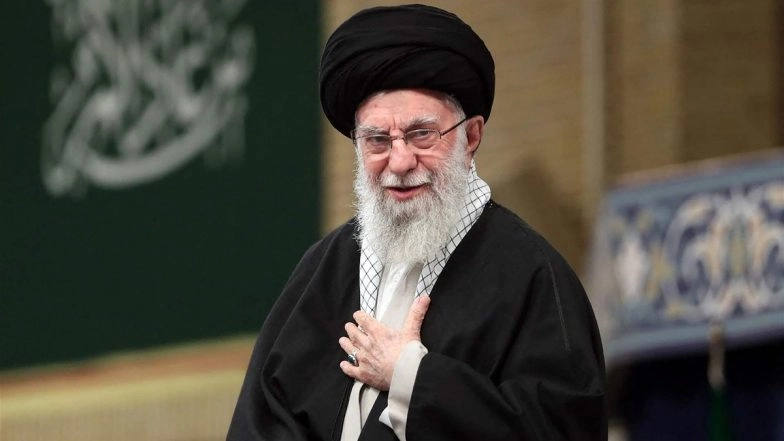
Tehran, January 9: Iran’s Supreme Leader Ayatollah Ali Khamenei on Friday broke his silence regarding the escalating nationwide protests, accusing "terrorist agents" of the United States and Israel of orchestrating the violence. In a televised address following twelve days of intense demonstrations, the 86-year-old leader characterized the movement as a foreign-backed plot to destabilize the Islamic Republic, asserting that protesters were "ruining their own streets to make the president of another country happy."
A Widening Crisis
The protests, which began in late December 2025 over the country's ailing economy and record-high inflation, have rapidly morphed into a broader uprising against the clerical establishment. Human rights organizations report that at least 45 people have been killed and over 2,200 detained since the unrest began. The situation intensified Thursday night as a nationwide internet blackout was imposed, coinciding with a call for mass demonstrations by the exiled Crown Prince Reza Pahlavi. Despite the communications cutoff, reports emerged of significant clashes in Tehran and several provinces, with security forces reportedly using lethal force to disperse crowds. Iran Shuts Internet and Phone Services as Nationwide Protests Escalate.
Khamenei Calls for Unity
During his Friday speech, Khamenei acknowledged that some economic grievances held by citizens were "just," but he drew a firm line between peaceful protesters and "rioters." He urged the nation to maintain unity in the face of what he described as a "soft war" being waged by Western powers. "The authorities must have dialogue with protesters, but it is useless to have dialogue with rioters," Khamenei said. "Those must be put in their place." State media echoed this rhetoric, claiming that "armed rioters" had attacked police stations and public infrastructure. Analysts suggest this language effectively signals a green light for security forces—including the Islamic Revolutionary Guard Corps (IRGC)—to intensify their crackdown.
International Reaction: Trump Issues Stern Warning
The international dimension of the crisis has been heightened by sharp rhetoric from Washington. U.S. President Donald Trump has repeatedly signaled support for the demonstrators, describing them as "brave people" and warning the Iranian regime against a violent suppression of the movement. "I have let them know that if they start killing people... we're going to hit them very hard," Trump said in a recent interview. He added that the Iranian government would "pay hell" if the crackdown continued, though he notably declined to officially meet with or endorse the exiled Crown Prince at this stage, stating it would be "inappropriate" to do so while the situation is still evolving. MEA Advises Indians Citizens To Avoid Non-Essential Travel to Iran Until Further Notice.
Context of the Unrest
This wave of protests is being viewed as the most significant challenge to the Iranian government since the 2022 demonstrations following the death of Mahsa Amini. The current movement is driven by a combination of severe economic hardship—with the Iranian rial reaching record lows—and long-standing demands for political reform. As the internet remains largely inaccessible within Iran, the full scale of the casualties and the extent of the government's response remain difficult to verify independently.
(The above story first appeared on LatestLY on Jan 09, 2026 03:26 PM IST. For more news and updates on politics, world, sports, entertainment and lifestyle, log on to our website latestly.com).