As Super 'El Nino' Looms, Wildfires Are Set to Heat Up
More than 150 million hectares — over twice the size of Texas — burned globally in the first months of 2026.

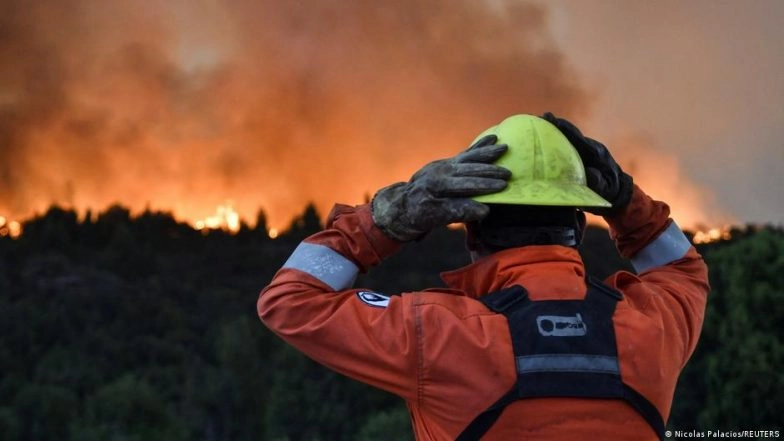
More than 150 million hectares — over twice the size of Texas — burned globally in the first months of 2026. With a high chance of a supercharged El Nino, the second half of the year could be even worse.The world could see a "particularly severe year" of wildfires fueled by climate change and a potentially strong El Nino weather phenomenon after a record-breaking first few months of 2026, researchers warned Tuesday.
Also Read | Neil DeGrasse Tyson Dreams of Alien Abduction in New Book.
"This year the global fire season has got off to a very fast start," said Theodore Keeping, an extreme weather researcher at Imperial College London, who is part of World Weather Attribution (WWA), a network of climate scientists.
Also Read | Cannes Film Festival: The Most Anticipated Movies of the 2026 Edition.
Wildfires have scorched 50% more than the average for this time of year, and the current area burnt by wildfires globally is over 20% higher than the previous record set since tracking began in 2012, he said.
Record-breaking burn areas have been observed in almost all countries in West Africa and the Sahel region.
"Overall, 85 million hectares [around 328,000 square miles] have burned in Africa this year, compared to the previous record of 69 million hectares," Keeping said.
Heavy rain provides more fuel for wildfires later on
During the last growing season, these areas received unusually high seasonal rainfall, fueling grass growth that then served as kindling for fires.
"In addition, the severe droughts and heat waves we've seen over the last few months have meant that fires are more likely to occur in lusher, generally less fire-prone areas," Keeping added.
This swing from wet to dry, called "hydroclimate whiplash," is increasing in West Africa, he said.
The other major contributor to the global fire season has been Asia, with massive wildfire outbreaks in India, Southeast Asia and northeastern China. Asian wildfires have so far burned nearly 40% more than the previous record year.
The US and Australia have also experienced unseasonably high burnt areas so far in 2026.
Scientists predict a 'super' El Nino for 2026
This all comes before a potential "super" El Nino that's expected to hit later this year. The El Nino weather phenomenon is the warm phase of a natural climate pattern in the Pacific Ocean and trade winds that affects global weather.
Forecasts say that there is a 61% chance that El Nino will emerge during the May-July period and stay at least until the end of the year, if not longer.
"The likelihood of harmful extreme fires potentially could be the highest we've seen in recent history if a strong El Nino does develop," Keeping said.
That is truly alarming, particularly from a health perspective, says Jemilah Mahmood, a medical doctor and Executive Director of the Sunway Center for Planetary Health at Sunway University in Malaysia.
"Wildfire smoke is not ordinary pollution," she said, adding that the fine particulate matter (PM2.5) from fire smoke could be 10 times more harmful to health than that from traffic emissions.
A 2024 study by British medical journal The Lancet found 1.5 million deaths every year were linked to air pollution. The study said the number of deaths was expected to increase in the coming years as climate change leads to more frequent and intense wildfires.
The global climate is more out of balance than at any time in observed history. Greenhouse gas concentrations, released largely by burning oil, coal and gas, are driving warming of the atmosphere and ocean and melting of ice, the World Meteorological Organization warned in March.
"Climate change is not going away unless we do something about it," Mahmood said.
El Nino meets hotter climate baseline
"While El Nino could lead to very extreme conditions later this year, it's not the reason to freak out," said WWA co-founder Friederike Otto, a climate science professor at Imperial College London.
El Nino comes and goes as part of a natural cycle, she added, but it was now happening on an increasingly warmer baseline in a dramatically changing climate.
Water temperatures in the central equatorial Pacific Ocean are forecast to reach or exceed 3 degrees Celsius (5.4 degrees Fahrenheit) above average in the second half of this year, she added.
"That is El Nino sitting on top of decades of accumulated warming. And the compounding is the point," Mahmood said.
The last 2023-2024 El Nino peaked as one of the five strongest on record. El Nino acted as a turbocharger on top of human-induced climate change, making 2024 the hottest year on record and, leading to heat waves and other devastating weather extremes.
In the more than 100 extreme weather events WWA scientists have studied so far, Otto said that human-induced climate change had a much greater influence on the likelihood and intensity of extreme weather events.
She points to cases such as the extreme wildfires across Europe last year or extreme rainfall events across the world or the ongoing extreme droughts in Syria and Iran where El Nino didn't play a role at all.
But planetary heating will get "worse as long as we do not stop burning fossil fuels," said Otto.
Unprecedented heat waves despite cooling La Nina?
Australia also saw record-breaking unprecedented heat even though El Nino's counterpart La Nina was still in full swing, which in theory would have had a small cooling effect on Australian summers.
"Human-induced climate change overtook the signal," WWA's Otto said.
This comes as governments have quietly stepped back from climate commitments, warns Mahmood, with some behaving "as though the climate crisis was a chapter."
"Climate change is the reason to freak out," said Otto, ideally, she added in a constructive way, by acting faster to bring down global emissions and adapt to warming that has already happened.
"And we do know what to do about it. We have the knowledge and technology to go very, very far away from using fossil fuels, " said Otto, referring to renewable energy and storage technologies.
Edited by: Jennifer Collins
(The above story first appeared on LatestLY on May 12, 2026 10:30 PM IST. For more news and updates on politics, world, sports, entertainment and lifestyle, log on to our website latestly.com).