










 Quickly
 Socially
 Trending
 Crypto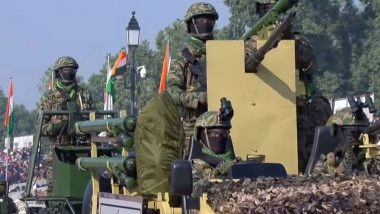
New Delhi [India], January 26 (ANI): India's mechanised and special forces capabilities were on full display on Monday as India celebrated its 77th Republic Day, highlighting the country's advanced defence technology, battlefield readiness, and commitment to self-reliance.
Leading the mechanised column, the T-90 Bhishma, under the command of Captain Vipanjot Singh Virk of the 77 Armoured Regiment, showcased its formidable firepower and mobility. Built on the Hunter-Killer concept, the tank is equipped with a 125-mm smoothbore gun, machine guns, and laser-guided missiles capable of striking targets up to five kilometres away.
The T-90 Bhishma, recently upgraded with enhanced firepower, mobility, and drone-enabled surveillance, has proven its effectiveness in high-altitude conditions and during Operation SINDOOR. Raised on June 1, 1972, the 77 Armoured Regiment operates under the motto, 'Vijay Ya Veergati.'
The indigenously developed Arjun Mk I Main Battle Tank, led by Maj Hitesh Mehta of the 75 Armoured Regiment, was also on display. Armed with a 120-mm rifled gun, advanced fire-control and sighting systems, and protected by Kanchan armour and Nuclear, Biological, Chemical (NBC) protection, the Arjun reflects India's focus on self-reliance and battlefield readiness.
Mechanised infantry strength was represented by the BMP-II Infantry Combat Vehicle, led by Captain Akshay Kumar Bali of 2 GUARDS. Equipped with a 30-mm automatic cannon, 7.62-mm PKT machine gun, Konkurs anti-tank guided missile, and upgraded Thermal Imaging Sight Kits, the BMP-II can engage targets up to four kilometres at night and operates efficiently across deserts, plains, and high-altitude regions.
The vehicle also carried Asteria AT-15, an indigenously developed Vertical Take-off and Landing ISR drone, Canister-Launched Anti-Armour Loitering Munition (CALM), and TASS for real-time battlefield awareness. The regiment operates under the motto, 'Pehla Hamesha Pehla.'
India's elite Special Forces advanced on Kartavya Path, capable of executing missions deep inside enemy territory. These teams are armed to the teeth and trained to fight in isolation. They can infiltrate by parachute drop, heliborne insertion, vehicles, or on foot, gather critical intelligence, and execute precision strikes with anti-tank, anti-personnel, and anti-air missiles.
The mechanised and strike elements were supported by advanced vehicles and unmanned systems. The AJAYKETU All Terrain Vehicle, led by Lt Col Ram Vinodh S, PARA (SF), carried indigenous loitering munitions, NAGASTRA and BHOJANK (JOHNETTE), enhancing precision-strike capabilities beyond line of sight.
The RANDHWAJ Tactical Transport System, designed for rugged terrain, deployed snipers and Special Operations soldiers with TRINETRA surveillance drones and TEER FPV strike drones.
The Dhwansak Light Strike Vehicles demonstrated a combination of firepower, surveillance, and anti-tank capabilities, including Heavy Machine Guns, IGLA Air Defence launchers, SPIKE launchers, Vehicle Mounted Infantry Mortar System (VMIMS), and advanced drones such as Q6, Tunga, and micro-canister-launched UAVs.
Robotic and unmanned systems, including UGVs and robotic dogs equipped with Tavor assault rifles and Negev LMGs, provided remote engagement, casualty evacuation, logistics support, and advanced surveillance. Notable platforms such as Nigraha, Bhairav, Bhuviraksha, and Krishna highlight India's strides in autonomous and remote-controlled battlefield technology.
Prime Minister Narendra Modi laid a wreath at the National War Memorial at the historical India Gate. Present alongside the PM were the Defence Minister Rajnath Singh, the Chief of Defence Services General Anil Chauhan, the Chief of Army Staff General Upendra Dwivedi, the Chief of Air Staff Air Chief Marshal APS Singh and the Chief of Naval Staff Admiral Dinesh Tripathi.
As the iconic Day parade began in the national capital, the spectators were treated to an aerial formation, the 'Dhwaj Formation'. Approaching in a striking inverted 'Y' formation, four Mi-17 1V helicopters of the 129 Helicopter Unit soared gracefully overhead, proudly carrying the National Ensign, along with the Service Ensigns of the Indian Army, Indian Navy and the Indian Air Force.
President Droupadi Murmu presided over the grand celebrations on Kartavya Path in New Delhi.
The President of the European Council, Antonio Costa, and the President of the European Commission, Ursula von der Leyen, attended as the Chief Guests on this momentous occasion.
This year, Kartavya Path, stretching from Rashtrapati Bhawan to the National War Memorial, has been elaborately decorated to showcase India's remarkable journey.
The celebrations featured an extraordinary blend of the 150-year legacy of the national song Vande Mataram, the country's unprecedented developmental progress, robust military strength, vibrant cultural diversity, and active participation from citizens across all walks of life.
For the first time, the parade showcased a phased Battle Array Format of the Indian Army, including the aerial component. The Recce element would consist of the 61 Cavalry in active combat uniform. It was followed by the High Mobility Reconnaissance Vehicle, India's first indigenously designed Armoured Light Specialist Vehicle. (ANI)
(The above story is verified and authored by ANI staff, ANI is South Asia's leading multimedia news agency with over 100 bureaus in India, South Asia and across the globe. ANI brings the latest news on Politics and Current Affairs in India & around the World, Sports, Health, Fitness, Entertainment, & News. The views appearing in the above post do not reflect the opinions of LatestLY)
 Share Now
 Google Trends



 Live Bot