












 Quickly
 Socially
 Trending
 Crypto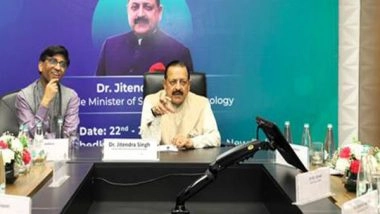
New Delhi [India], May 23 (ANI): In a clarion call for deepening Centre-State collaboration in Science, Technology and Innovation (STI), Union Minister Jitendra Singh emphasised the need for States and Union Territories to become engines of innovation in India's journey towards a developed nation by 2047, said an official release.
Speaking at the valedictory session of the Annual Review Meeting of State Science and Technology (S&T) Councils, the Minister defined technology as an engine of transformation and asserted that "a developed India cannot exist without developed States and Union Territories.
Addressing over 30 State and UT S&T Councils, Jitendra Singh underscored the pivotal role of STI in realising the Viksit Bharat vision.
This mission aligns with Prime Minister Narendra Modi's call for a self-reliant and globally competitive India by its centenary of independence. "Science, Technology and Innovation is not just a sector--it is the engine powering our transformation," he said.
He pointed out that the Department of Science and Technology (DST) has supported this transformation through the State Science and Technology Programme (SSTP), providing budgetary and technical backing to State S&T Councils.
These councils function as nodal institutions, catalysing regional STI ecosystems that align local needs with national priorities. The Minister highlighted the 23 Patent Information Centres network as vital for strengthening Intellectual Property Rights (IPR) awareness and facilitation across the States.
Jitendra Singh also emphasised the importance of increasing awareness and effectively utilising various Science and Technology schemes offered by the Centre.
He urged State S&T Councils to proactively disseminate information about these programmes at the grassroots level, ensuring that stakeholders, particularly in rural and remote areas, are informed and empowered to benefit from them.
"Awareness is the first step towards impact," he said, adding that visibility and outreach must become integral to the Councils' strategy for inclusive innovation.
The Minister also encouraged State S&T Councils to actively study and emulate successful models from their counterparts across the country.
Highlighting the value of peer learning, he noted that best practices from high-performing states could serve as replicable templates, enabling others to scale up their impact efficiently.
"Cross-learning is key to accelerating progress," he said, stressing the need for regular exchange of ideas and experiences to strengthen the national STI ecosystem collectively.
The two-day meeting drew enthusiastic participation from Councils across the country and focused on strengthening the STI ecosystem through peer learning, strategic planning, and showcasing success stories.
A special session brought together Secretaries and Principal Secretaries from 13 States/UTs to share innovative state-level interventions, propose science-based solutions, and outline future strategies.
The exchange, Jitendra Singh said, reinforced the importance of collaborative federalism in achieving equitable development.
The meeting also considered proposals from Jammu and Kashmir for further assistance to its S&T Council and plans to establish new Patent Information Centres in Jharkhand, Andhra Pradesh, Bihar, Meghalaya, and Madhya Pradesh. Jitendra Singh noted that these initiatives will help create a more robust and inclusive IPR framework across the country.
Looking ahead, the Minister called for State S&T Councils to reposition themselves as "visionary enablers of change," not just administrative bodies.
He urged them to actively promote and brand their impactful programmes, replicate successful models across regions, and foster cross-sectoral collaboration with academia, industry, policymakers and civil society.
"The Councils must take decisive steps to ensure Science and Technology becomes a cornerstone of governance and development," he said.
Jitendra Singh concluded on an optimistic note, expressing confidence that through strategic alignment and policy coherence, India can build an inclusive and innovation-driven future.
"The journey towards Viksit Bharat@2047 is ambitious but achievable--through Centre-State cooperation, we can unlock the full potential of this Amrit Kaal."
DST Secretary Prof Abhay Karandikar, members of the Expert Committee on SSTP, including Prof Satish B. Agnihotri and PK Agrawal, and key DST officials attended the meeting, marking a united push towards science-led regional development. (ANI)
(The above story is verified and authored by ANI staff, ANI is South Asia's leading multimedia news agency with over 100 bureaus in India, South Asia and across the globe. ANI brings the latest news on Politics and Current Affairs in India & around the World, Sports, Health, Fitness, Entertainment, & News. The views appearing in the above post do not reflect the opinions of LatestLY)
 Share Now
 Google Trends



 Live Bot