
World News | China's Frenzied Naval Shipbuilding Continues Apace
Get latest articles and stories on World at LatestLY. As countries like the USA struggle to design and build warships and submarines in desired quantities, or lack the budget to do so, China has no such problems. Last year was another prolific year for Chinese shipbuilders as they meet demand from the People's Liberation Army Navy (PLAN).

Hong Kong, January 20 (ANI): As countries like the USA struggle to design and build warships and submarines in desired quantities, or lack the budget to do so, China has no such problems. Last year was another prolific year for Chinese shipbuilders as they meet demand from the People's Liberation Army Navy (PLAN).
It is estimated that the PLAN commissioned at least 18 naval vessels last year. The reason that numbers cannot be totally precise is that the navy maintains some secrecy, especially when it comes to submarine production.
There is no such difficulty recognising when the PLAN's largest ever ship, however, the aircraft carrier Fujian, entered service. This conventionally powered aircraft carrier is the first Chinese one to feature an electromagnetic aircraft launch system, instead of the ski jump ramp that exists on China's first two carriers.
Fujian was commissioned with much fanfare, with Chairman Xi Jinping in attendance, at Sanya Naval Base on Hainan Island on 5 November 2025. This carrier, almost rivaling its American supercarrier counterparts, measures more than 300m long and displaces an estimated 80,000 tonnes.
Prior to officially entering naval service, Fujian had hosted a series of take-offs and landings by three new aircraft types. These included the Shenyang J-35 fifth-generation carrier-borne fighter, the Shenyang J-15T fighter equipped for catapult launches, and the Xian KJ-600. The latter is a twin-turboprop airborne early warning aircraft that acts as the eyes and ears of a carrier strike group. The PLAN's two earlier carriers - Liaoning and Shandong - could not carry the KJ-600, since it requires catapult assistance to get off the flight deck.
Naval analysts have already spotted what is believed to be a fourth carrier under construction. This Type 004 vessel is likely to be nuclear-powered, another Chinese first, according to initial assessments of its construction.
Another impressive vessel commissioned into the PLAN in 2025 was Hubei. Carrying the pennant number '34', Hubei is a Type 075 landing helicopter dock (LHD) vessel. An LHD is one that has a large flight deck akin to an aircraft carrier, though reserved for helicopters and vertical take-off drones in China's case. It also has a well dock inside where landing craft, hovercraft and amphibious assault vehicles can load up and disembark while at sea. This vessel, possessing a displacement of around 35,000 tonnes, entered service on 1 August 2025.
Whilst on the topic of amphibious vessels, China's first new-generation Type 076 amphibious assault ship, Sichuan, began sea trials last year. This 252m-long, 45,000-tonne vessel is one of the largest amphibious assault ships in the world. Like the Type 075, it has a well deck, but its flight deck is optimized for drones to take off and land.
Turning to surface combatants, the PLAN received a number of frigates and destroyers in 2025. No fewer than seven Type 052D destroyers were commissioned, numbered '125', '126', '127', '128', '158', '166' and '176'. China has around 30 of these destroyers. Of interest, Loudi ('176') was described as having enhancements to its radar, weapons and combat systems. A CCTV report said it has improved area air defense, surface strike and task group command functions. The most obvious change is installation of a rotating active electronically scanned array radar atop the main mast.
While the Type 052D is a very capable warship, it is not the most capable one in the PLAN. That honor belongs to the Type 055, which China calls a destroyer but the USA is more likely to describe as a guided-missile cruiser. Six Type 055 warships are already in service, and construction of a second batch of six is continuing at Jiangnan and Dalian. None entered service in 2025, however.
Also handed over were two Type 054AG frigates bearing the hull numbers '535' and '543'. With well over 40 in service, the Type 054A is a workhorse Chinese frigate, and the Type 054AG is lengthened slightly so it can accommodate Z-20 helicopters. The main naval gun has now also changed to the H/PJ-87 100mm gun instead of the previously fitted 76mm weapon. The Type 054AG's radar is also improved.
Significantly, on 22 January 2025, the initial Type 054B frigate, christened Luohe ('545'), was commissioned into the PLAN's northern fleet in Qingdao. This first-of-class warship was followed a few months later by another Type 054B frigate, Qinzhou ('555').
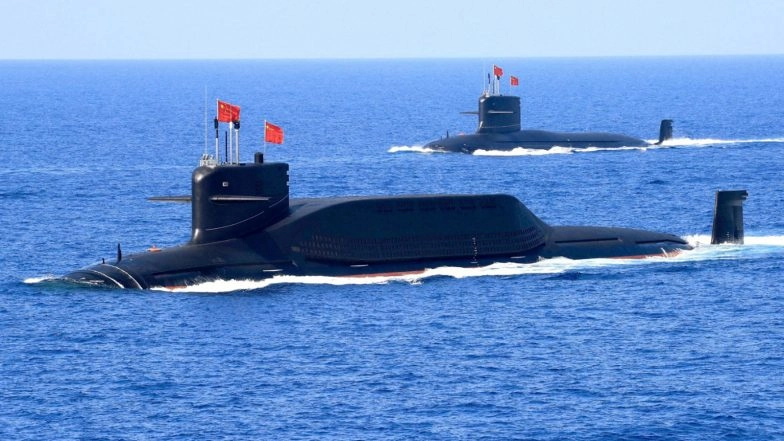
The situation concerning Chinese submarines is harder to decipher, as the PLAN works hard to keep numbers and deployments a secret. China is rebalancing its large submarine fleet to add a greater ratio of nuclear-powered boats. All these are built by Bohai in Huludao, and production capacity has expanded there.
Current production focuses on the Type 093B (also written as Type 09IIIB) guided-missile, nuclear-powered attack submarine. First observed under construction in 2022, it is estimated that seven of these submarines had been launched as of late 2025. The US Pentagon stated that four Type 093Bs were launched between May 2022 and January 2023 alone, and an annual production rate of two per year seems feasible, even if Bohai has greater capacity than this. It is possible that an eighth Type 093B was launched at the start of this year.
China is working on Type 094 nuclear-powered ballistic missile submarines (SSBN) as well, though none were observed being completed last year. Because of delays in inducting the next-generation Type 096 SSBN, the US Pentagon has suggested China might build more Type 094A boats. All the PLAN's SSBNs are stationed with the Southern Theater Command at Hainan Island, so these vessels have to transit the Taiwan Strait every time they return to Huludao for maintenance.
Current estimates are that the PLAN possesses six Type 093/Type 093A attack boats and six Type 094/094A SSBNs. It probably also has two or three Type 093B attack submarines operational, with others undergoing fitting out. The vertical launch system on the Type 093B can fire an array of land-attack and anti-ship missiles, including the advanced YJ-21 hypersonic missile designed for long-range strikes. Its speed helps it overcome conventional defenses on warships.
President Donald Trump's threats to invade and conquer Greenland have been gaining international headlines. One of Trump's arguments is that the Chinese and Russian militaries are seeking to use Greenland for their own ends, and that vessels from both nations' navies have been roving around the Danish protectorate. His claims are obviously exaggerated, and Denmark has said no Chinese warships have been spotted there since ten years ago.
However, it is possible that Chinese submarines are operating in the Arctic. An intelligence assessment released by the Danish Defense Intelligence Service last December noted that the Arctic provides an ideal location to launch nuclear-tipped missiles at Northern Hemisphere targets, given the shorter distances the missiles have to travel. Additionally, submarines can hide beneath the icecap. The report stated: "The capability to operate strategic submarines beneath the Arctic Ocean icecap is therefore part of the capacity that both Russia and the United States have to retaliate in the event of a nuclear attack."
The report continued: "China is determined to acquire this capability too. This requires the ability to operate missile-carrying submarines beneath the Arctic ice. Hence, China's growing interest in developing the capability required for submarine operations in the Arctic."
Dr. Collin Koh, Senior Fellow and Coordinator of Projects (Naval/Maritime Affairs) at Singapore's S. Rajaratnam School of International Studies, concurred: "The envisaged PLA Navy nuclear submarine presence, I surmise, is not to secure Arctic sea lines of communications. It's more for strategic nuclear deterrent. Arctic SSBN deployment could exploit the unique complex environmental conditions and enhance its strike capabilities on the continental US."
As for Chinese diesel-electric submarines, production seems to have slowed considerably by Wuchang Shipbuilding in Wuhan. The PLAN has ten Kilo-class submarines imported from Russia many years ago, as well as 13 Type 039 Song-class submarines, 21 Type 039A/Type 039B Yuan-class boats, and a smaller number of the latest Type 039C submarine. There is speculation, unconfirmed, that possibly three Type 039C diesel-electric submarines fitted with air-independent propulsion entered PLAN service last year. It may be that the PLAN has already completely retired its Type 035G/Type 035B Ming-class submarines too.
Perhaps one reason for the slowdown in PLAN submarine construction is that Wuchang has been busy building Hangor-class submarines for Pakistan, and an S26T for Thailand. The deal with Islamabad sees four submarines manufactured in China, and another four assembled from supplied components in Karachi. These submarines are based on the Yuan class. The four Chinese-built submarine hulls for the Pakistan Navy were launched in April 2024, on 15 March 2025, 16 August 2025 and 18 December 2025 respectively.
Finally, auxiliary ships are also being built for the PLAN. The Type 920 ocean-going hospital ship Silk Road Ark left Quanzhou in Fujian Province for the first time. It is China's second domestically designed and constructed 10,000-tonne-class hospital ship.
More Type 903/Type 903A replenishment oilers are under construction. While not as sexy as warships bristling with weapons, such auxiliary ships are vital to sustain long-range missions and task groups traveling the world's oceans. The Type 903 displaces more than 20,000 tonnes. The PLAN has nine of these, but constant demand as the PLAN makes longer and more frequent forays into far oceans means more are required. Five new boats have been under construction at COMAC in Guangzhou and at Wuhu Shipbuilding on the Yangtze River. At least one had commenced sea trials as of June 2025.
The Type 901 is an even larger replenishment ship, displacing around 40,000 tonnes. These are needed to support carrier strike groups, so it is possible more will be built to join the two already in service.
The PLAN continues to innovate spectacularly too. Last year, first images emerged of amphibious barges used to help unload vehicles and cargo during beach lodgments. These self-propelled barges have pylons that rest on the seabed, and long ramps that allow vehicles to roll ashore after disembarking from cargo or amphibious vessels berthed at sea. These were likely developed for a Taiwan invasion scenario, and they certainly give the PLA more options in terms of where they could make an amphibious landing in Taiwan. The PLAN has been cautiously testing these landing systems.
Another interesting tactic rehearsed by China last year was quietly mobilizing hundreds of fishing boats to create massive floating barriers at least 200 miles long. These floating "belts" or "barriers" of fishing boats demonstrate a new level of coordination that could give Beijing more ways to impose control in contested seas. Such operations have been conducted twice to date. These maneuvers are complex and massive, with one of them involving 1,400 Chinese vessels. The second occasion, occurring around Christmas time last year, saw 2,000 boats form two parallel lines some 290 miles long. These fishing boats halt their normal fishing activities and assembled into a dense formation that would be difficult to penetrate. These events show how the Chinese military and government control private fishing boats, as well as those known to be part of the People's Maritime Militia. Beijing would have no hesitation using them during a conflict. During a Taiwan contingency, for example, they could overwhelm shipping lanes, block ports, disrupt naval and legitimate commercial traffic, create false radar targets and create a true "gray zone" that blurs the difference between civilian and military activity.
If last year is anything to go by, then 2026 will see continued output of new warships, submarines and auxiliary vessels for the PLAN. Just as the imaginative new amphibious landing barges appeared last year, we can expect new innovations to emerge in the months to come, including in sectors such as unmanned technology. (ANI)
(The above story is verified and authored by ANI staff, ANI is South Asia's leading multimedia news agency with over 100 bureaus in India, South Asia and across the globe. ANI brings the latest news on Politics and Current Affairs in India & around the World, Sports, Health, Fitness, Entertainment, & News. The views appearing in the above post do not reflect the opinions of LatestLY)