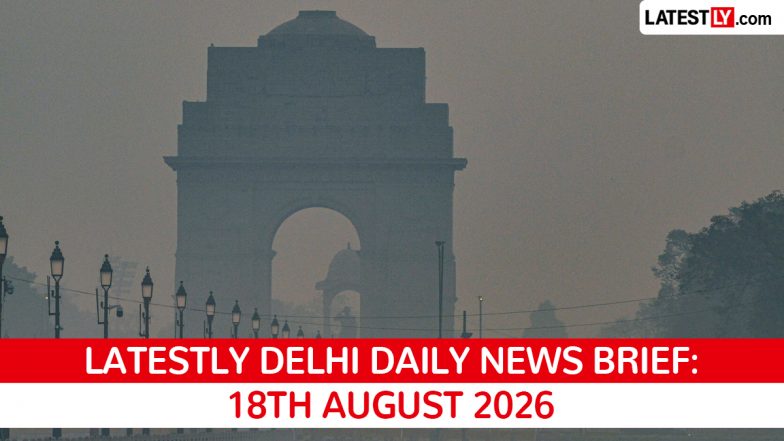
Delhi-NCR Rains: Rainfall Brings Brief Relief in National Capital; Air Quality Remains in ‘Poor’ Category
Scattered rainfall across Delhi and the National Capital Region (NCR) on Saturday morning provided a temporary reprieve from rising temperatures, but failed to significantly improve the region’s air quality. Despite the rain, the Air Quality Index (AQI) remained in the ‘poor’ category.


New Delhi, April 18: Despite a spell of sudden rain across Delhi-NCR that brought temporary relief from the intensifying summer heat, air quality levels largely remained in the 'Poor' category on Saturday, with a few areas recording 'Moderate' conditions, according to official data. The rain, accompanied by cloudy and hazy skies, offered residents a short-lived respite from soaring temperatures. However, it failed to significantly improve pollution levels across the region.
The change in weather has been attributed to a Western Disturbance, a meteorological phenomenon that often brings unseasonal rainfall to north India during winter and pre-summer months. Delhi-NCR Heatwave Alert: Temperatures To Cross 40 Degrees Mark as Air Quality Dips Into ‘Very Poor’ Category in Ghaziabad and Noida.
Data released by the Central Pollution Control Board (CPCB) showed varying Air Quality Index (AQI) readings across monitoring stations in Delhi. Anand Vihar recorded a high AQI of 265, followed by Wazirpur at 260 and Mundka at 233, all falling within the 'Poor' category. Other areas such as Jahangirpuri (211) and Narela (209) also reported poor air quality levels.
Meanwhile, several locations registered 'Moderate' AQI levels, including Ashok Vihar (186), Bawana (178), DTU (158), IIT Delhi (158), and Dwarka Sector-8 (192). Delhi Rains-Weather Forecast: Rainfall Lashes Delhi-NCR As IMD Forecasts Strong Winds, Thunderstorms and Cloudy Skies.
Relatively better air quality was observed in areas such as Sonia Vihar (117) and JNU (125), although these, too, remained above the 'Satisfactory' range. Earlier, on April 16, the Commission for Air Quality Management (CAQM) invoked Stage-I of the Graded Response Action Plan (GRAP) with immediate effect after Delhi's average AQI reached 226, firmly placing it in the 'Poor' category.
GRAP is a four-stage emergency framework designed to tackle air pollution in Delhi-NCR based on AQI levels. Stage-I is implemented when AQI ranges between 201 and 300 ('Poor'), followed by Stage-II (301–400, 'Very Poor'), Stage-III (401–450, 'Severe'), and Stage-IV (above 450, 'Severe+'), which entails the strictest measures.
According to the CPCB, AQI is measured on a scale from 0 to 500 and is categorised into six levels based on health impact. An AQI between 0–50 is considered 'Good', while 51–100 falls under 'Satisfactory'. The 'Moderate' category (101–200) may cause breathing discomfort to sensitive groups.
The 'Poor' category (201–300) can lead to breathing discomfort for most people with prolonged exposure. 'Very Poor' (301–400) poses health risks even to healthy individuals, while 'Severe' levels (401–500) are considered hazardous for the entire population.
(The above story first appeared on LatestLY on Apr 18, 2026 11:44 AM IST. For more news and updates on politics, world, sports, entertainment and lifestyle, log on to our website latestly.com).