What Is Delimitation and Why Does It Matter?
The Centre is set to begin a new delimitation exercise to redraw Lok Sabha constituencies and ensure fair representation based on population changes. The move could increase total seats and enable women’s reservation. The process aims to address voter imbalance but has sparked debate over regional impact and political implications.

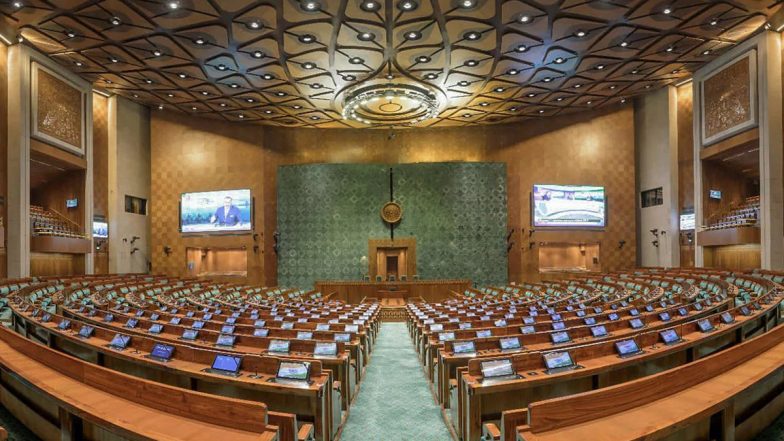
New Delhi, April 16: The Centre is preparing to initiate a fresh delimitation exercise to redraw parliamentary constituencies and potentially increase the strength of the Lok Sabha from 543 to as many as 850 seats. The move is aimed at ensuring fair representation based on population changes and enabling one-third reservation for women in Parliament ahead of the 2029 general elections.
To carry out the process, the government plans to constitute a new Delimitation Commission. Three key bills, including a Constitution Amendment Bill and a Delimitation Bill, are expected to be introduced during the ongoing Budget Session. The exercise will likely rely on 2011 Census data, as the next census is still underway. Delimitation Bill 2026: Tamil Nadu CM MK Stalin Hoists Black Flag, Burns Copy of Bill (Watch Video).
What Is Delimitation?
Delimitation is the process of redrawing the boundaries of electoral constituencies to reflect population changes. It ensures that each elected representative in the Lok Sabha represents a roughly equal number of citizens.
This exercise is carried out periodically and is essential to maintaining the principle of equal representation in a growing and changing population. Without delimitation, some constituencies could become significantly over- or under-represented over time. Lok Sabha Expansion: Govt Proposes 850 Seats With 815 Directly Elected MPs; Aims Women's Reservation Rollout Before 2029 Elections.
Why Is Delimitation Necessary Now?
India’s population has more than doubled since the last major seat allocation in 1973, when Lok Sabha seats were fixed at 543 based on the 1971 Census. Since then, only boundaries were adjusted in 2002, without increasing the total number of seats.
According to 2011 Census data, disparities in voter distribution have widened. Some constituencies now have over 20–30 lakh voters, while smaller regions such as Lakshadweep and Ladakh have significantly fewer voters.
The proposed delimitation aims to correct these imbalances and provide states with representation proportional to their population.
Proposed Changes to Lok Sabha Composition
Under the government’s proposal, Lok Sabha seats could increase to a maximum of 850, with around 815 seats allocated to states and 35 to Union Territories. The final number, however, will be decided by the Delimitation Commission.
The exercise will also enable implementation of the women’s reservation policy passed in 2023, reserving one-third of seats for women on a rotational basis.
Regional Impact and Political Debate
The proposed redistribution is expected to benefit northern states such as Uttar Pradesh, Bihar, and Maharashtra, which have seen higher population growth. In contrast, southern states including Tamil Nadu and Kerala may see a relatively smaller increase in seats due to lower population growth rates.
This has triggered concerns among opposition parties and regional leaders, who argue that states that successfully controlled population growth could be disadvantaged.
Concerns and Opposition Views
Opposition parties have raised concerns about potential political implications, including fears of gerrymandering and changes to the electoral balance. Some leaders have called for alternative approaches, such as a “hybrid model” that factors in both population and economic contribution.
The government, however, maintains that delimitation is a constitutional necessity and essential for strengthening democratic representation.
India has conducted delimitation exercises several times since Independence, in 1952, 1963, 1973, and 2002. The 1973 exercise fixed the current number of Lok Sabha seats, while the 2002 exercise only revised constituency boundaries. The upcoming exercise will be the first major revision in over five decades to potentially increase the total number of seats.
(The above story first appeared on LatestLY on Apr 16, 2026 12:36 PM IST. For more news and updates on politics, world, sports, entertainment and lifestyle, log on to our website latestly.com).