Stock Market Today: Sensex, Nifty Slide Over 2% Amid Bond Yield Spike and Global Uncertainty
The benchmark Nifty 50 closed at 22,820, down 2.09 per cent, after opening with a gap-down and remaining under pressure throughout the session. The banking index Bank Nifty also mirrored the weakness, declining 2.67 per cent to settle at 52,275.

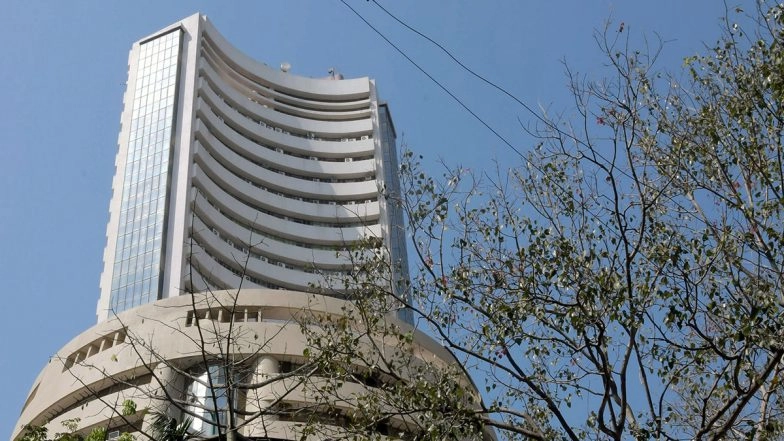
Mumbai, March 27: Indian equity benchmarks fell sharply on Friday, weighed down by global macro headwinds, rising bond yields, and persistent geopolitical tensions. The benchmark Nifty 50 closed at 22,820, down 2.09 per cent, after opening with a gap-down and remaining under pressure throughout the session. The banking index Bank Nifty also mirrored the weakness, declining 2.67 per cent to settle at 52,275.
BSE Sensex closed at 73,583.22, down by 2.25%. According to Sudeep Shah, Head of Technical and Derivatives Research at SBI Securities, a combination of global and domestic factors dampened investor sentiment. Stock Market Today: Sensex Falls 400 Points, Nifty Opens at 23,173 Down 132 Points Amid Weak Global Cues and Rising Brent Crude on Iran Tensions.
"A combination of macro headwinds weighed heavily on market sentiment, including a pullback in crude oil prices, the rupee hitting a record high, a spike in US and Japanese 10-year bond yields, and a rise in VIX. Ongoing geopolitical tensions in West Asia further added to the cautious undertone," Shah said. He added that the index faced selling pressure after failing to cross key resistance levels earlier this week.
"After failing to surpass the 23,350-23,400 resistance zone, Nifty witnessed renewed selling pressure... every pullback has been sold into at higher levels, reinforcing the prevailing bearish trend," he noted. On the technical front, indicators continued to signal weakness. "RSI has slipped after briefly crossing the 40 mark... while MACD continues to trade well below both the zero line and the signal line, further strengthening the bearish bias," Shah said. Stock Market Today: Sensex Jumps 600 Points, Nifty Above 23,000 as West Asia Tensions Ease, Donald Trump’s Iran Plan Boosts Sentiment.
Sectorally, only the CPSE index managed to end in positive territory, while PSU banks and defence stocks were among the worst hit. Broader markets also remained under pressure, with midcap and smallcap indices falling over 1.5 per cent each. Market breadth remained decisively negative, with a large majority of stocks ending in the red, reflecting widespread selling pressure.
Looking ahead, Shah highlighted key levels for the benchmark index. "The immediate support for Nifty is placed in the 22,650-22,600 zone. Any sustainable move below this zone could result in Nifty extending its weakness towards 22,400, followed by 22,200. On the upside, 23,150-23,200 is likely to act as strong resistance."
For Bank Nifty, he said, "The immediate support is placed in the 51,800-51,700 zone... while 52,700-52,800 will act as immediate resistance," adding that the index continues to underperform the broader market. Meanwhile, market experts believe policy support and easing fuel costs could provide some relief going forward. Dr Vijay Kalantri said the government's move to reduce excise duty on petrol and diesel is a positive step amid volatile conditions. He noted that the measure "will help stabilise prices and provide relief to consumers," adding that it could prevent further inflationary pressures and support economic activity.
Kalantri also flagged concerns over supply disruptions due to tensions in the Gulf region, particularly for critical imports such as fertilisers and petrochemicals, but expressed optimism. He said assurances from Iran regarding safe passage could ease concerns, while adding that the Indian rupee is expected to strengthen. Despite near-term volatility, he maintained a positive long-term outlook. "With continued government support for trade and industry, the Indian economy is expected to witness positive growth despite current challenges," he said.
(The above story is verified and authored by ANI staff, ANI is South Asia's leading multimedia news agency with over 100 bureaus in India, South Asia and across the globe. ANI brings the latest news on Politics and Current Affairs in India & around the World, Sports, Health, Fitness, Entertainment, & News. The views appearing in the above post do not reflect the opinions of LatestLY)