









 Quickly
 Socially
 Trending
 Crypto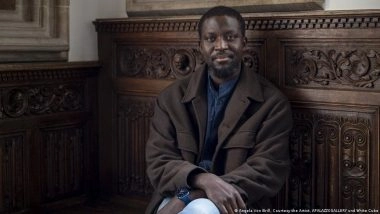
Best known for large-scale burlap sack installations, Ibrahim Mahama is helping shift power in the art world to the Global South while redefining art as a collective practice.A rough burlap sack launched Ibrahim Mahama to global fame.
In 2015, when Mahama was in his late 20s and finishing up his fine arts Ph.D. in Ghana, he was selected to participate in one of the world's most important art festivals, the Venice Biennale.
His installation there, "Out of Bounds," combined stitched-together burlap sacks — made in Southeast Asia used to export Ghanaian cacao beans to the West — with knotted ropes and metal tags, creating a giant patchwork of material that he draped over a long medieval dockyard passageway.
The immersive corridor, which touched on labor, exploitation, colonial legacies and global trade, brought Mahama international acclaim, prestigious gallery representation and, over time, financial success that he is using to transform the artistic landscape in Ghana.
His approach as an artist leading change has led him to be recognized as one of the most significant artists in the world.
In early December, he took the No. 1 spot on the Power 100 list of magazine ArtReview, a well-respected ranking of the most influential artists in the world — the first African to top the list.
Mahama described reaching the top spot as "quite humbling." He sees himself and his achievements as part of something greater, as a sustained movement of artists and curators from the Global South that is shifting the power in the art world away from the West where it was long concentrated.
"I don't necessarily see [the ranking] in relation to myself, but as a testimony to the work that has been done by many of the curators before us, all these curators from the [African] continent and elsewhere who have been fighting so hard to expand the existing narratives of art and what it is and can be," he told DW.
A large family and formative university years
Collectivity runs through the heart of everything Mahama does. In his interview with DW, he nearly always uses "we," never "I" to describe his work and impact.
Mahama traces this back to his childhood. He was born in 1987 in Tamale, northern Ghana, into a polygamous family; his father had four wives, 10 biological children and many non-biological children. "When I was growing up, I always had new brothers and sisters," he said.
The large family instilled in Mahama the importance of equality and redistribution.
"It's very important for us to be able to distribute resources," he said of growing up in a large family where no one individual was ever at the center.
As a child, Mahama drew comics and created collages, using his pocket money to buy art supplies. "I was always interested in things that people made with their hands," he said.
His family supported his artistic interests and art studies at Kwame Nkrumah University of Science and Technology, in Kumasi, which were formative for him.
"Everything that I do was actually born out of the university," he said. There, he found a community of professors and other students who were interested not just in making art but using it to transform systems and conditions.
"We always imagined that the future of the world was more based on the idea of the collective," he explained.
'Negotiated' materials, collaborative work
From discarded burlap bags, worn and covered in grease to defunct trains and planes to abandoned grain silos, the materials and spaces Mahama works with are "negotiated" — sourced and acquired for the value they contain in terms of memory and meaning.
"They might seem like old, tattered things that are at the end of their life cycle, but ... when things are old, they are at their most wise experience and they are even more alive than when they are new, because then they've accumulated so much memory, so much so that you can find ways of disseminating [it]," he said.
Mahama often collaborates with laborers, farmers, tradespeople and street vendors to find and rework items, such as for his work Non-Orientable Nkansa II, a towering wall of "shoemaker boxes." His burlap installations, which have been displayed in Germany, Italy, North Macedonia and the UK, among other places, involve multiple teams of people stitching the sacks together and often later securing the resulting fabric over large buildings and structures.
Reaching the next generation in Ghana
Despite — or perhaps thanks to — his international fame, he is firmly rooted in Ghana, working there to redefine how people engage with art and even the meaning of art itself.
The capital generated from his artistic success has become a "kind of new material," he explained, "which can also produce a new discourse," a more communal one.
That is what he is aiming to do with the three art institutions he has founded in his birthplace, Tamale: the Savannah Centre for Contemporary Arts (SCCA), an artist-run exhibition space; Red Clay Studio, an open studio; and Nkrumah Volini, an institution for "archaeological memory." All spaces are open to the public; anyone and everyone is welcome to walk in and experience art, though it is perhaps young people he particularly seeks to reach and influence.
Together with colleagues from the University of Ghana, Mahama is currently working to open an independent art school in Tamale that would be connected to his other institutions.
"One of the things that we are hoping for is that the work we're doing will give birth to a new generation that has a different sense of cultural sensibilities," Mahama said. He hopes young people will grow up able to see the memories contained in the objects and spaces around them — and then learn from this to make a different future
"The reimagination of the world, I think, is the most important gift that humanity can have."
Edited by: Elizabeth Grenier
(The above story first appeared on LatestLY on Jan 05, 2026 02:20 PM IST. For more news and updates on politics, world, sports, entertainment and lifestyle, log on to our website latestly.com).
 Share Now
 Google Trends



 Live Bot