Long Island Rail Road Strike Will Halt North America’s Largest Commuter System
Workers on New York’s Long Island Rail Road are on strike, paralyzing the busiest commuter rail system in North America

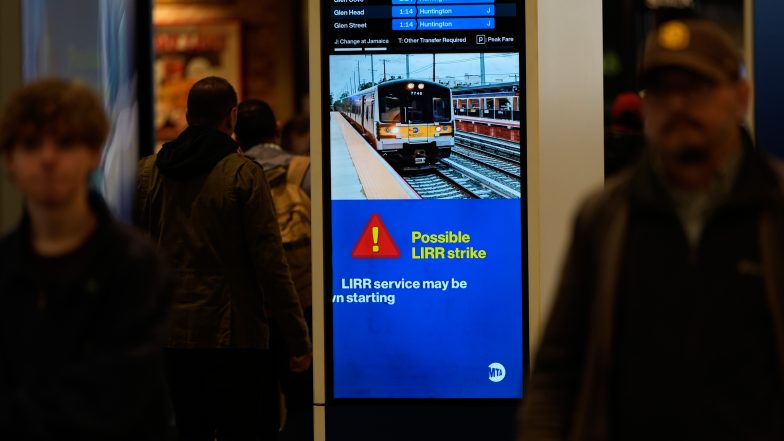
NEW YORK (AP) — Workers on New York’s Long Island Rail Road are on strike, union officials said early Saturday, paralyzing the busiest commuter rail system in North America.
Labor unions representing about half the system’s workers announced the walkout after negotiations with the Metropolitan Transportation Authority ended Friday without a new contract. The five unions, which represent about half the system’s 7,000 workers, including locomotive engineers, machinists and signalmen, are legally allowed to go on strike at 12:01 a.m. Saturday.
Kevin Sexton of the National Vice President of the Brotherhood of Locomotive Engineers and Trainmen said no new negotiations have been scheduled.
Also Read | Castle, Spurs Eliminate Timberwolves 139-109 in Game 6.
“We’re far apart at this point," Sexton said. “We are truly sorry that we are in this situation.”
Janno Lieber, the MTA chairman, said the agency “gave the union everything they said they wanted in terms of pay” and that to him it was apparent the unions always intended to walk out.
The strike will force the roughly 250,000 people who ride the system each weekday to find alternative routes into New York City from its Long Island suburbs or to work from home. That means more cars on traffic-choked highways and longer work commutes.
Also Read | Long Island Rail Road Strike Will Halt North America's Largest Commuter System.
“It’s gonna be such a nightmare trying to get in,” said Rob Udle, an electrician who takes the LIRR at least five days a week into Manhattan.
The strike will even make it challenging for some sports fans to get into Manhattan to watch the NBA’s New York Knicks playoff run or see the baseball rivals the New York Yankees battle the crosstown Mets this weekend.
Gov. Kathy Hochul has urged LIRR riders to work from during the walkout as the MTA plans to provide free but limited shuttle buses during the work day rush hours geared toward essential workers.
Dispute over wages
The union has demanded a total raise of 16% over four years, saying it is needed to help workers keep up with inflation and rising living costs. The MTA argued that the union’s initial demands would lead to fare increases. The authority has agreed to a pay raise of at least 9.5% over the next three years, plus what would effectively amount to a 4.5% raise in year four.
“The difference between those two positions is not unbridgeable,” Gary Dellaverson, the MTA’s chief negotiator, suggested during a news conference Wednesday.
“The key question is: Will MTA and Gov. Hochul create frustration and gridlock for commuters, spend millions on buses during a strike and lose millions in revenue over what amounts to roughly a one percent difference in wages?” Nick Peluso, national vice president for the Transportation Communications Union, said in a statement.
Commuters brace for the worst
Susanne Alberto, a personal trainer from Long Island, said she has already made plans with her Manhattan clients to hold virtual sessions in the event of a shutdown.
She said the union likely has the upper hand.
“The MTA is going to cave, and they know that,” Alberto said. “Why don’t they just do it now instead of waiting until virtually millions of people get inconvenienced?”
Udle, the electrician, said he will likely use his vacation days rather than navigate the “nightmare” of commuting into Manhattan if the rail service shuts down.
A union member, he sympathized with the unions’ affordability concerns, but he said he didn’t agree with their strong-arm tactics.
“I get it, the cost of living is going up and stuff like that,” Udle said while waiting at Penn Station for a train home. “But they shouldn’t hold everybody hostage to do it. There’s a better way. You’re affecting a lot of other people."
A strike was temporarily averted in September when President Donald Trump’s administration agreed to help with negotiations. Those efforts ended without a deal, giving both sides 60 days — ending 12:01 a.m. Saturday — to again try to resolve their differences before the union is legally allowed to go on strike or the agency could lock out workers.
LIRR workers last went on strike in 1994, for about two days.
Workers on the commuter rail system connecting Manhattan to New Jersey, New Jersey Transit, went on strike last year. It lasted three days.
___
The first reference to the rail system has been updated to correct to Long Island Rail Road, from Long Island Railroad.
___
Follow Philip Marcelo at https://x.com/philmarcelo
(The above story first appeared on LatestLY on May 16, 2026 09:55 AM IST. For more news and updates on politics, world, sports, entertainment and lifestyle, log on to our website latestly.com).