Marine Fossils Dating to 8,000–12,000 Years Unearthed by Scientists in Tamil Nadu’s Panaiyur
Marine fossils dating back thousands of years have been discovered in Panaiyur, under Kulathur South Panchayat in Thoothukudi district. The site, located about 25 kilometres from Thoothukudi, was first identified by an enthusiast in December 2025.

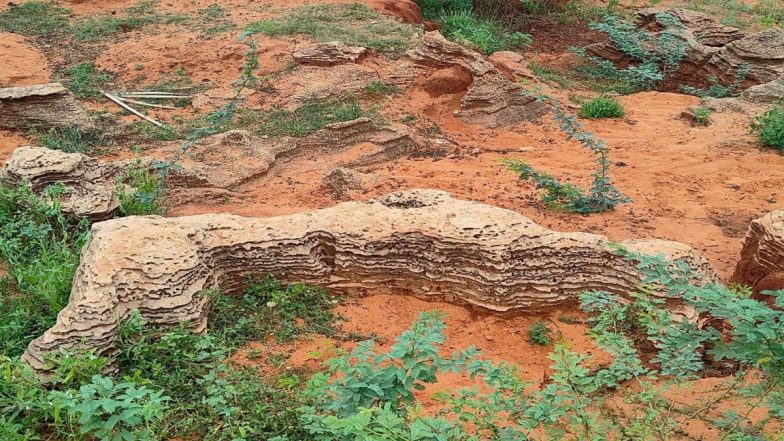
Thoothukudi, April 28: Marine fossils dating back thousands of years have been discovered in Panaiyur, under Kulathur South Panchayat in Thoothukudi district. The site, located about 25 kilometres from Thoothukudi, was first identified by an enthusiast in December 2025. Following this discovery, a team of scientists from the Zoological Survey of India (ZSI) conducted geological and paleontological studies between January 5 and 10.
During the study, a total of 104 fossil specimens were collected, primarily including marine organisms such as bivalves and gastropods. Scientists have stated that these fossils belong to the Holocene epoch, dating back approximately 8,000 to 12,000 years. The findings suggest that the area was once submerged due to rising sea levels, which led to the formation of these fossil deposits. Fossils, Possibly From Dinosaur-Era, Found During Pond Excavation in Rajasthan's Jaisalmer, GSI Probe Ordered (Watch Video).
Notably, the fossil site is located about 5 to 7 kilometres inland from the present coastline, indicating significant changes in coastal geography over time. Experts have recommended that the government take steps to protect the site and conduct radiocarbon dating to determine the precise age of the fossils. This discovery is considered an important scientific finding that provides insight into the geological and marine history of the Thoothukudi region.
In an 'X' post on Monday, Union Environment Minister Bhupender Yadav noted that, following a request from the Thoothukudi administration, the Zoological Survey of India conducted a field survey of fossil sites exposed by heavy rainfall in 2023. He said the assessment confirmed a newly identified fossil bed from the Holocene period (8,000-12,000 years), which adds important data to India's Quaternary fossil record. He added that the finding enhances understanding of the country's ancient environment, wildlife, and climate, and praised ZSI's scientific response in documenting and safeguarding the natural heritage.
"At the request of the Thoothukudi administration in Tamil Nadu, Zoological Survey of India conducted a field survey of fossil sites exposed by torrential rains in 2023. The assessment confirms a newly discovered Fossil Bed dating back to the Holocene period (8,000-12,000 years), which significantly enriches the Quaternary fossil record of India. This discovery is important because it helps us better understand India's ancient wildlife, environment, and climate. Ministry of Environment, Forest and Climate Change commends ZSI's swift and exemplary scientific response in safeguarding India's natural heritage," Yadav wrote on 'X'. Real-Life Kraken: Bus-Sized Ancient Octopus Hunted Marine Giants, New Study Confirms.
Meanwhile, Antony Ravindran from the Department of Geology, VO Chidambaram College, Thoothukudi, observed that the Kulathur-Panaiyur village site contains distinct fossil forms and subsurface geological structures. He noted that the area is dominated by sedimentary formations, with layers of sandstone and lateritic red soils. He explained that much of the interior was earlier buried under sand, but heavy rainfall in 2023 exposed the underlying deposits.
"At the site located near Kolathur Badayur village, we have seen differently formed fossils and different subsurface geological features. Sedimentary features occur in this place, so we generally observed that area. The interior area was totally buried due to sand. Due to heavy rain in 2023, the internally buried material came out, and we could see the differences accidentally. These features seen here include submarine canyons or water channels cutting through layers, where waves cut different sedimentary layers occurring in this particular area. Condensed sedimentary sandstones and lateritic red soils are present," he said.
(The above story is verified and authored by ANI staff, ANI is South Asia's leading multimedia news agency with over 100 bureaus in India, South Asia and across the globe. ANI brings the latest news on Politics and Current Affairs in India & around the World, Sports, Health, Fitness, Entertainment, & News. The views appearing in the above post do not reflect the opinions of LatestLY)