Should Travel Content Creators Be Promoting Afghanistan?
In the race for clicks, likes and followers, some travel influencers are being criticized for promoting Afghanistan while ignoring the harsh reality of Taliban rule.

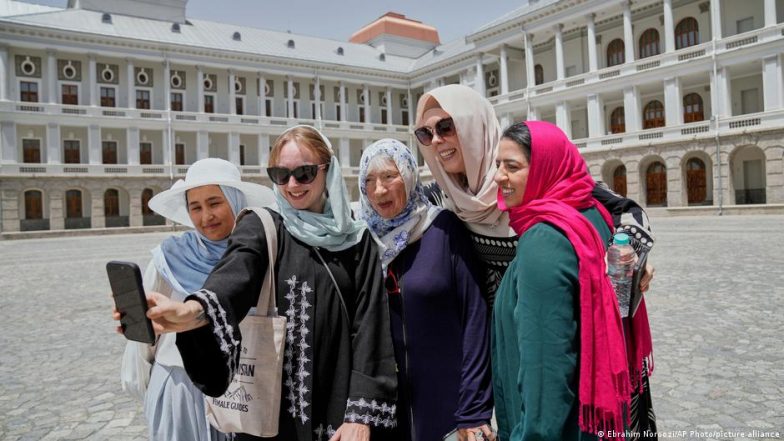
In the race for clicks, likes and followers, some travel influencers are being criticized for promoting Afghanistan while ignoring the harsh reality of Taliban rule.With sensational headlines packed with superlatives and often written in all caps, travel influencers battle for our attention on social media platforms — the more exotic the destination, the better. As a result, Instagram, YouTube, TikTok and similar platforms are increasingly filled with travel videos from countries that are far from conventional tourist destinations. With titles like "The worst country on earth," "Traveling in the most dangerous country in the world," dozens of content creators describe trips to Taliban-controlled Afghanistan, ignoring all official travel warnings.
Zoe Stephens has traveled to Taliban-controlled Afghanistan several times, most recently for several months. On her YouTube channel Zoe Discovers, on Instagram and on other platforms, the young woman from Liverpool has published dozens of videos about her trips there, including a multi-part series about the situation of women in the country. Of the six content creators we contacted, Stephens was the only one willing to speak publicly about the subject. She claims to present a more nuanced picture than other content creators, who often spent only a few days in Afghanistan. "That's also why I have way less followers than most of the others," she says. "I refuse to do the sensationalist stuff."
Posing with heavily armed Taliban fighters
Some other influencers post videos of themselves chatting and posing with heavily armed members of the Taliban, saying things like, "They're all super nice." Afterwards, they check out a few Instagram-worthy must-sees before crossing the country off their globetrotting bucket lists.
As a result, the comment sections of their social media posts are full of scathing criticism. Many accuse them of indirectly supporting the Taliban regime, which has announced intentions to boost tourism in Afghanistan. "You shouldn't publicly recommend travel to Afghanistan. Trying to make this inhumane country appealing to viewers is morally questionable," one person writes on YouTube.
Claudia Paganini, a philosopher at the University of Innsbruck in Austria, agrees. She has spent years researching media ethics and also follows travel content on social media. She points out that influencers are primarily interested in a destination's aesthetics — that is, what it looks like — which can be problematic when the country in question has a dictatorial regime that routinely violates human rights. "Many problems simply cannot be made visible in a social media video," says Paganini. Often the videos lack context, making it difficult for users to properly assess the situation. In the case of Afghanistan, the deplorable human rights conditions may be downplayed as a result. Yet, she acknowledges that the range of travel content on offer is broad: "This criticism applies more to some videos, and less to others."
High-quality social media content
While travel journalists generally have a code of conduct, there are no guidelines for content creators and influencers. Paganini proposes the introduction of a kind of quality seal for high-quality social media posts. Yet the social media platforms themselves have no interest in stricter regulation. "These are not NGOs acting for some higher collective good. Attention is the highest currency on social media." Everything revolves around clicks, likes and follows.
"Travel content on social media is usually based on a sensationalist concept — this is the only thing that gets you visibility there," says Johannes Klaus, a blogger who founded the platform for travel writers, Reisedespechen. Klaus has also been campaigning for the creation of a code of conduct for travel bloggers. This would, among other things, enshrine authors' journalistic independence. Yet, he doesn't believe a similar voluntary commitment could emerge from the content creators and influencer scene. "There, it's about entertainment. It has nothing to do with journalism." Balanced or in-depth travel reports, which can also be found on social media, are rarely rewarded by the platforms' algorithms.
You can't do it without self-censorship
While some Taliban-related clips are viewed millions of times, Zoe Stephens' videos don't reach nearly as many viewers. Nonetheless, she continues to attempt to provide factual reporting, though she acknowledges that it's not easy in a country like Afghanistan. Since she also works as a tour guide there, she admits to applying a certain amount of self-censorship: "In order to continue doing the work I do, which I believe creates a positive impact, I have to be aware of what I say and how I say it, lest I be banned from returning." Still, she believes that not every aspect of life in Afghanistan has to be politicized. After all, the nation is also shaped by its food, culture, history and the people who live there. "My aim is to show a different side of the country."
This article was translated from German.
(The above story first appeared on LatestLY on Apr 08, 2026 02:30 PM IST. For more news and updates on politics, world, sports, entertainment and lifestyle, log on to our website latestly.com).