
World News | Iran's Control of Strait of Hormuz is Their Superweapon, Says US Diplomat Donald Heflin
Get latest articles and stories on World at LatestLY. A high-level American negotiating team, including Vice President JD Vance, Jared Kushner, and Special Envoy Steve Witkoff, is en route to Pakistan to initiate critical negotiations with the Iranian leadership.

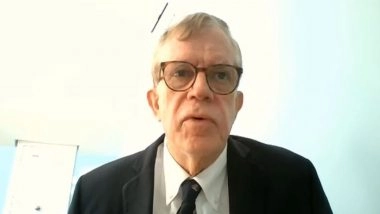
Boston [US], April 21 (ANI): US diplomat and Former United States Ambassador to Cape Verde, Donald Heflin, said Iran's control over the Strait of Hormuz has emerged as a key strategic leverage point in the ongoing tensions, impacting global energy supply and shaping the course of diplomatic negotiations.
Speaking to ANI on Monday, Heflin said, "Iran has been trying for years to develop weapons-grade materials, and the outside world has tried to stop them... One thing that Iran has discovered in the last month or two is they don't really need nuclear weapons as a deterrent force to keep someone from attacking it or attempting to change the regime. Their control of the Straits of Hormuz is their superweapon."
"The blockade is caused by the United States feeling that, suffering under all these economic sanctions, Iran desperately depends on exporting oil and importing certain key goods. So if we can keep them from getting those, they will come to the peace table. Both sides are using the waterway as an advantage over each other... It will be two steps forward and one step back," he said.
Further, Heflin said in the upcoming talks in Islamabad, suggesting that diplomatic signals point towards Tehran returning to negotiations despite ongoing tensions.
Also Read | US President Donald Trump Open to Direct Talks With Iran Amid Uncertainty Over Pakistan Negotiations.
"I think they will come back to the table. Now, I could be wrong. I don't think the Pakistanis would encourage the US delegation led by the vice president to come all that way if they didn't have a reason to think the Iranians were coming. I think the Iranians would be well served to not just abandon the vice president of the United States in the middle of Pakistan, but to show up, even if there are no real results from it... If they do not go to Islamabad, it's going to be a problem," he further said.
The remarks came ahead of a second round of talks following a 21-hour marathon discussion earlier this month that ended without agreement, with diplomatic efforts now entering a critical phase amid warnings of possible escalation if negotiations fail.
A high-level American negotiating team, including Vice President JD Vance, Jared Kushner, and Special Envoy Steve Witkoff, is en route to Pakistan to initiate critical negotiations with the Iranian leadership.
With the ceasefire set to lapse on Wednesday, the Islamabad talks represent the final diplomatic off-ramp before a potential escalation into full-scale infrastructure warfare. While the US maintains that a "fair and reasonable" deal is on the table, the Iranian leadership's refusal to negotiate under the "shadow of a blockade" suggests that the 21-hour marathon of the previous round may have been just a prelude to a much darker confrontation. (ANI)
(The above story is verified and authored by ANI staff, ANI is South Asia's leading multimedia news agency with over 100 bureaus in India, South Asia and across the globe. ANI brings the latest news on Politics and Current Affairs in India & around the World, Sports, Health, Fitness, Entertainment, & News. The views appearing in the above post do not reflect the opinions of LatestLY)