Hijab, Niqab-Wearing Customers Asked to Remove Face Coverings for Facial Identification at Bihar Jewellery Shops; Federation Cites Security Concerns
The All India Jewellers and Goldsmith Federation (AIJGF) has introduced a new security protocol in Bihar, prohibiting customers from entering jewelry stores with their faces covered by a hijab, naqab, or ghoonghat.

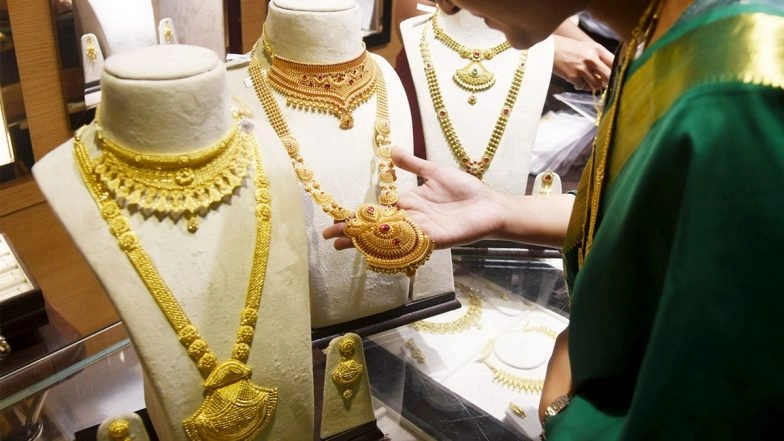
Bihar, January 7: The All India Jewellers and Goldsmith Federation (AIJGF) has introduced a new security protocol in Bihar, prohibiting customers from entering jewelry stores with their faces covered by a hijab, naqab, or ghoonghat. The directive, announced by the federation’s leadership, requires all patrons to reveal their faces before entering the premises to ensure high-definition CCTV cameras can clearly identify every individual. Jewelry association officials state the measure is a direct response to a rising wave of daylight robberies and the increasing difficulty of identifying suspects who hide their features under religious or traditional attire.
Federation Directive on Face Coverings
Ashok Kumar Verma, the State President of the Federation, emphasized that the decision was made out of necessity to protect the lives and assets of traders. According to Verma, the organization has instructed all members to strictly enforce the rule, ensuring that no individual enters a showroom without their face being fully visible to security personnel and surveillance systems. The policy is not limited to religious attire; it also encompasses helmets, surgical masks, and heavy mufflers. However, the explicit mention of the hijab, naqab, and ghoonghat highlights the federation's focus on traditional face coverings that have been used by miscreants to blend into crowds while carrying out heists. ‘Agar Mai Aapki Dhoti…’: Rakhi Sawant Fumes Over ‘UP CM’ Nitish Kumar’s AYUSH Doctor Hijab Pulling Incident, Demands Apology (Watch Video).
Security Rationale and Criminal Trends
The decision follows several high-profile incidents across Bihar where armed robbers utilized face coverings to evade identification. Verma and other association leaders pointed out that in many recent gold loots, criminals entered shops disguised in ways that made it impossible for law enforcement to track them through digital evidence. By enforcing a "face-visible" entry policy, the federation aims to provide a stronger deterrent against potential heists. The goal is to ensure that every person who enters a shop has a clear digital trail, assisting police in investigations should a crime occur.
Implementation at the Shop Level
Under the new guidelines, shopkeepers have been instructed to station staff or security guards at entrances to monitor incoming customers. Those arriving with their faces covered will be asked to uncover them for identification purposes before they are allowed to browse or conduct transactions. Ashok Kumar Verma clarified that the intent is not to offend any community or tradition but to establish a universal security standard. The federation maintains that the safety of the staff and the security of the inventory must take precedence during business hours. ‘If Anyone Dares to Touch a Muslim Woman’s Hijab, I Will Cut Off Their Hands’: AIMIM Leader Imtiaz Jaleel Slams Nitish Kumar Over Hijab Incident (Watch Video).
Context of Rising Crime in Bihar
Bihar has seen a spike in jewelry-related crimes in recent months, leading to increased pressure on both business owners and local police. Jewelry associations have argued that without these internal measures, their showrooms remain vulnerable to organized gangs that exploit the anonymity provided by various types of headgear and veils. While the move has sparked discussion regarding personal customs, many shop owners in the state have already begun placing notices at their entrances. Customers are being advised to cooperate with these new measures as the industry seeks to curb the trend of violent robberies in the region.
(The above story first appeared on LatestLY on Jan 07, 2026 04:55 PM IST. For more news and updates on politics, world, sports, entertainment and lifestyle, log on to our website latestly.com).