Sun Solar Flare: NASA Monitors Most Intense ‘X4.2’ Class Eruption on February 4; Radio Communications, Electric Power Grids, Spacecraft and Astronauts at Risk
The Sun solar flare of X4.2 intensity erupted on February 4, prompting NASA and ISRO to monitor impacts. Originating from an active sunspot in Solar Cycle 25, it triggered radio blackouts and may disrupt satellites, GPS navigation, power grids, and space missions worldwide. Authorities issued advisories as conditions evolve globally today.

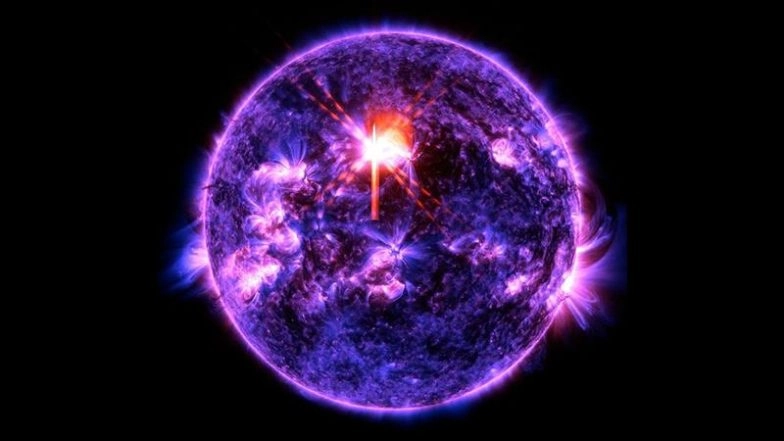
Mumbai, February 6: The Sun has emitted a series of powerful solar flares since February 1, 2026, culminating in a significant X4.2 class eruption that peaked at 5:43 p.m. IST (7:13 a.m. ET) on Wednesday. NASA’s Solar Dynamics Observatory captured high-resolution imagery of the event, which originated from a highly active sunspot region. The Indian Space Research Organisation (ISRO) and global space agencies are now monitoring the potential for geomagnetic storms that could affect satellite operations and terrestrial infrastructure.
The X4.2 flare is categorised within the most intense classification of solar activity. These bursts of radiation represent the largest explosive events in our solar system, capable of sending massive amounts of energy across the heliosphere. According to NASA, the current activity is part of Solar Cycle 25, which is approaching its predicted peak, leading to more frequent and volatile solar events. NASA Internship Programs for Summer 2026: Know How To Apply, Application Deadline and Eligibility Criteria.
Sun Solar Flares Impact on Global Communications
Initial reports indicate that the recent flares have already triggered shortwave radio blackouts across parts of the Pacific and Indian Oceans. When solar radiation hits the Earth’s ionosphere, it ionises the atmosphere, which can temporarily disrupt or completely block high-frequency radio signals used by aviation, maritime vessels, and emergency services.
In India, experts suggest that while total blackouts are unlikely, minor fluctuations in power grids and GPS accuracy may occur. ISRO has issued advisories to satellite operators to monitor for potential charging effects on spacecraft electronics. The agency’s Aditya-L1 mission, India’s first dedicated solar observatory, is providing crucial data to help predict the arrival of any associated coronal mass ejections (CMEs).
The Science Behind Solar Cycle 25
The Sun operates on an approximate 11-year cycle, transitioning from solar minimum to solar maximum. We are currently in a period of heightened activity where sunspots become more numerous and magnetic fields frequently realign, resulting in flares and CMEs. The X-class designation of this latest flare signifies its extreme strength, with the number 4.2 indicating its specific magnitude within that class.
Mitigation and Safety Measures
Power grid operators in high-latitude regions have been placed on alert to manage potential geomagnetically induced currents. These currents can saturate transformers and lead to voltage instability if not properly managed. For the general public, these solar events pose no direct physical threat to human health on the ground, as the Earth’s atmosphere provides sufficient protection against harmful radiation. IIT Bombay Researchers Develop Improved Method To Harvest Lab-Grown T-Cells for Advanced Cancer Therapies.
However, for astronauts aboard the International Space Station, such flares require specific safety protocols to avoid increased radiation exposure. NASA and the US National Oceanic and Atmospheric Administration (NOAA) continue to coordinate with international partners to provide real-time updates on space weather conditions.
(The above story first appeared on LatestLY on Feb 06, 2026 01:30 PM IST. For more news and updates on politics, world, sports, entertainment and lifestyle, log on to our website latestly.com).