Solar Storm 2026: Strong Radio Blackouts Likely in India After Sun’s ‘Active Region 14366’ Unleashes Powerful X8.1 Solar Flare; Know When the Storm Will Hit Earth
Today, February 4, ISRO issued a high alert following an X8.1-class solar flare, the strongest of the year. The Sun's hyperactive "Region 14366" threatens India with strong radio blackouts and GPS disruptions. ISRO is monitoring 50+ satellites while using the Aditya-L1 probe to track the storm's impact on Earth's atmosphere.

- Read in
- हिंदी
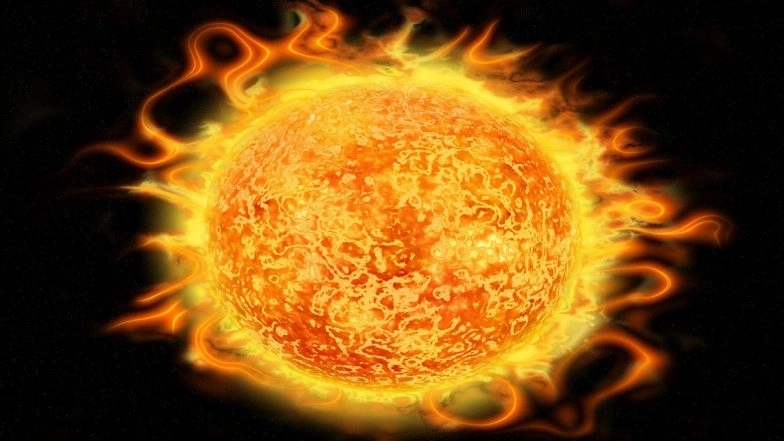
Mumbai, February 4: The Indian Space Research Organisation (ISRO) has placed India’s space infrastructure on high alert following a series of powerful solar flares that have erupted from the Sun over the past several days. On Wednesday, February 4, 2026, space weather monitors confirmed that the Sun’s "Active Region 14366" unleashed an X8.1-class flare, the strongest recorded so far this year. ISRO officials warned that these intense bursts of radiation could trigger significant radio blackouts, potentially disrupting high-frequency communication, GPS navigation, and satellite operations across the country.
High-Intensity Flares Trigger Global Warnings
The current solar unrest originated from a magnetically complex sunspot cluster that has fired off four major flares since the start of February. The most powerful of these, the X8.1 eruption, occurred on February 1, ranking among the top 20 most powerful solar events ever recorded by modern satellite monitoring. ISRO Chairman V Narayanan Confirms Gaganyaan Human Spaceflight Slated for 2027 Following Series of Uncrewed Tests.
According to scientists at the Indian Institute of Science Education and Research (IISER) in Kolkata, this heightened activity is a characteristic of the current "Solar Maximum" - the peak period in the Sun’s 11-year cycle. During this phase, the Sun becomes hyperactive, frequently ejecting massive bursts of electromagnetic energy toward Earth.
Potential Impact on Communication and Power
While solar flares do not pose a direct physical threat to humans on the ground, they can severely disturb the ionosphere, Earth’s upper atmosphere. The primary risks identified by ISRO include:
Radio Blackouts: High-frequency (HF) radio signals used by aviation, maritime, and emergency services may experience temporary or total loss of connectivity.
Satellite Disruptions: ISRO is currently monitoring over 50 operational Indian satellites for signs of "frying" electronics or payload anomalies.
Navigation Errors: GPS and other satellite-based navigation systems may experience degraded accuracy.
Power Grid Stability: Extremely strong flares can sometimes induce currents that stress electrical transformers.
ISRO's Defensive Measures and Aditya-L1
Anil Kumar, Director of ISRO’s Telemetry, Tracking and Command Network (ISTRAC), confirmed that all ground stations have issued alerts to mission control centers. Contingency plans are in place to address any communication loss immediately.
India's dedicated solar observatory, Aditya-L1, is currently serving as the frontline defense. Positioned 1.5 million kilometers away from Earth, it is providing real-time data on solar radiation and magnetic fields. This data allows Indian scientists to issue advance warnings before the effects of the solar storm reach the planet's atmosphere. ISRO PSLV-C62 Mission: Indian Space Agency Says Rocket Suffered ‘Anomaly’ During End of PS3 Stage, Detailed Analysis Initiated.
Forecast: When Will the Solar Storm Hit?
While the most intense flares have already occurred, the threat remains active as the sunspot region continues to face Earth. Scientists have noted a "weak" Coronal Mass Ejection (CME) currently en route, which may trigger moderate geomagnetic activity over the next 24 to 48 hours. Experts advise that while catastrophic damage is unlikely, the Sun remains volatile. Further radio blackouts could occur intermittently through the end of this week. ISRO and global agencies like NASA continue to monitor for any "Earth-directed" plasma clouds that could escalate the current alert levels.
(The above story first appeared on LatestLY on Feb 04, 2026 07:16 PM IST. For more news and updates on politics, world, sports, entertainment and lifestyle, log on to our website latestly.com).